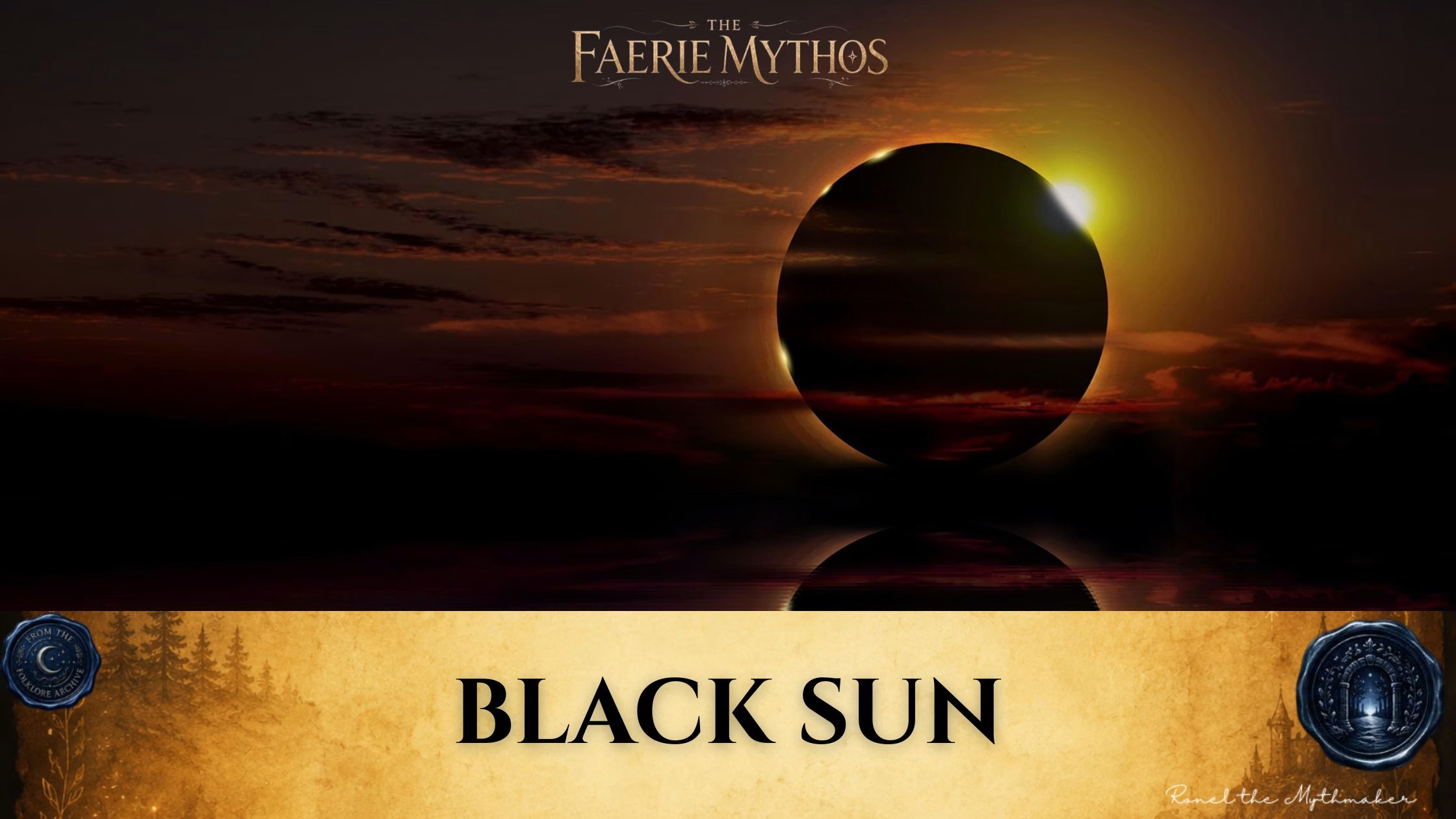
Black Sun folklore
B is for Black


Solar eclipses have been seen as messages from the gods — or the work of dark magicians — since forever.

Folklore
The Golden Bough by Sir James George Frazer, [1922]
The Magical Control of the Sun.
AS THE MAGICIAN thinks he can make rain, so he fancies he can cause the sun to shine, and can hasten or stay its going down. At an eclipse the Ojebways used to imagine that the sun was being extinguished. So they shot fire-tipped arrows in the air, hoping thus to rekindle his expiring light. The Sencis of Peru also shot burning arrows at the sun during an eclipse, but apparently they did this not so much to relight his lamp as to drive away a savage beast with which they supposed him to be struggling. Conversely during an eclipse of the moon some tribes of the Orinoco used to bury lighted brands in the ground; because, said they, if the moon were to be extinguished, all fire on earth would be extinguished with her, except such as was hidden from her sight. During an eclipse of the sun the Kamtchatkans were wont to bring out fire from their huts and pray the great luminary to shine as before. But the prayer addressed to the sun shows that this ceremony was religious rather than magical. Purely magical, on the other hand, was the ceremony observed on similar occasions by the Chilcotin Indians. Men and women tucked up their robes, as they do in travelling, and then leaning on staves, as if they were heavy laden, they continued to walk in a circle till the eclipse was over. Apparently they thought thus to support the failing steps of the sun as he trod his weary round in the sky. Similarly in ancient Egypt the king, as the representative of the sun, walked solemnly round the walls of a temple in order to ensure that the sun should perform his daily journey round the sky without the interruption of an eclipse or other mishap. And after the autumnal equinox the ancient Egyptians held a festival called “the nativity of the sun’s walking-stick,” because, as the luminary declined daily in the sky, and his light and heat diminished, he was supposed to need a staff on which to lean. In New Caledonia when a wizard desires to make sunshine, he takes some plants and corals to the burial-ground, and fashions them into a bundle, adding two locks of hair cut from a living child of his family, also two teeth or an entire jawbone from the skeleton of an ancestor. He then climbs a mountain whose top catches the first rays of the morning sun. Here he deposits three sorts of plants on a flat stone, places a branch of dry coral beside them, and hangs the bundle of charms over the stone. Next morning he returns to the spot and sets fire to the bundle at the moment when the sun rises from the sea. As the smoke curls up, he rubs the stone with the dry coral, invokes his ancestors and says: “Sun! I do this that you may be burning hot, and eat up all the clouds in the sky.” The same ceremony is repeated at sunset. The New Caledonians also make a drought by means of a disc-shaped stone with a hole in it. At the moment when the sun rises, the wizard holds the stone in his hand and passes a burning brand repeatedly into the hole, while he says: “I kindle the sun, in order that he may eat up the clouds and dry up our land, so that it may produce nothing.” The Banks Islanders make sunshine by means of a mock sun. They take a very round stone, called a vat loa or sunstone, wind red braid about it, and stick it with owls’ feathers to represent rays, singing the proper spell in a low voice. Then they hang it on some high tree, such as a banyan or a casuarina, in a sacred place.
The offering made by the Brahman in the morning is supposed to produce the sun, and we are told that “assuredly it would not rise, were he not to make that offering.” The ancient Mexicans conceived the sun as the source of all vital force; hence they named him Ipalnemohuani, “He by whom men live.” But if he bestowed life on the world, he needed also to receive life from it. And as the heart is the seat and symbol of life, bleeding hearts of men and animals were presented to the sun to maintain him in vigour and enable him to run his course across the sky. Thus the Mexican sacrifices to the sun were magical rather than religious, being designed, not so much to please and propitiate him, as physically to renew his energies of heat, light, and motion. The constant demand for human victims to feed the solar fire was met by waging war every year on the neighbouring tribes and bringing back troops of captives to be sacrificed on the altar. Thus the ceaseless wars of the Mexicans and their cruel system of human sacrifices, the most monstrous on record, sprang in great measure from a mistaken theory of the solar system. No more striking illustration could be given of the disastrous consequences that may flow in practice from a purely speculative error. The ancient Greeks believed that the sun drove in a chariot across the sky; hence the Rhodians, who worshipped the sun as their chief deity, annually dedicated a chariot and four horses to him, and flung them into the sea for his use. Doubtless they thought that after a year’s work his old horses and chariot would be worn out. From a like motive, probably, the idolatrous kings of Judah dedicated chariots and horses to the sun, and the Spartans, Persians, and Massagetae sacrificed horses to him. The Spartans performed the sacrifice on the top of Mount Taygetus, the beautiful range behind which they saw the great luminary set every night. It was as natural for the inhabitants of the valley of Sparta to do this as it was for the islanders of Rhodes to throw the chariot and horses into the sea, into which the sun seemed to them to sink at evening. For thus, whether on the mountain or in the sea, the fresh horses stood ready for the weary god where they would be most welcome, at the end of his day’s journey.
As some people think they can light up the sun or speed him on his way, so others fancy they can retard or stop him. In a pass of the Peruvian Andes stand two ruined towers on opposite hills. Iron hooks are clamped into their walls for the purpose of stretching a net from one tower to the other. The net is intended to catch the sun. Stories of men who have caught the sun in a noose are widely spread. When the sun is going southward in the autumn, and sinking lower and lower in the Arctic sky, the Esquimaux of Iglulik play the game of cat’s cradle in order to catch him in the meshes of the string and so prevent his disappearance. On the contrary, when the sun is moving northward in the spring, they play the game of cup-and-ball to hasten his return. When an Australian blackfellow wishes to stay the sun from going down till he gets home, he puts a sod in the fork of a tree, exactly facing the setting sun. On the other hand, to make it go down faster, the Australians throw sand into the air and blow with their mouths towards the sun, perhaps to waft the lingering orb westward and bury it under the sands into which it appears to sink at night.
As some people imagine they can hasten the sun, so others fancy they can jog the tardy moon. The natives of New Guinea reckon months by the moon, and some of them have been known to throw stones and spears at the moon, in order to accelerate its progress and so to hasten the return of their friends, who were away from home for twelve months working on a tobacco plantation. The Malays think that a bright glow at sunset may throw a weak person into a fever. Hence they attempt to extinguish the glow by spitting out water and throwing ashes at it. The Shuswap Indians believe that they can bring on cold weather by burning the wood of a tree that has been struck by lightning. The belief may be based on the observation that in their country cold follows a thunder-storm. Hence in spring, when these Indians are travelling over the snow on high ground, they burn splinters of such wood in the fire in order that the crust of the snow may not melt.

Encyclopedia of Fairies in World Folklore and Mythology by Theresa Bane
The Heliades (“children of the sun”) were the seven daughters born of the sun god Helios and the Oceanid, Clymene. According to the Greek oral poet, Hesoid, when their brother Phaethon (“gleaming”) died, his sisters, the heliades wept for months until they transformed into poplar trees. It is believed the amber colored sap bleeding from these trees are the continuing tears of the mourning sisters.
*More can be read in the book.

The Encyclopedia of Celtic Mythology and Folklore by Patricia Monaghan
Áine
There are indications that she was a sun goddess, for she was connected with solar wells like Tobar Áine near Lissan in Ulster as well as being linked with the sun goddess Grian, her sister… As sun goddess, Áine could assume the form of an unbeatable horse, Lair Derg (“red mare”). Áine’s special feast was held on either Midsummer night, the summer solstice on June 21, or Lughnasa, the Celtic feast on August 1. At that time, straw torches were waved over animals that were then driven up the slopes of Knockainy to solicit Áine’s protection.
*More can be read in the book.

The Forest in Folklore and Mythology by Alexander Porteous
Then they passed on and went to the Trees of the Sun and of the Moon. When they had reached them, the old man said to them, ‘Look up above, and think in your hearts what you wish to ask, and do not speak it aloud.’ Alexander asked him in what language the trees replied to people. And he replied, ‘The Tree of the Sun begins to speak in Indian.’ Then Alexander kissed the trees, and began to think in his heart whether he would conquer the whole world, and return to Macedonia with all his army. Then the Tree of the Sun replied, ‘Alexander, you will be king of the whole world, but Macedonia you will never see.’ This prediction was fulfilled as Alexander died at Babylon in 323 B.C.
*More can be read in the book.

The Element Encyclopedia of 5000 Spells by Judika Illes
Spell-casting Using the Power of Planets
Because they’re old systems that pre-date modern astronomy, in magical and astrological parlance, the luminaries, the sun and the moon, are considered planets just like other heavenly bodies, although this does not concur with modern scientific classifications. Modern astrologers know that technically the sun and moon are not planets, however both astrology and magic are geocentric systems, meaning that everything is perceived as revolving around Earth, even when this is not literally the case.
Solar-charged Infusions
If you can depend upon consistent warm, sunny weather, extremely powerful infusions may be created via solar power. These infusions contain the power of the sun as well as that of botanicals.
1. Place the botanicals inside a jar with a tight-fitting lid.
2. Pour oil over them (make sure the botanicals are completely covered).
3. Add one tablespoon of apple cider vinegar.
4. Leave the jar to sit exposed to warm sun all day and in a warm cupboard (or exposed to moonbeams, if it’s warm) all night, for two weeks.
Strain as above.
*More can be read in the book.

The Element Encyclopedia of Witchcraft by Judika Illes
Bastet, daughter of the sun, is a solar spirit, associated with the life-giving warmth of the sun. (Her sister, Sekhmet, a lioness, represent’s the sun’s scorching, destructive potential.)
According to Aztec belief, supernatural jaguars live in caverns beneath the Earth, occasionally emerging as the need arises. A modern Lacandon Mayan prophecy warns that life as we know it will end when these jaguars emerge from their underground cavern home to devour the sun and moon.
Fire may be understood as a little bit of the sun on Earth. In the spirit of the metaphysical adage “as above, so below,” the magical power of the sun was rekindled and enhanced by the Beltane bonfires. These bonfires were known as “bel-fires” or bale fires. They joyfully celebrate and proclaim the return of fertility (life) to Earth. Beltane bonfires were ritual fires and were traditionally kindled by friction or by sparks from a flint.
Svarog, ruler of the sun and spirit of fire, once headed the Slavic pantheon. Svarog is a divine smith and patron of human smiths. He forged the sun. His sacred territory is the hearth; he is present in hearth fire and forge fire. Hearth fire was once called “Svarog’s son.”
Saule is the Baltic solar goddess of spinning and weaving. She spins rays of sunshine.
*More can be read in the book.

Herbal Magick: A Witch’s Guide to Herbal Folklore and Enchantments by Gerina Dunwich
Despite the fact that myrrh trees were not native to Egypt, myrrh played a vital role in the religious and magickal ceremonies of the ancient Egyptians. The fragrant aroma produced by the burning of myrrh was believed to be pleasing to the gods. Myrrh was burned every day at the midday hour as an offering to the sun god Ra.
*More can be read in the book.

Further Reading:
- Fiery Folklore: 5 Dazzling Sun Myths
- Solar deity
- Solar Eclipse Myths From Around the World
- Sköll
- Myths and Superstitions Around Solar Eclipses
- UK solar eclipse 2015: Ancient myths and folklore surrounding the phenomenon
- Solar eclipse
- Solar Eclipse: A Moment of Awe, Wonder, and Belief

Folklore in a Nutshell by Ronel
A solar eclipse is no big mystery: the moon passes between the Earth and sun, blotting out the sun for a few minutes. But throughout history, the sun’s mysteriousness, significance and awesomeness proved fodder for folklore.
In Ancient China, it was believed that a dragon was devouring the sun during a solar eclipse. This led to people banging on pots and drums to scare the evil sun devourer away.
In Norse myth, the wolf Sköll chases the sun goddess Sól through the sky and a solar eclipse is a sign that he is getting dangerously close to devouring her. Of course, when he finally succeeds Ragnarok will come with major battles and extinction.
In Egyptian mythology, the falcon-headed sun god Ra captains a boat across the sky to bring light to mortals. At night, he returns to the east through the Underworld, bringing light to the dead. The giant serpent Apep tries to devour Ra every day. A solar eclipse signal that Apep got the upper hand, but Ra escapes him every time.
Other cultures have their own stories: canines trying to steal the sun, frogs swallowing the sun, archers shooting suns out of the sky, and even squirrels eating the sun.

Solar Eclipse in Modern Culture
In Little Shop of Horrors a solar eclipse brings the horror to life.
Seymour explains he bought the plant—which he dubbed “Audrey II”—from a Chinese flower shop during a solar eclipse (“Da-Doo”). Attracting business to Mushnik’s shop, the plant soon starts to wither. Seymour accidentally pricks his finger, and discovers that Audrey II needs human blood to thrive (“Grow for Me”).
Learn more here.
If you haven’t watched this musical yet, you really should. I find something new every time.

In A Knight in Camelot, Vivien Morgan ( played by Whoopi Goldberg) uses her knowledge of solar eclipses to save her own life.
Scientist Vivien Morgan is zapped back to the medieval age and time of King Arthur and Camelot, when her scientific machine malfunctions. She is sent back along with many objects from her desk, including her laptop and boom box. As she is sentenced to be burned at the stake, she discovers among the laptop-data, that there will be a solar eclipse in short time. With her “magical powers” she makes the sun re-appear and is being knighted by King Arthur as Sir Boss and becomes a member of the Knights of the Round Table. She soon begins constructing devices that will not be present for many centuries, she saves the king, defeats Sir Sagramore and saves the day countless times before being zapped back to the present.
Learn more here.

In Avatar: The Last Airbender the Solar Eclipse affects their “magic”.
The Day of Black Sun is a recurring celestial event during which the sun is entirely blocked out by the moon, rendering all firebenders powerless. The event is only known to have occurred twice during recorded history.
Learn more on Avatar Wiki.

Solar Eclipse in My Writing
Origin of the Fae: Black Sun
The solar eclipse can power various magical beings and magic spells if harnessed correctly. Depending on the type of eclipse (full or partial) and the duration, its magical properties can be weaker or stronger.
The Sun gives life to all on Earth (and in some other realms). It can also be fickle in what it wants to do and who it wants to help. Summer Fae and Fire Elementals have a stronger connection to the Sun and can intervene on behalf of various other fae.
Solar Eclipse translated to Afrikaans: Sonsverduistering
See this in action:
Stories on Scrolls

I looked up. The solar eclipse was in full force. Orange tendrils caressed the outside of the dark moon creating a black sun.
Day of Black Sun, Stories on Scrolls, Ronel Janse van Vuuren
If this tale has lingered with you, I would be glad to hear it.
Where did you first encounter this creature – through story, superstition, memory, or something half-remembered?
If you know other versions of its myth, feel free to leave them in the record below. Folklore survives by being spoken again.
Further fragments and interpretations of this creature can be found in my Pinterest grimoire.
If you wish to support the time and craft behind these folklore posts – researching old tales, gathering fragments, and shaping them into something worth reading – you may do so by buying me a coffee. It can be a single offering, or something you return to whenever the spirit moves you.
Listen to this post on my podcast!
And in Afrikaans:
You can own the season of the podcast this faery features in as an audiobook.



I was blessed to see a full solar eclipse one time in my life and I will never forget it. Thank you for weaving all of these myths and narratives together in one place for us.
You’re welcome. That must have been an awesome sight — even partial eclipses are magical to behold.
These are such fascinating resources! Thank you for sharing sun mythology!
You’re welcome 🙂
I knew there was mythology aplenty about solar eclipse, but I didn’t know the stories vary so widely from nation to nation. A fascinating post.
It was loads of fun to research 🙂
I miss Avatar…
In Hungarian lore, the sun is believed to be devoured by a creature called a markoláb.
The Multicolored Diary
I know, right? I think I’ll have to do some binge-watching…
Oo, interesting! I’ll have to go research that one.
I love the idea of weaving beams of sunlight!
Black and White: D for Dorado
It conjures up so many fascinating images, doesn’t it?