C is for Cat

If stretching were wealth, the cat would be rich – African Proverb.

Cats appear all over folklore. In superstitions, black cats are seen as unlucky and such. In some folklore they’re seen as soul-stealing monsters. In Ancient Egypt they were the keepers of the dead – guardians to the Underworld (if we’re to believe The Mummy). Sometimes children will mock each other by saying that the other is a scaredy cat if they do not accept a challenge. Throughout history cats have played their part in legends, folklore, mythology and figures of speech.

Folklore
Fairy and Folk Tales of the Irish Peasantry Edited and Selected by W. B. Yeats, [1888]
THE DEMON CAT by LADY WILDE.
THERE was a woman in Connemara, the wife of a fisherman; as he had always good luck, she had plenty of fish at all times stored away in the house ready for market. But, to her great annoyance, she found that a great cat used to come in at night and devour all the best and finest fish. So she kept a big stick by her, and determined to watch.
One day, as she and a woman were spinning together, the house suddenly became quite dark; and the door was burst open as if by the blast of the tempest, when in walked a huge black cat, who went straight up to the fire, then turned round and growled at them.
“Why, surely this is the devil,” said a young girl, who was by, sorting fish.
“I’ll teach you how to call me names,” said the cat; and, jumping at her, he scratched her arm till the blood came. “There, now,” he said, “you will be more civil another time when a gentleman comes to see you.” And with that he walked over to the door and shut it close, to prevent any of them going out, for the poor young girl, while crying loudly from fright and pain, had made a desperate rush to get away.
Just then a man was going by, and hearing the cries, he pushed open the door and tried to get in; but the cat stood
on the threshold, and would let no one pass. On this the man attacked him with his stick, and gave him a sound blow; the cat, however, was more than a match in the fight, for it flew at him and tore his face and hands so badly that the man at last took to his heels and ran away as fast as he could.
“Now, it’s time for my dinner,” said the cat, going up to examine the fish that was laid out on the tables. “I hope the fish is good today. Now, don’t disturb me, nor make a fuss; I can help myself.” With that he jumped up, and began to devour all the best fish, while he growled at the woman.
“Away, out of this, you wicked beast,” she cried, giving it a blow with the tongs that would have broken its back only it was a devil; “out of this, no fish you have today.”
But the cat only grinned at her, and went on tearing and spoiling and devouring the fish, evidently not a bit the worse for the blow. On this, both the women attacked it with sticks, and struck hard blows enough to kill it, on which the cat glared at them, and spit fire; then, making a leap, it tore their heads and arms till the blood came, and the frightened women rushed shrieking from the house.
But presently the mistress returned, carrying with her a bottle of holy water; and, looking in, she saw the cat still devouring the fish, and not minding. So she crept over quietly and threw holy water on it without a word. No sooner was this done than a dense black smoke filled the place, through which nothing was seen but the two red eyes of the cat, burning like coals of fire. Then the smoke gradually cleared away, and she saw the body of the creature burning slowly till it became shrivelled and black like a cinder, and finally disappeared. And from that time the fish remained untouched and safe from harm, for the power of the evil one was broken, and the demon cat was seen no more.

The Blue Fairy Book, by Andrew Lang, [1889]
THE MASTER CAT; OR, PUSS IN BOOTS
There was a miller who left no more estate to the three sons he had than his mill, his ass, and his cat. The partition was soon made. Neither scrivener nor attorney was sent for. They would soon have eaten up all the poor patrimony. The eldest had the mill, the second the ass, and the youngest nothing but the cat. The poor young fellow was quite comfortless at having so poor a lot.
“My brothers,” said he, “may get their living handsomely enough by joining their stocks together; but for my part, when I have eaten up my cat, and made me a muff of his skin, I must die of hunger.”
The Cat, who heard all this, but made as if he did not, said to him with a grave and serious air:
“Do not thus afflict yourself, my good master. You have nothing else to do but to give me a bag and get a pair of boots made for me that I may scamper through the dirt and the brambles, and you shall see that you have not so bad a portion in me as you imagine.” The Cat’s master did not build very much upon what he said. He had often seen him play a great many cunning tricks to catch rats and mice, as when he used to hang by the heels, or hide himself in the meal, and make as if he were dead; so that he did not altogether despair of his affording him some help in his miserable condition. When the Cat had what he asked for he booted himself very gallantly, and putting his bag about his neck, he held the strings of it in his two forepaws and went into a warren where was great abundance of rabbits. He put bran and sow-thistle into his bag, and stretching out at length, as if he had been dead, he waited for some young rabbits, not yet acquainted with the deceits of the world, to come and rummage his bag for what he had put into it.
Scarce was he lain down but he had what he wanted. A rash and foolish young rabbit jumped into his bag, and Monsieur Puss, immediately drawing close the strings, took and killed him without pity. Proud of his prey, he went with it to the palace and asked to speak with his majesty. He was shown upstairs into the King’s apartment, and, making a low reverence, said to him:
“I have brought you, sir, a rabbit of the warren, which my noble lord the Marquis of Carabas” (for that was the title which puss was pleased to give his master) “has commanded me to present to your majesty from him.”
“Tell thy master,” said the king, “that I thank him and that he does me a great deal of pleasure.”
Another time he went and hid himself among some standing corn, holding still his bag open, and when a brace of partridges ran into it he drew the strings and so caught them both. He went and made a present of these to the king, as he had done before of the rabbit which he took in the warren. The king, in like manner, received the partridges with great pleasure, and ordered him some money for drink.
The Cat continued for two or three months thus to carry his Majesty, from time to time, game of his master’s taking. One day in particular, when he knew for certain that he was to take the air along the river-side, with his daughter, the most beautiful princess in the world, he said to his master:
“If you will follow my advice your fortune is made. You have nothing else to do but go and wash yourself in the river, in that part I shall show you, and leave the rest to me.”
The Marquis of Carabas did what the Cat advised him to, without knowing why or wherefore. While he was washing the King passed by, and the Cat began to cry out:
“Help! help! My Lord Marquis of Carabas is going to be drowned.”
At this noise the King put his head out of the coach-window, and, finding it was the Cat who had so often brought him such good game, he commanded his guards to run immediately to the assistance of his Lordship the Marquis of Carabas. While they were drawing the poor Marquis out of the river, the Cat came up to the coach and told the King that, while his master was washing, there came by some rogues, who went off with his clothes, though he had cried out: “Thieves! thieves!” several times, as loud as he could.
This cunning Cat had hidden them under a great stone. The King immediately commanded the officers of his wardrobe to run and fetch one of his best suits for the Lord Marquis of Carabas.
The King caressed him after a very extraordinary manner, and as the fine clothes he had given him extremely set off his good mien (for he was well made and very handsome in his person), the King’s daughter took a secret inclination to him, and the Marquis of Carabas had no sooner cast two or three respectful and somewhat tender glances but she fell in love with him to distraction. The King would needs have him come into the coach and take part of the airing. The Cat, quite overjoyed to see his project begin to succeed, marched on before, and, meeting with some countrymen, who were mowing a meadow, he said to them:
“Good people, you who are mowing, if you do not tell the King that the meadow you mow belongs to my Lord Marquis of Carabas, you shall be chopped as small as herbs for the pot.”
The King did not fail asking of the mowers to whom the meadow they were mowing belonged.
“To my Lord Marquis of Carabas,” answered they altogether, for the Cat’s threats had made them terribly afraid.
“You see, sir,” said the Marquis, “this is a meadow which never fails to yield a plentiful harvest every year.”
The Master Cat, who went still on before, met with some reapers, and said to them:
“Good people, you who are reaping, if you do not tell the King that all this corn belongs to the Marquis of Carabas, you shall be chopped as small as herbs for the pot.”
The King, who passed by a moment after, would needs know to whom all that corn, which he then saw, did belong.
“To my Lord Marquis of Carabas,” replied the reapers, and the King was very well pleased with it, as well as the Marquis, whom he congratulated thereupon. The Master Cat, who went always before, said the same words to all he met, and the King was astonished at the vast estates of my Lord Marquis of Carabas.
Monsieur Puss came at last to a stately castle, the master of which was an ogre, the richest had ever been known; for all the lands which the King had then gone over belonged to this castle. The Cat, who had taken care to inform himself who this ogre was and what he could do, asked to speak with him, saying he could not pass so near his castle without having the honor of paying his respects to him.

The ogre received him as civilly as an ogre could do, and made him sit down.
“I have been assured,” said the Cat, “that you have the gift of being able to change yourself into all sorts of creatures you have a mind to; you can, for example, transform yourself into a lion, or elephant, and the like.”
“That is true,” answered the ogre very briskly; “and to convince you, you shall see me now become a lion.”
Puss was so sadly terrified at the sight of a lion so near him that he immediately got into the gutter, not without abundance of trouble and danger, because of his boots, which were of no use at all to him in walking upon the tiles. A little while after, when Puss saw that the ogre had resumed his natural form, he came down, and owned he had been very much frightened.
“I have been, moreover, informed,” said the Cat, “but I know not how to believe it, that you have also the power to take on you the shape of the smallest animals; for example, to change yourself into a rat or a mouse; but I must own to you I take this to be impossible.”
“Impossible!” cried the ogre; “you shall see that presently.”
And at the same time he changed himself into a mouse, and began to run about the floor. Puss no sooner perceived this but he fell upon him and ate him up.
Meanwhile the King, who saw, as he passed, this fine castle of the ogre’s, had a mind to go into it. Puss, who heard the noise of his Majesty’s coach running over the draw-bridge, ran out, and said to the King:
“Your Majesty is welcome to this castle of my Lord Marquis of Carabas.”
“What! my Lord Marquis,” cried the King, “and does this castle also belong to you? There can be nothing finer than this court and all the stately buildings which surround it; let us go into it, if you please.”
The Marquis gave his hand to the Princess, and followed the King, who went first. They passed into a spacious hall, where they found a magnificent collation, which the ogre had prepared for his friends, who were that very day to visit him, but dared not to enter, knowing the King was there. His Majesty was perfectly charmed with the good qualities of my Lord Marquis of Carabas, as was his daughter, who had fallen violently in love with him, and, seeing the vast estate he possessed, said to him, after having drunk five or six glasses:
“It will be owing to yourself only, my Lord Marquis, if you are not my son-in-law.”
The Marquis, making several low bows, accepted the honor which his Majesty conferred upon him, and forthwith, that very same day, married the Princess.
Puss became a great lord, and never ran after mice any more but only for his diversion.

The Element Encyclopedia of Fairies by Lucy Cooper
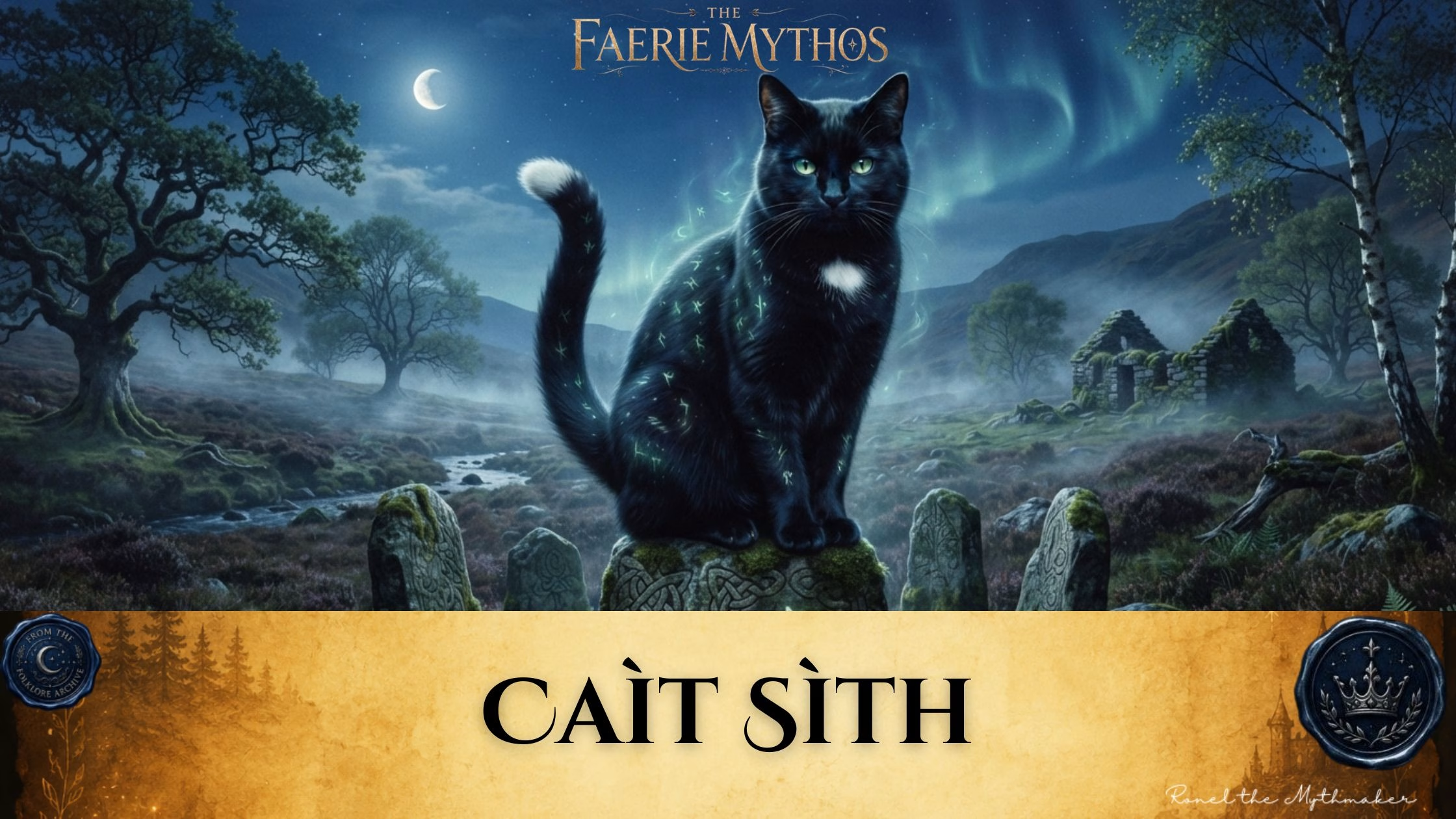
(pronounced cait shee) Fairy cat of the Scottish Highlands. Believed by some to be a witch transformed into a cat rather than a fairy, the cait sith is described in JG Campbell’s Superstitions of the Highlands and Islands of Scotland (1900) as being black with a white spot on its breast, the size of a dog. When angry, it arches its back and bristles its fur.
*More can be read in the book.

Encyclopedia of Fairies in World Folklore and Mythology by Theresa Bane
Big Ears was monstrous, catike creature originating in the fairy lore of the Scottish Highlands. It was summoned through use of the Taghairm, an ancient magical rite, for the purpose of granting wishes. For four consecutive days cats were roasted alive over an open fire until it appeared. Stones with deep ruts in them were said to be places where Big Ears appeared, his claw marks left behind as evidence of his presence. Described as having evil-looking yellow eyes and gigantic ears it was believed it is the King of the Underworld cats. Big Ears was sometimes associated with cait sith, a witch transformed into a cat.
Cait Sith
Variations: cat sìdhe, cat sith, elfin cats
The cait sith (“fairy cat”) is spoken of in the fairy lore of both Ireland and the Scottish Highlands. Described as looking like a black cat with white mark on the center of its chest, this fairy animal is said to be somewhere between the size of a large dog or a small calf. Large and ferocious, especially if surprised, the caith sith are said to have a king among their kind called Big Ears.
In the Scottish Highlands it is a popular belief the cait sith is not a fairy animal at all but a transformed witch. It has been proposed by some the cat sith is a hybrid animal between the European Wildcats and the domestic cats only found in Scotland; these large black hybrids are typically called Kellas Cats. These animals cannot be domesticated.
*More can be read in the book.

The Encyclopedia of Celtic Mythology and Folklore by Patricia Monaghan
cait sith
Scottish mythological animal. In the Scottish Highlands, this black spectral creature of ambiguous species (probably feline) was so large that it was sometimes mistaken for a black dog. Although its name (“fairy cat”) suggests that is was of the fairy race, it was also reported to be a shape-shifting witch or her familiar.
*More can be read in the book.

The Element Encyclopedia of Magical Creatures by John and Caitlín Matthews
Cat
Cats have walked among us and lived around us for millennia. The big cats still walk by themselves and are given a wide berth by those who have cause to fear their depredations, but the domestic cat remains our constant companion as both pet and exterminator of vermin. The relationship between cats and humans is often seen as both opportunistic and helpful, enabling the cat generally to be the one who benefits most.
Cats have been central to myth and legend. The Egyptian cat cult based at Bubastis, where Bastet’s shrine was to be found, derives from the myth of the great jungle cat which cuts off the head of the serpent Apophis that tried to strangle the sacred persea tree. It was death to kill a cat in such a culture of cat reverence, for they were regarded as being the living exemplars of Bastet.
Among the Romans, the cat was the companion of the goddess of liberty, and, as a creature which can exhibit both complete relaxation and lascivious freedom, as symbol for the throwing off of all restraint. In Scandinavian tradition, cats pulled the chariot of the Norse goddess, Freya.
Cath Sith
In the Highlands of Scotland, the Cath Sith or Fairy Cat is a great black cat the size of a large dog. It has a white blaze upon its chest and its hair sticks up all over its arched back. The Cath Sith bears all the hallmarks of the existing Scottish wild cat, being both fierce and highly secretive.
Ccoa
Among the myths of the Quechua tribes of Peru Ccoa is a cat who is the spirit of storms. It has a grey coat with darker stripes about its body. Perpetual hail streams from its eyes and ears whenever it is aboard. To avert storms, Ccoa is the subject of many offerings, especially in the time before harvest when his attentions could ruin the crops.
*More can be read in the book.

The Element Encyclopedia of Witchcraft by Judika Illes
Cats, especially black ones, are the favored form of many species of spirits and fairies are no exception. One Celtic tradition suggests that gazing into a cat’s eye is a method of viewing fairies and magically entering Fairyland. Cats are also identified as Fairies. Who says fairy tales aren’t true?
The Cait Sith (pronounced “cat shee”) is the fairy cat of the Scottish Highlands, described as being as large as a dog or calf and black, with a white star on its breast. This is no little cuddly kitty but is an exceptionally fierce animal, spitting and growling when encountered. It is described as having an arched back and bristles, although that’s typical of any angry cat. Apparently, many Highlanders once also believed these cats were transformed witches on the prowl.
The cait sith is no forgotten legend: in recent years, Scottish police have received over a thousand reports of sightings of huge black cats.
*More can be read in the book.

Further Reading:
- How Irish folklore inspired the black cat superstition
- Myths and Superstitions About Black Cats
- Cats in Myth & Folklore
- Cat Mythology, a Collection of Feline Stories, Myths and Superstitions in Folklore and Legend
- Feline Folklore: The Stories Behind the Superstitions
- Cat Magic, Legends, and Folklore
- CAT FOLKLORE
- SHIP’S CATS IN FOLKLORE AND LEGEND
- Cats in Myth & Folklore
- Cats Throughout History: Tales of Good, Bad and Just Plain Kooky Feline Legends
- CAT I. In Mythology and Folklore
- Cats in folklore
- FELINE FOLKTAILS – CATS IN FOLKLORE AND SUPERSTITION
- Cat Folklore & Legends From Around the World
- 14 Legends About Cats From Around the World
- Cultural depictions of cats
- Feline Folklore
- Cats In Folklore: Not Just A Witch’s Familiar

Folklore in a Nutshell by Ronel
Cats figure in the history and folklore of many nations and are a favourite with artists and writers. Everyone knows that cats have nine lives – and this lore comes from their apparent durability as they survive falls that would be fatal to others, their nonchalant attitude that can be perceived as lack of any instinct for self-preservation, and the way they seem to stare right through you.
Black cats seem to chop off at every corner: since medieval times they’re seen as either witches in disguise or as familiars who work with witches and thus harbingers of black magic, seeing one from behind is a bad omen, if it walks away from you it’s bad luck, if it crosses your path it’s bad luck, and it is even blamed for putting its nose to that of a new-born baby and sucking the life out of it.
Except in the UK: there black cats are held as being good luck and white cats (apparently the colour of ghosts) are held to be unlucky.
In Ancient Egypt, Bast is the goddess of cats. She is portrayed with the head of a cat and as the protector of cats. And she’s usually depicted as a beautiful black cat.
In Norse mythology, Freyja has two black cats who pull her chariot.
Seems not everyone equates black cats with death and darkness…
In Ireland, though, a black cat with a white patch of fur on its chest is known as the King of the Cats, Caìt Sìth or Grimalkin. This cat is indeed a faery. The only way to keep this mischievous cat happy is to leave out a saucer of cream. Even Shakespeare has Gimalkin in one of his plays: Macbeth, Act I, the first witch says “I come, Graymalkin” when her feline familiar calls.
Whether you believe them magical or not, if you stare too deeply into a cat’s eyes, you’ll see visions of a faery world which spies on you through those self-same eyes… or maybe that’s just the pain of getting scratched after challenging the cat!

Caìt Sìth in Modern Culture
Let’s start with cats in movies. (Though loads of these are based on books.)
Harry Potter
“Break a rule in front of her, put just one toe out of line, and she’d whisk off for Filch, who’d appear, wheezing, two seconds later.“—Mrs Norris’s close relationship with her master[src]
Mrs Norris was the pet cat of Argus Filch, the caretaker of Hogwarts School of Witchcraft and Wizardry. Mrs Norris was described as having an unusually strong connection with her master, alerting him to any students misbehaving inside the school castle. She was described as appearing almost the same way as Filch, with bulging yellow, lamp-like eyes, a scrawny, skeletal body and dust-coloured fur.
Learn more here.

Austin Powers
Dr. Evil: That makes me angry. And when Dr. Evil gets angry, Mr. Bigglesworth gets upset. (Meow) And when Mr. Bigglesworth gets upset, people die!
Learn more about this cat here.

The Mummy
As cats were the guardians of the Underworld, they were feared by Imhotep, who had been cursed with an ancient malediction known as the Hom-Dai; Imhotep feared cats while he was in his mummified state. Evelyn Carnahan‘s pet Cleo was a white-furred cat.
Learn more about this story here.

The Princess Diaries
it’s time for us to take a moment to appreciate Fat Louie from The Princess Diaries, one of the finest felines to grace the big screen and Genovia. The black and white kitty was always cool, collected, and caring ear to all of Mia’s royal dilemmas.
Read the full article (with loads of pictures!) here.

Alice in Wonderland
I have two versions of the Cheshire cat for you to enjoy.
Coraline
“No. I’m not the other anything. I’m me!”
— The cat, upon meeting Coraline Jones in the other world.
The cat is one of the major supporting characters of the story. He demonstrates the ability to appear and disappear on a whim, often to hide from danger or to help Coraline from danger. For unexplained reasons, he is able to speak in the other world.
Learn more about the book and movie here.

Cats in Books (loads of them above!)
The Iron Knight by Julie Kagawa
Grimalkin (also known as Grim, cait sith, Devil’s Cat) is an ally and friend of Meghan, Ash, Ironhorse, and Puck‘s. He can disappear and appear at will and is very mysterious.
Learn more about this book series here.
He is very wise and mysterious, often disappearing without warning in the face of danger. He always appears, however, at the last moment in order to save everyone. Grimalkin can be very patronizing and impatient with dimwitted people, but he is very informative and helpful all the same. There are many people who owe him, and he is often smug when collecting his debts. In the Iron Knight, the group faces reflections of themselves. While the others look at their reflections and they look different and harsh, Grim’s is the same as his physical form. He explained to them that the reflections showed who they truly were or could be. His appearance doesn’t change because he is already his true self.

Caìt Sìth in My Writing
Origin of the Fae: Caìt Sìth
Faery Cat in Scottish Mythology that usually presents as a black cat with gem colour eyes.
They have no true allegiance, though rarely they do form a strong bond with another Faery.
They use Mindspeak to communicate and are usually cheeky. They speak as they wish.
Normally they bring misfortune on all humans who see them. They are mischievous in nature. Some do have ill-will towards humans.
They can make themselves invisible at will – even to other Fae.
The only known alliance between the Cù Sìth and the Caìt Sìth is that of the Cù Sìth Saphira and the Caìt Sìth Jade.
Faery Cat translated to Afrikaans: Feetjie Kat
See them in action:
Once… Tales, Myths and Legends of Faerie

The faery cat sped over the landscape, his feet barely touching the ground as he ran. Just when Em had thought that things were going too smoothly. But maybe, just maybe, he knew something…
It was almost too late. Behind the cat, she could see the big, yellow moon wanting to touch the ground.
The cat came to a stop, out of breath, between the standing stones next to Em.
<Goblins had stolen all the smooth, black stones from the human realm and sold it to an important dark fae in Faerie.>
‘What?’
He glared at the grogoch. ‘There isn’t time! Come! Quickly!’
Em didn’t follow all the druid rambled. All of her attention was on the cat that looked like he could pass out at any moment.
‘How?’
He looked at her and smiled.
<I’m a cat.>
Phantasm, Once… Tales, Myths and Legends of Faerie, Ronel Janse van Vuuren
Remember that you can request all of my books from your local library!
Do you like cats? What are your thoughts about the cat folklore I shared? Any cat-related folklore you’d like to share? Check out my Pinterest board dedicated to the subject.
If you wish to support the time and craft behind these folklore posts – researching old tales, gathering fragments, and shaping them into something worth reading – you may do so by buying me a coffee. It can be a single offering, or something you return to whenever the spirit moves you.
Listen to this post on my podcast!
And in Afrikaans:
You can own the season of the podcast this faery features in as an audiobook.


No-one writes about the fae like Ronel Janse van Vuuren.


I love it how humans have been working hard on domesticating cats for millennia, and at the same time we all agree that they are weird magical creatures 😀
The Multicolored Diary
Some would argue that cats have been domesticating humans 😉
Some puuurrrrrrfect cat lore you’ve shared.
Cats are also masters of teaching consent. They will allow petting only when they wish for such affection. Agreeing to said petting may be revoked at any time without cause or explanation. Arguing will likely result in injury by the cat.
https://ifunny.co/picture/gf6WqBip6
And cats are better hunters people believe. This cat used security cameras to track and catch a mouse.
See: cats are cunning and they teach humans! I’m glad you enjoyed the post 🙂