Episode 170: Irascible Immortals: Hades
The folklore of Hades in a nutshell and how I reimagined it for my writing.
Transcript
You’re listening to the Faeries and Folklore podcast by Ronel.
I’m dark fantasy author Ronel Janse van Vuuren. With nearly a decade of digging around in dusty folklore books, researching creatures of imagination that ignited my curiosity, I’m here to share the folklore in a nutshell and how I reimagined it for my writing in an origin of the fae.
This is the Faeries and Folklore podcast.
Hi, I’m your host Ronel Janse van Vuuren. You can just call me Ronel. In today’s episode, we’re continuing our exploration of the fae realm.
This episode is brought to you by my Irascible Immortals series, available in ebook, paperback, hardback and audiobook. They’ve been alive forever. They’ve been bored for some time. And now they’re showing it. Go to ronelthemythmaker.com/my-books/the-irascible-immortals-series for more.
We’re continuing our exploration of the Immortals.
Today’s immortal: Hades
Folklore in a nutshell
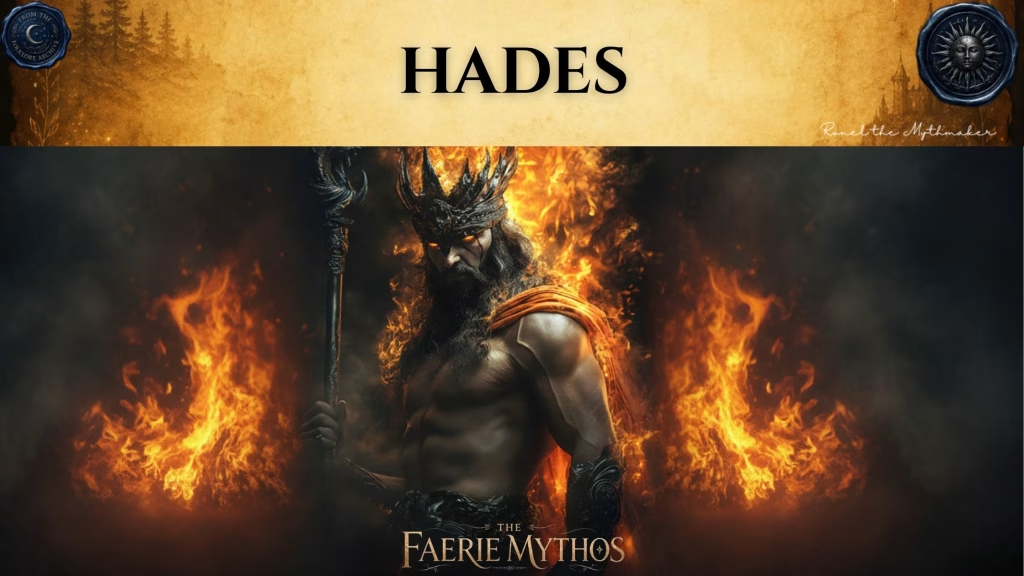
Hades, also known as Aïdes – the Unseen – and Pluto – the Wealthy One – and some other names, is the god of the underworld. His parents are the Titans Kronos and Rhea. His siblings are Zeus, Poseidon, Hera, Demeter and Hestia.
After they overthrew their father Kronos, Zeus, Poseidon and Hades divided his kingdom and Hades ended up ruling the underworld. Hades named the underworld after himself, and ruled it with his queen whom he abducted, Persephone – who is also his niece. He has a giant three-headed dog named Cerberus who guards the entrance to his realm, keeping those who should stay inside in, and those who don’t belong there out.
Hades doesn’t really run the day-to-day operations of his realm, leaving it to the Furies, Cerberus, Charon and others to fulfil their duties. He is also immune to prayers and sacrifices made to him. His realm doesn’t just include ruling over the dead, but also the hidden wealth of the earth: from fertile soil to precious gems and metals.
He rarely leaves the underworld, which is why some call him the Unseen One as his realm is invisible to most. He even has a helmet called the Helm of Darkness which can turn him invisible. But there are few myths about him from ancient Greek sources because he stays hidden.
In all the myths about him, he comes forth as an aloof and forbidding personality, never quite distinct from the shadowy darkness of his realm. It is only when he abducts Persephone that ancient writers took note of him.
The most important myth regarding Hades is when he abducted Persephone who is Demeter’s daughter. Which makes her his niece… But with a pantheon full of sister-brides, it’s not that unusual.
So Hades falls in love with Persephone who doesn’t give him the time of day. He then creates a beautiful, rare flower that blooms right in front of her while she is gathering flowers with a couple of nymphs. Of course she reaches for it, and the earth opens before her and Hades appears in his chariot drawn by pitch-black horses, grabs her and races back to his realm with her. The ground closes up behind them and no-one is the wiser. Demeter is the only one who worries, and we’ve discussed already how that went. Meanwhile, Persephone has a grand time being wooed by Hades and finally becomes his queen. Then she eats the pomegranate seeds, probably knowing full well the consequences, and spends part of her time with her mother above ground and the rest with her husband.
But because Hades didn’t make any waves after this, his name became synonymous with his realm where human souls go after death. Homer and Hesiod called him pitiless, loathsome and monstrous… Sounds an awful lot like the Phantom from The Phantom of the Opera to me.
Origin of the fae
Hades likes to stay out of the drama the other Olympians like to embroil themselves in. He prefers his own realm, however dark and dreary. He loves his wife, Persephone, his dog, Cerberus, and his horses, Abatos, Abaster, A’eton and Nonios. And he even tolerates the furies, Charon, Hecate, and his mother-in-law, Demeter, who all have a place in his life. Most of the Olympians stay clear of him. Even the Titans keep their distance. As for the wailing dead… He has enough riches to pay the ferryman on their behalf just for the peace and quiet it brings.
He enjoys writing and playing music, gardening with his wife – growing the plants that only grow in their garden, taking care of his horses and Cerberus, and talking magic with Hecate.
I hope that you’ve enjoyed this episode of the faeries and folklore podcast and that you’ve learned something new about faeries.
Remember that you can get a transcript of this episode in the description. If you’re new to the podcast, why not go and grab your free copy of Unseen, the second book in the Faery Tales series, on my website ronelthemythmaker.com? Loads of folklore, magic and danger await! Take care!
Available at
Audible | Podbean | Amazon Music | Spotify | Youtube | iHeart Radio | Player FM | Listen Notes | Apple Podcasts | TuneIn

Read the full folklore article:
Explore the folklore, modern interpretations, and the Faerie Mythos.
Listen to this season’s audiobook:
Listen to the full season with no interruptions.
Explore the Audiobook Library ✦ Browse the Lore Archive ✦ Discover the Faerie Mythos Books ✦ Join the Mythmaker’s Circle
Enjoying the podcast?
If you’ve enjoyed this episode, you can support the time and care that goes into researching, writing, recording, and producing the Faeries & Folklore Podcast by buying me a coffee.
Your support is always appreciated, whether it’s a one-time thank you or an occasional coffee whenever you feel like it. Every contribution helps me continue sharing the folklore, myths, and legends that inspire the Faerie Mythos.