Tooth Faeries in Folklore | The Faeries and Folklore Podcast
Episode 2: Small, Everyday Fae: Tooth Faeries
The folklore of tooth faeries in a nutshell, how I reimagined them for my writing, and the faery translated into Afrikaans.
Written and narrated by Ronel Janse van Vuuren.
Copyright 2021 Ronel Janse van Vuuren — All rights reserved.
Learn more about tooth faeries here.
Get the transcript here.
Music: Secrets by David Fesliyan (FesliyanStudios.com) and Dramatic Heartbeat by FesliyanStudios.com
Transcript
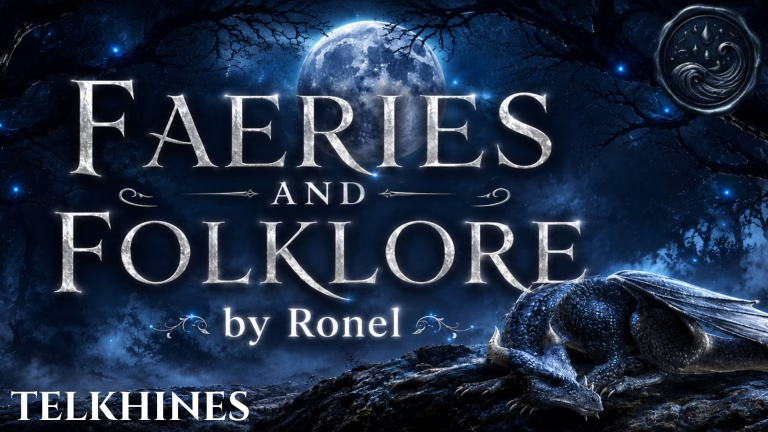
You’re listening to the Faeries and Folklore podcast by Ronel.
I’m dark fantasy author Ronel Janse van Vuuren. With nearly a decade of digging around in dusty folklore books, researching creatures of imagination that ignited my curiosity, I’m here to share the folklore in a nutshell and how I reimagined it for my writing in an origin of the fae.
This is the Faeries and Folklore podcast.
Hi, I’m your host Ronel Janse van Vuuren. You can just call me Ronel. In today’s episode, we’re continuing our exploration of the fae realm.
We’re continuing our exploration of small every day fae.
Today’s faery: Tooth Faeries
Folklore in a nutshell by Ronel
The Vikings paid children for their milk teeth, believing it would bring good luck and protection in battle. This tradition of a tooth fee was recorded in the Eddas and has continued through history. In some countries, such as South Africa, there is a tooth mouse that collects the milk teeth that have fallen out, leaving a reward. In other countries, the tooth faery comes to collect the teeth. Children know to leave the fallen tooth under their pillow (or in their slipper) and the faery will come to collect it and leave a reward.
But between Vikings paying for teeth and mice and fairies doing the same, superstitions made children burn their baby teeth before witches could get hold of it and thus have power over them or to ensure they didn’t have hardship in the afterlife.
The tooth faery can come in many forms. Usually female, usually with a puffy dress and a wand, with glittering wings and a benign smile. But some see the tooth faery as a motherly figure. Others see it as male.
No matter how you see the tooth faery – as a black-clad ninja or as Dwayne Johnson from the Tooth Fairy movie – this faery helps children come to terms with the change and loss of teeth and bring them understanding of dental care.
And now for my interpretation of the fae in an origin of the fae: Tooth Faeries
They are dependent on the milk teeth of human children as much as the children need their magic to ensure the growth of their teeth.
Tooth Faeries cannot choose their own outfits: they wear whatever the Tooth Faery Princess wants them to.
They can flit between dimensions and prefer to do so when the walls between Realms are thin.
They are especially sensitive to iron.
They work with the tooth mice who are immune to iron, though there aren’t as many mice as fae.
As a little bonus, let’s look at the translation of tooth faeries into Afrikaans: tandefeë.
I hope that you’ve enjoyed this episode of the faeries and folklore podcast and that you’ve learned something new about faeries.
Remember that you can get a transcript of this episode in the description. If you’re new to the podcast, why not go and grab your free copy of Unseen, the second book in the Faery Tales series, on my website ronelthemythmaker.com? Loads of folklore, magic and danger await! Take care!
Available at
Audible | Podbean | Amazon Music | Spotify | Youtube | iHeart Radio | Player FM | Listen Notes | Apple Podcasts | TuneIn
Enjoying the podcast?
If you’ve enjoyed this episode, you can support the time and care that goes into researching, writing, recording, and producing the Faeries & Folklore Podcast by buying me a coffee.
Your support is always appreciated, whether it’s a one-time thank you or an occasional coffee whenever you feel like it. Every contribution helps me continue sharing the folklore, myths, and legends that inspire the Faerie Mythos.
You can now own the backlist seasons as audiobooks. All proceeds go to hosting the podcast. Exclusively available from Ronel’s store.