Surreal Sea Nymphs
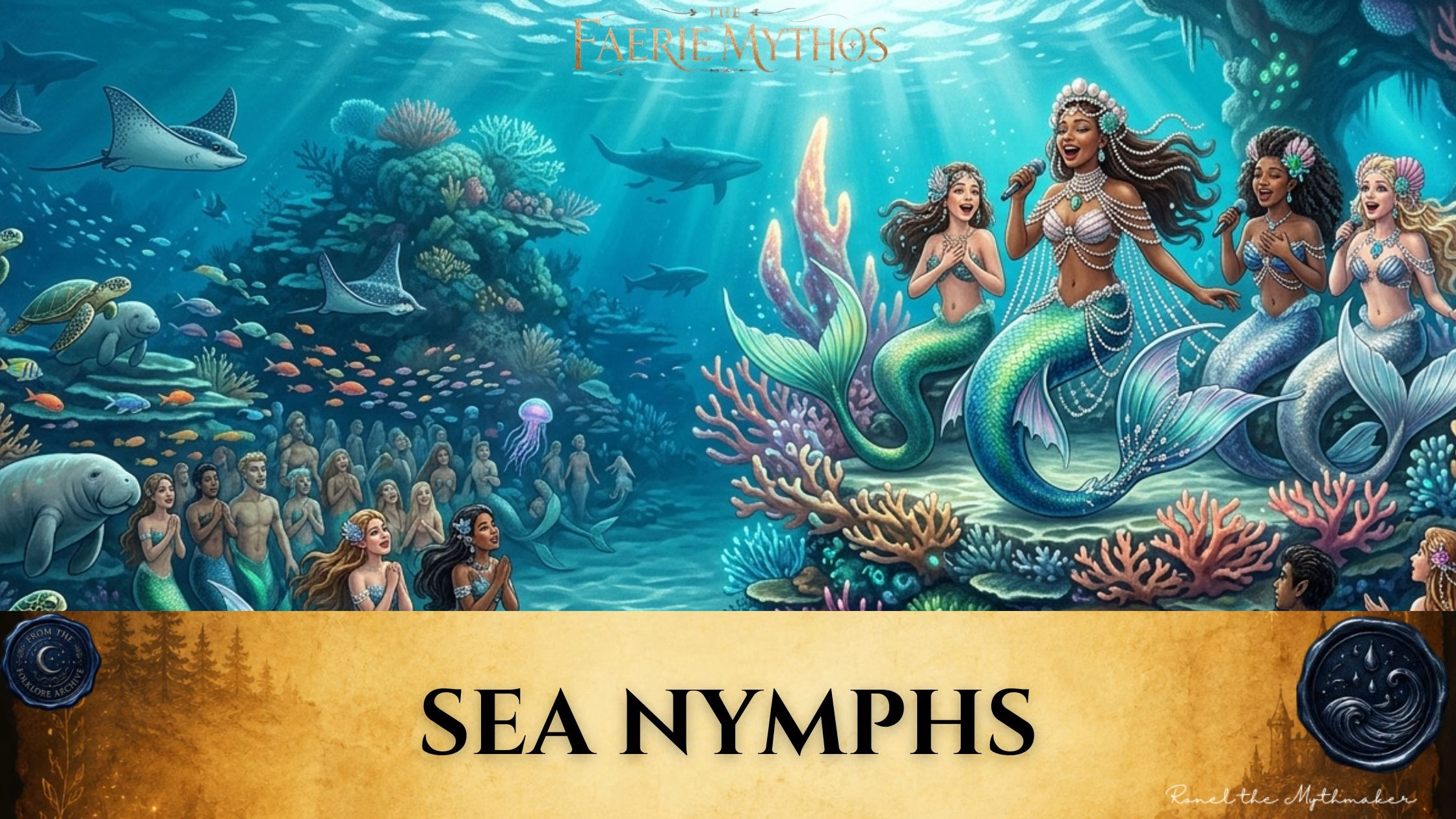
Sea Nymphs embody all that’s good about the sea. There’s something magical about them. Being so different from mermaids in general gives them an even greater ethereal quality.

Folklore
Fictitious and Symbolic Creatures in Art by John Vinycomb [1909]
Amphitrite, his [Poseidon] wife, one of the Nereids in ancient art, is represented as a slim and beautiful young woman, her hair falling loosely about her shoulders, and distinguished from all the other deities by the royal insignia. On ancient coins and gems she appears enthroned on the back of a mighty triton, or riding on a sea-horse, or dolphin.

BULFINCH’S MYTHOLOGY by Thomas Bulfinch [1855]
PAN, the god of woods and fields, of flocks and shepherds, dwelt in grottos, wandered on the mountains and in valleys, and amused himself with the chase or in leading the dances of the nymphs. The wood-nymphs, Pan’s partners in the dance, were but one class of nymphs. There were besides them the Naiads, who presided over brooks and fountains, the Oreads, nymphs of mountains and grottos, and the Nereids, sea-nymphs.

The Hymns of Orpheus Translated by Thomas Taylor [1792]
TO THE NEREIDS
DAUGHTERS of Nereus, resident in caves
Merg’d deep in Ocean, sporting thro’ the waves;
Fanatic fifty nymphs, who thro’ the main
Delight to follow in the Triton’s train,
Rejoicing close behind their cars to keep;
Whose forms half wild, are nourish’d by the deep,
With other nymphs of different degree
Leaping and wand’ring thro’ the liquid sea:
Bright, wat’ry dolphins, sonorous and gay,
Well pleas’d to sport with bachanalian play;
Nymphs beauteous-ey’d, whom sacrifice delights,
Send rich abundance on our mystic rites;
For you at first disclos’d the rites divine,
Of holy Bacchus and of Proserpine,
Of fair Calliope from whom I spring,
And of Apollo bright, the Muse’s king.

The Element Encyclopedia of Fairies by Lucy Cooper
Sea fairies are often capricious creatures, sometimes helping fishermen, at other times luring them to a watery grave.
Nereids
In Greek mythology, the 50 daughters of the sea god Nereus and sea nymph Doris, whose kingdom was the Aegean Sea. Usually depicted as beautiful young ladies, sometimes riding the backs of dolphins or sea horses, they took care of the sea’s riches and protected fishermen. Each one represented a different aspect of the sea, such as sand, rocks, waves, and currents. They formed part of the sea god Poseidon’s entourage and lived at the bottom of the sea.
*More can be read in the book.

Encyclopedia of Fairies in World Folklore and Mythology by Theresa Bane
Nereids
Variations: Neraids, Nereides, Nêreïdes, Nêrêïdes, Nereis, Nerine.
Nereids are one of the twelve different species of Nymph in classical Greek mythology; they are the Nymphs of the Mediterranean Sea in general and the Aegean Sea in particular. Born the daughters of Nereus and Doris, an Oceanid, the Nereids (“wet ones”) are blue- and golden-haired sea nymphs, often found in the company of Poseidon (Neptune), the god of the sea. Always friendly and well known to help sailors who are caught in dangerous storms, the nereids are described as being both beautiful and youthful. Typically they are depicted naked, holding a fish in their hands, and surrounded by dolphins, hippokampoi, and various sea animals. On occasion they have been portrayed as being half maiden and half fish, like a mermaid.
Living in the underwater palace of their father, these sea nymphs each have a golden throne of their own within the palace. They pass their time riding dolphins, spinning, and weaving. Thetis, the wife of Peleus and mother of Achilles, is portrayed as their leader.
*More can be read in the book.

Further Reading:
- The Myth of Nereids Sea Nymphs
- Water mythology
- NYMPHS
- Nymph
- What were the three types of water nymphs in ancient Greece?
- Nymph
- Nereid
- The Nereids in Greek Mythology

Folklore in a Nutshell by Ronel
The Nereids of Greek mythology are deeply associated with water, especially sea water. They are the personified spirits of the sea in female form. Usually found in the sea around ancient Greece, they live harmoniously with all sea creatures and enjoy playing with dolphins and hippocampi. The sea nymphs are benevolent figures and are helpful to sailors in distress. In some versions of the myth, they are portrayed with fish tails – like mermaids – instead of feet.
Amphitrite is the most famous of the Nereids as she is the wife of Poseidon, mother of Triton, and queen of the ocean.
Mostly, the Nereids live in a golden palace in the depths of the Aegean Sea with their father Nereus. They symbolise all that is good and kind about the sea. The Nereids are beautiful young maidens who love to sing and dance.

Sea Nymphs in Modern Culture
Television
The Winx look eerily like sea nymphs in the season where they go to save the magical ocean in Winx Club.

Books
On Goodreads, there are loads of romance novels that has “sea nymph” in the title. Check it out here.
Movies
Ariel’s story really begins in Ancient Greece. According to lore, she is a nereid, one of the dozens of daughters of the sea-god Triton. Nereids weren’t given particularly distinctive personalities to differentiate between them in Ancient art, but they have appeared on vases, in mosaics, and as relief sculpture and statues.

Sea Nymphs in My Writing
Origin of the Fae: Sea Nymphs
These Fae are the embodiment of everything beautiful and kind about the sea. They love to sing and dance, causing happiness and serenity throughout the sea. Sea Nymphs are always at the height of fashion, though they prefer being barefoot. They appear frivolous, but they are actually extremely powerful and loyal.
They protect the sea, those who live in it and those who travel over it. Which naturally makes them clash with the Sea Witches from time-to-time.
Some live with the king of the ocean in his golden palace, but most prefer travelling the depths and discovering new things.
On occasion they’ll take part in parades and ride on the backs of dolphins or hippocampi.
Translation of Sea Nymph to Afrikaans: Seenimfe
See them in action:
Tortured Tales (Faery Tales #6)

A palace of pearls and shells stood in front of her, glittering and glimmering in the light from the sea life around it. Merpeople swam around with seals. Ethereal creatures resembling women, with wispy wings and wearing floating dresses that were short in front and long in the back, glided through the crowd like the popular clique in High School.
Bride of the Unfathomable Deep, Tortured Tales, Faery Tales #6, Ronel Janse van Vuuren
If this tale has lingered with you, I would be glad to hear it.
Where did you first encounter this creature – through story, superstition, memory, or something half-remembered?
If you know other versions of its myth, feel free to leave them in the record below. Folklore survives by being spoken again.
Further fragments and interpretations of this creature can be found in my Pinterest grimoire.
If you wish to support the time and craft behind these folklore posts – researching old tales, gathering fragments, and shaping them into something worth reading – you may do so by buying me a coffee. It can be a single offering, or something you return to whenever the spirit moves you.
You can listen to this post on my podcast:
And in Afrikaans!


4 Comments
Comments are closed.