Ra: King of the Gods
R is for Ra

I’m weaving folklore and book reviews into a single offering, shaped to reach a wider audience drawn to both. In years past, interest has surfaced in fragments of each; now, I’m gathering those threads into April alone, so the rest of the year remains quiet and deliberate.
If you came only for today’s book review, you may follow the link here.
Ra: the sun, the king of the ancient Egyptian gods. But is there more?

Folklore
Book of the Dead: Becoming a God in Ancient Egypt [Ancient Egyptian text]
Spells known from the Book of the Dead were employed in a variety of temple rituals. Not surprisingly, these spells are particularly common in contexts of Osirian mythology where the deceased and resurrected god Osiris joins the sun god Re in his cycle through the netherworld to be reborn each day.
The hymn references the sun god as the primary creator, calling him “Khepri who came into being himself”. A complex solar theology is embedded in this pun through the use of the Ancient Egyptian term kheper, which meant “to come into being”. The sun god, by coming into being himself, is thus presented as the elemental creative force, appearing out of the inert waters of Nun and going on to subsequently create the rest of the visible universe illuminated by his rays.

Ancient Egypt: A Captivating Guide to Egyptian History, Ancient Pyramids, Temples, Egyptian Mythology, and Pharaohs such as Tutankhamun and Cleopatra by Captivating History
The sun god goes into the underworld every night. The chaos monster Apophis threatens, but various deities and spirits defend the sun god. The sun god joins Osiris. Together, they raise the dead. The sun god ascends in the morning to regenerate creation.
The solar cycle was essential for the afterlife, because the dead would lay in primordial darkness if it weren’t for the sun god who visited them each night.
*More can be read in the book.

Egyptian Gods: Discover the Ancient Gods of Egyptian Mythology by Stephan Weaver
Also known as Re, Ra was the god of the sun (known as a solar deity). In particular, he was the god of the rising sun, triumphantly returning to warm and regenerate the earth. Naturally, as the god of such a powerful force as the sun, he was a principle deity. The construction of the pyramids and the resurrection of the pharaohs came from the worship of Ra. Every sunset Ra symbolically died; every morning he was resurrected.
Over many centuries, Ra and Horus overlapped, although Ra’s sigil always included a disc of the sun. The disc of the sun was the Eye of Ra. Sometimes the Eye of Ra was thought to be part of the god Sekhmet. The sheer ferocity of the sun’s light and heat awed the ancient Egyptians so much that they built solar temples to Ra where the light of the sun came through into a room with an altar to the god, as well as an obelisk. There was never a statue of Ra in such a temple, as the rays of the sun themselves were considered his most proper representation.
*More can be read in the book.

Egyptian Mythology: A Guide to the Gods, Goddesses, and Traditions of Ancient Egypt by Geraldine Pinch
RA (RE, PRE) The sun god who was the ultimate source of light, energy, and life. The first sunrise, when the sun emerged as a shining bird or a golden child from dark watery chaos, was the most important event in Egyptian myth. Ra merged with the primeval form of the creator to make the cosmos and its laws. He ruled as King of the Gods, first on earth and later from the heavens. Ra was born to his mother the sky goddess each morning. He passed through many transformations before being absorbed back into her each evening. Alternatively, the progress of the sun was pictured as a voyage across the skies above and below the earth. Each night the divine crew of the solar barque had to overcome the forces of chaos so that Ra could revive the sleeping dead and renew the world. The name Ra is simply the Egyptian word for the sun, the most visible of the divine forces that created and sustained the world.
*More can be read in the book.

Further Reading:
- Ra
- Ra (Egyptian God)
- Re
- Ra
- RA – The Creator of Gods and Universe in Egyptian Mythology
- Ra in Egyptian Mythology: Myths, Legends, and Powers
- Eye of Ra

Folklore in a Nutshell by Ronel
Ra, the Egyptian god of the sun, king of the gods, the light from which everything else came. The sun is such an important part of life, that the ancient Egyptians built various altars to Ra – including the pyramids. Ra symbolically died every night only to be reborn at dawn. As he travelled through the Duat, bringing light to the dead, he was also weaker than during the day and needed other gods with him on his journey in case Apophis decided to attack. His journey through the underworld was to protect the world from chaos.
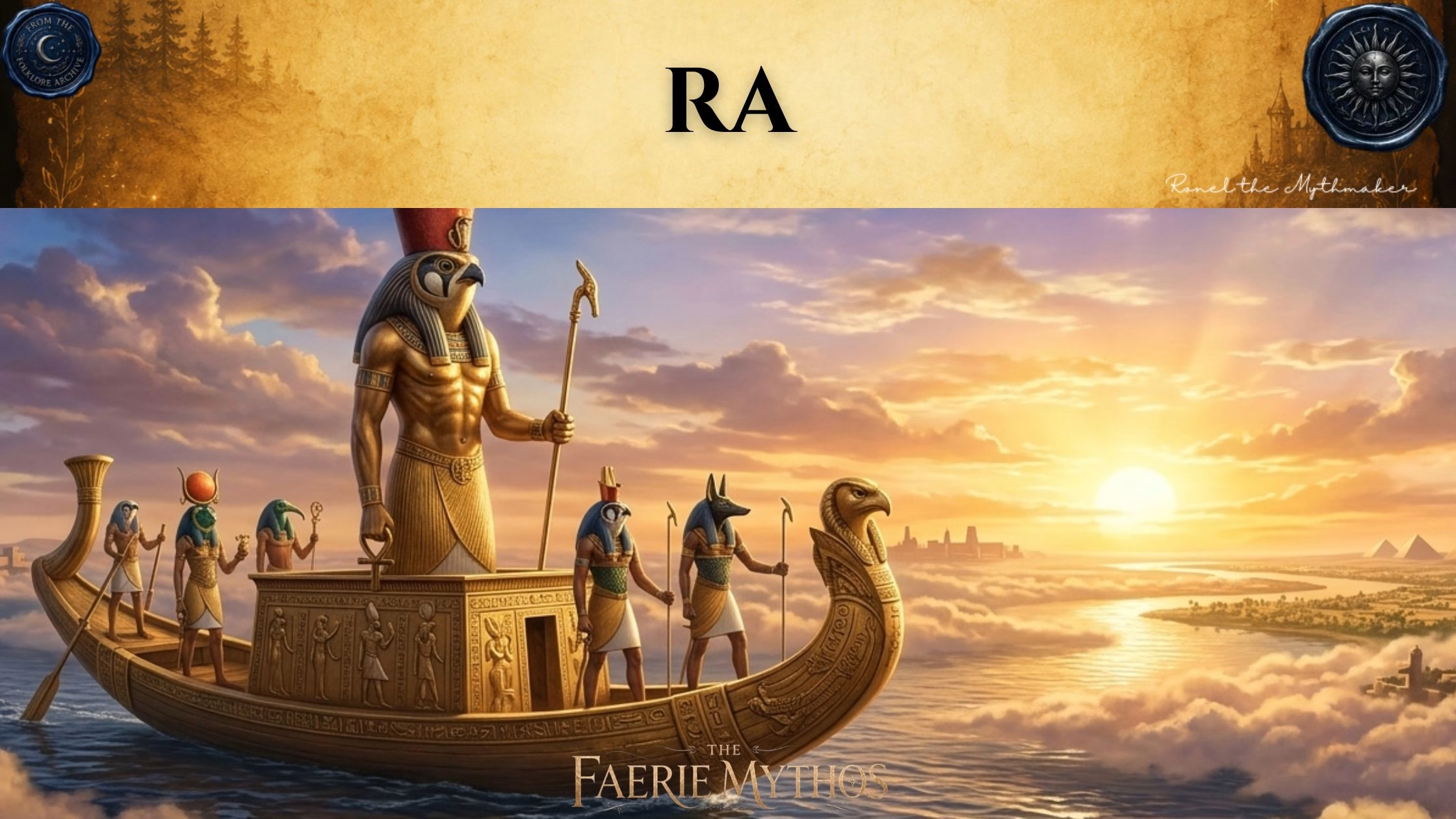
Ra was portrayed with a falcon head, a man’s body, with a sun disk on his head along with a cobra – the symbol of royalty and divine authority. His morning iteration, Khepri, was depicted as a scarab beetle. His eyes, the wedjat, are the sun and the moon. His late afternoon iteration, Atum, is that of the aging Ra.
His children were Shu (god of the air) and Tefnut (goddess of mists). They were the parents of Geb (earth) and Nut (sky). They in turn were the parents of Osiris, Set, Isis and Nephthys. Ra thought that Nut would be his, but she chose Geb. So he cursed her to not be able to give birth on any day of the year. Thoth, being a good guy, played a game with the moon and took his winnings in the form of the moon’s light. This gave him 5 new days to add to the year – and Nut was able to give birth.
After Horus’s birth, Isis poisoned Ra with snake venom and his own blood. He couldn’t heal himself and asked for her help. She said she could only help him if she had his true name – something which holds power, according to the Ancient Egyptians. He prevaricated, telling her he is Khepri in the morning, Ra at noon and Atum in the evening. Eventually, though, the pain was so bad he told her his true name and she healed him. Her price: his eyes (the sun and the moon). She gave these to Horus and he took over Ra’s job as solar deity.
Ra travels through the sky on his solar barque. He also has a staff he uses to fight off the snake of chaos, Apophis.

Ra in Modern Culture
Kane Chronicles by Rick Riordan
Ra is a former pharaoh of the Egyptian gods and the most powerful god in existence in Egyptian mythology. He was forced into retirement by Isis and, after taking precautions to stop Apophis, became a senile old man, who wound up in the House of Rest in the Duat. After being hosted by Zia, he returns to his former self as a powerful god. He has four aspects: Khepri as the morning god, Ra as the day god, Khnum as the evening god, and Atum as the afternoon god.
The Kanes found Ra in the House of Rest in the Duat and Sadie managed to revive him, however, he was still senile though he retook his throne. Even with Khepri returned to him and thus his ability to be reborn, Ra is not reborn and lives in the House of Life during the day and does his nightly journey protected by the other gods at night. He gives a beetle, the last remnant of Khepri, to Zia Rashid, his chosen host so she could channel his powers in times of need. After the Battle of Brooklyn House, Ra, along with Bast, returns to the heavens on his sun boat.
Learn more here.

SMITE video game
Without the sun, there would be no light, no warmth, no life. Without Ra, there would be no sun.
Ra is a guardian, the keeper of Ma’at – order and truth, and master of the sun. Each day he sails across the sky in a golden ship, and each night traverses the underworld, bringing light and warmth to the dead beneath the horizon. For those in the scorched South, Ra was the first God, creator of earth and sky and father to all other Gods.
But Ra’s time is fading like a twilight sky. His descendants have grown in power and prominence and seek to replace him as the figure of authority. His own granddaughter, Eset, cleverly poisoned him by secretly summoning a viper under his feet. When he stepped on it, the serpent’s venomous bite poisoned him. Eset promised to heal Ra if he revealed to her his True Name. At first, he refused, for knowledge of his True Name would give Eset unparalleled power over him, but as the pain mounted, Ra was forced to relent. Eset kept her word and Ra was healed, though the cost may have been too high.
Light can heal, but light can also burn, and the great protector is showing signs of wrath not seen since mankind’s insolence. In that rare moment of anger, Ra sent his daughter, Hathor, in the form of a lion, to devour the people. However, he ended her bloody feeding before she consumed all mankind. This time, his burning gaze is set on the other Gods. When his wrath finally cools, nothing may be left but ash.
Learn more here.

Gods of Egypt movie
Ra is the all-powerful God of the Sun and Light. Responsible for the existence of all creation, he stays aboard his divine vessel and fights the demonic creature Apophis night after night to ensure that the world is never destroyed by chaos.
Ra is first encountered when Horus and Bek visit his vessel. After witnessing the fight between the Sun God and the enormous shadow beast Apophis, Horus is unable to convince Ra to regrant him his power so he can defeat Set himself, as Ra is both neutral about their conflict (despite not approving of Set’s reign) and daily at war with Apophis that threatens to devour the world. He does, however, allow Horus to obtain a vial of the divine waters that surround his vessel, which can extinguish the desert thirst and weaken Set gravely, for the water itself was not Ra to keep and much less deny to anyone else who sets foot on his vessel. Ra tells Horus that his weakness is the result of him not fulfilling his destiny, which Horus believes is avenging his parents’ deaths.
Learn more here.

Marvel comic books
Amon Ra[4] or just Ra[citation needed] is the “God of the Sun” and “King of the Gods” and one of the most powerful of the pantheon. He represented the burning blazing emblem of masculine virility; the Sun. He stands for the sovereignty of masculinity, logic, and raw power.[3] He is the creator-god,[5] and god of sun and fertility;[4] originally an Elder God known as Atum who was created to slay the “demons” (corrupted Elder Gods of Earth), becoming Demogorge, the God-Eater. After he slew the creatures he ventured to the sun to reborn.[2] He became the progenitor of the Heliopolitan race of gods who lived in the extradimensional realm of Celestial Heliopolis adjacent to Earth and was worshipped by the people of Ancient Egypt.[17] He is also a member of the Council of Godheads battling all threats against the Pantheons of Earth.[18] Unable to enter the Earthly plane, throughout history he would pick a champion who would work as an avatar and be guided by his will the lone warrior would be called the “Sun King“.[19]
Learn more here.

Ra in My Writing
Origin of the Fae: Ra
Ra is the king of the Egyptian pantheon. He can wield magic, the power of the sun, and can fight with his staff like it’s no-one’s business. He is constantly herding those in his pantheon to keep them from destroying each other, themselves or the world. He keeps out of their petty squabbles and weird secrets – like the one about Osiris hiding from Isis in the Duat. He only interferes when it will impact the world. He spends most of his time on his barque chasing the sun…
This is the first song that came to me when I thought about Ra, especially how he acts in my Irascible Immortals series.
See this immortal in action in my writing:
Smoke on the Water

Dawn was moments away. The final Door of Night loomed ahead on the River. Horus and Bast had accompanied him – Bast, because she needed something productive to do; Horus, because he had ordered him to.
Ra walked around the edges, watching the water. Nothing.
‘Come,’ he said to his two subjects.
He sat down on his throne on the barque he steered through the sky during the day and the Duat at night. Horus and Bast kneeled before him.
‘I need the two of you to take the barque until I return. No-one can know of my absence. Stand, you’re hurting my neck.’
They stood up.
‘If I may,’ Bast said slowly. ‘Why?’
He smiled. His fiercest protector wouldn’t like the answer.
It Ends Tonight, Smoke on the Water, Irascible Immortals by Ronel Janse van Vuuren
If this tale has lingered with you, I would be glad to hear it.
Where did you first encounter this creature – through story, superstition, memory, or something half-remembered?
If you know other versions of its myth, feel free to leave them in the record below. Folklore survives by being spoken again.
Further fragments and interpretations of this creature can be found in my Pinterest grimoire.
If you wish to support the time and craft behind these folklore posts – researching old tales, gathering fragments, and shaping them into something worth reading – you may do so by buying me a coffee. It can be a single offering, or something you return to whenever the spirit moves you.



Love the images you post.
Thanks!
This post has made my day. I’m such a fan of the Egyptian pantheon, and you’ve provided such a wealth of info to muse on – thanks!
I’m glad you enjoyed this post!