
Persephone: Goddess of Spring and the Underworld
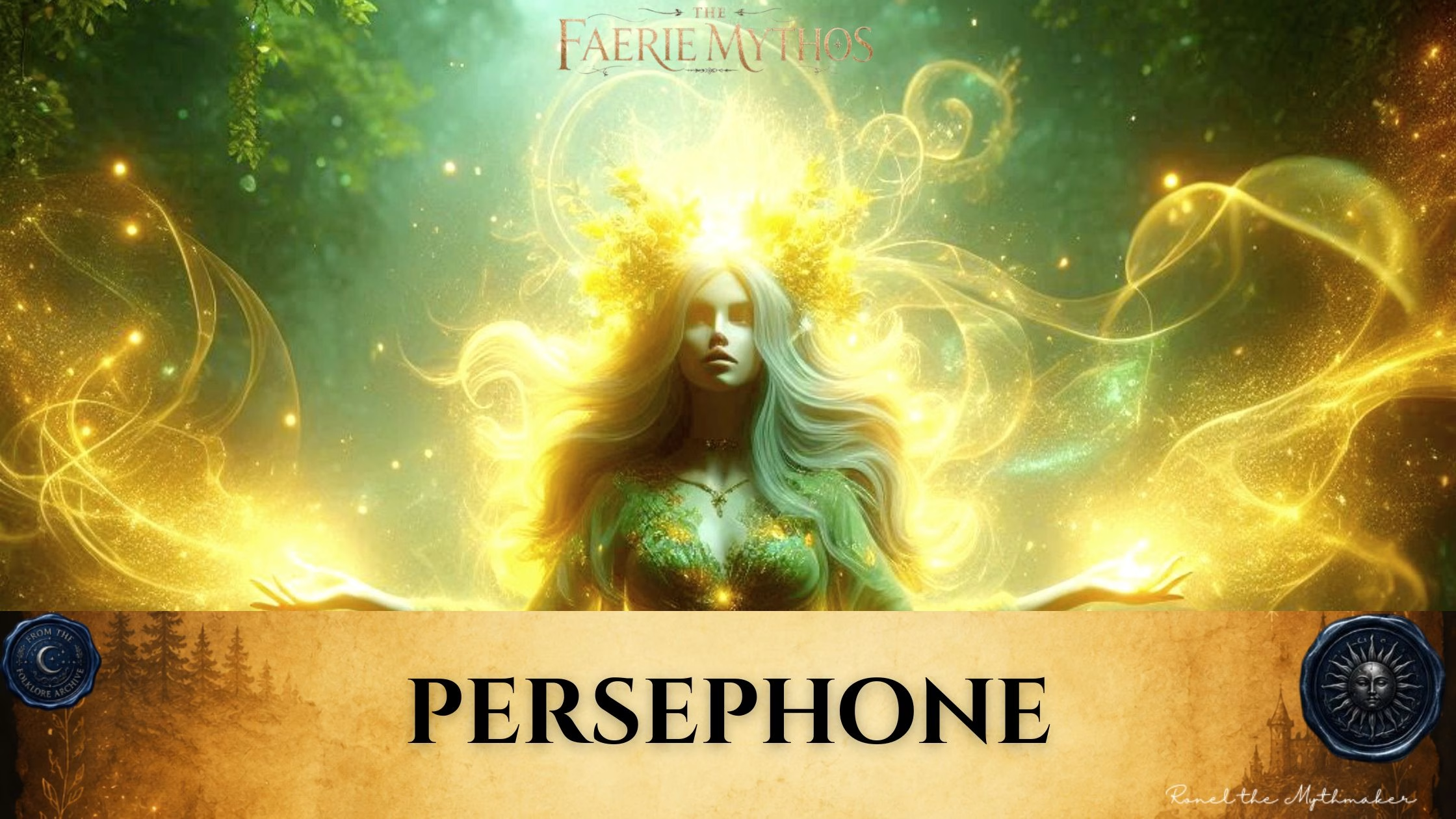
P is for Persephone

I’m weaving folklore and book reviews into a single offering, shaped to reach a wider audience drawn to both. In years past, interest has surfaced in fragments of each; now, I’m gathering those threads into April alone, so the rest of the year remains quiet and deliberate.
If you came only for today’s book review, you may follow the link here.
Known as Demeter’s daughter and the wife of Hades, it seems there’s not much more to this goddess than flowers…

Folklore
Dictionary of Greek and Roman Biography and Mythology by William Smith [1844]
PERSE′PHONE (Persephonê), in Latin Proserpina, the daughter of Zeus and Demeter. (Hom. Il. xiv. 326, Od. xi. 216; Hes. Theog. 912, &c. ; Apollod. i. 5. § 1.) Her name is commonly derived from pherein phonon, “to bring” or “cause death,” and the form Persephone occurs first in Hesiod (Theog. 913; comp. Hom. Hymm. in Cer. 56), the Homeric form being Persephoneia. But besides these forms of the name, we also find Persephassa, Phersephassa, Persephatta, Phersephatta. Pherrephassa, Pherephatta, and Phersephoneia, for which various etymologies have been proposed. The Latin Proserpina, which is probably only a corruption of the Greek, was erroneously derived by the Romans from proserpere, “to shoot forth.” (Cic. de Nat. Deor. ii. 26.) Being the infernal goddess of death, she is also called a daughter of Zeus and Styx (Apollod. i. 3. § 1 ); in Arcadia she was worshipped under the name of Despoena, and was called a daughter of Poseidon Hippius and Demeter, and said to have been brought up by the Titan Anytus. (Paus. viii. 37. § 3, 6, 25. § 5.) Homer describes her as the wife of Hades, and the formidable, venerable, and majestic queen of the Shades, who exercises her power, and carries into effect the curses of men upon the souls of the dead, along with her husband. (Hom. Od. x. 494, xi. 226, 385, 634, Il. ix. 457, 569; comp. Apollod. i. 9. § 15.) Hence she is called by later writers Juno Inferna, Auerna, and Stygia (Virg. Aen. vi. 138; Ov. Met. xiv. 114), and the Erinnyes are said to have been daughters of her by Pluto. (Orph. Hymn. 29. 6, 6, 70. 3.) Groves sacred to her are said by Homer to be in the western extremity of the earth, on the frontiers of the lower world, which is itself called the house of Persephone. (Od. x. 491, 509.)
The story of her being carried off by Pluto, against her will, is not mentioned by Homer, who simply describes her as his wife and queen; and her abduction is first mentioned by Hesiod (Theog. 914). Zeus, it is said, advised Pluto, who was in love with the beautiful Persephone, to carry her off, as her mother, Demeter, was not likely to allow her daughter to go down to Hades. (Comp. Hygin. Fab. 146.) Pluto accordingly carried her off while she was gathering flowers with Artemis and Athena. (Comp. Diod. v. 3.) Demeter, when she found her daughter had disappeared, searched for her all over the earth with torches, until at length she discovered the place of her abode. Her anger at the abduction obliged Zeus to request Pluto to send Persephone (or Cora, i. e. the maiden or daughter) back. Pluto indeed complied with the request, but first gave her a kernel of a pomegranate to eat, whereby she became doomed to the lower world, and an agreement was made that Persephone should spend one third (later writers say one half) of every year in Hades with Pluto, and the remaining two thirds with the gods above. (Apollod. i. 5. 1, &c,; Or. Met. v. 565; comp. Demeter.) The place where Persephone was said to have been carried off, is different in the various local traditions. The Sicilians, among whom her worship was probably introduced by the Corinthian and Megarian colonists, believed that Pluto found her in the meadows near Enna, and that the well Cyane arose on the spot where he descended with her into the lower world. (Diod. v. 3, &c.; comp. Lydus, De Mens. p. 286; Ov. Fast. iv. 422.) The Cretans thought that their own island had been the scene of the rape (Schol. ad Hes. Theog. 913), and the Eleusinians mentioned the Nysaean plain in Boeotia, and said that Persephone had descended with Pluto into the lower world at the entrance of the western Oceanus. Later accounts place the rape in Attica, near Athens (Schol. ad Soph. Oed. Col. 1590) or at Erineos near Eleusis (Paus. i. 38. § 5), or in the neighbourhood of Lerna (ii. 36. § 7 ; respecting other localities see Conon, Narr. 15 ; Orph. Argon. 1192; Spanheim, ad Callim. Hymn. in Cer. 9).
The story according to which Persephone spent one part of the year in the lower world, and another with the gods above, made her, even with the ancients, the symbol of vegetation which shoots forth in spring, and the power of which withdraws into the earth at other seasons of the year. (Schol. ad Theocrit. iii. 48.) Hence Plutarch identifies her with spring, and Cicero De Nat. Deor. ii. 26) calls her the seed of the fruits of the field. (Comp. Lydus, De Mes. pp. 90, 284; Porphyr. De Ant. Nymph. p. 118. ed. Barnes.) In the mysteries of Eleusis, the return of Cora from the lower world was regarded as the symbol of immortality, and hence she was frequently represented on sarcophagi. In the mystical theories of the Orphics, and what are called the Platonists, Cora is described as the all-pervading goddess of nature, who both produces and destroys every thing (Orph. Hymn. 29. 16), and she is therefore mentioned along, or identified with, other mystic divinities, such as Isis, Rhea, Ge, Hestia, Pandora, Artemis, Hecate. (Tzetz. ad Lyc. 708, 1176; Schol. ad Apollon. Rlod. iii. 467; Schol. ad Theocrit. ii. 12 ; Serv. ad Aen. iv. 609.) This mystic Persephone is further said to have become by Zeus the mother of Dionysus, Iacchus, Zagreus or Sabazius. (Hesych. s. v. Zagreus; Schol. ad Eurip. Or. 952 ; Aristoph. Ran. 326; Diod. iv. 4; Arrian. Exped. Al. ii. 16; Lydus De Mens. p. 198; Cic. de Nat. Deor. iii. 23.) The surnames which are given to her by the poets, refer to her character as queen of the lower world and of the dead, or to her symbolic meaning which we have pointed out above. She was commonly worshipped along with Demeter, and with the same mysteries, as for example, with Demeter Cabeiria in Boeotia. (Paus. ix. 25. § 5.) Her worship further is mentioned at Thebes, which Zeus is said to have given to her as an acknowledgment for a favour she had bestowed on him (Schol. ad Eurip. Phoen. 687): in like manner Sicily was said to have been given to her at her wedding (Pind. Nem. i. 17; Diod. v.2; Schol. ad Theocrit. xv. 14), and two festivals were celebrated in her honour in the island, the one at the time of sowing, and the other at the time of harvest. (Diod. v. 4; Athen. iv. p. 647.) The Eleusinian mysteries belonged to Demeter and Cora in common, and to her alone were dedicated the mysteries celebrated at Athens in the month of Anthesterion. (Comp. Paus. i. 31. § 1, &c.) Temples of Persephone are mentioned at Corinth, Megara, Sparta, and at Locri in the south of Italy. (Paus. iii. 13. § 2; Liv. xxix. 8, 18; Appian, iii. 12.) In works of art Persephone is seen very frequently: she bears the grave and severe character of an infernal Juno, or she appears as a mystical divinity with a sceptre and a little box, but she was mostly represented in the act of being carried off by Pluto. (Paus. viii. 37. § 2.)

Rebel Folklore by Icy Sedgwick
The Persephone myth sees the goddess descend into the underworld to spend six months with Hades. Her mother Demeter misses her so much that she sends the world into autumn and winter. When Persephone re-emerges, the earth enjoys the return of spring. Such tales help to explain natural phenomena…
*More can be read in the book.
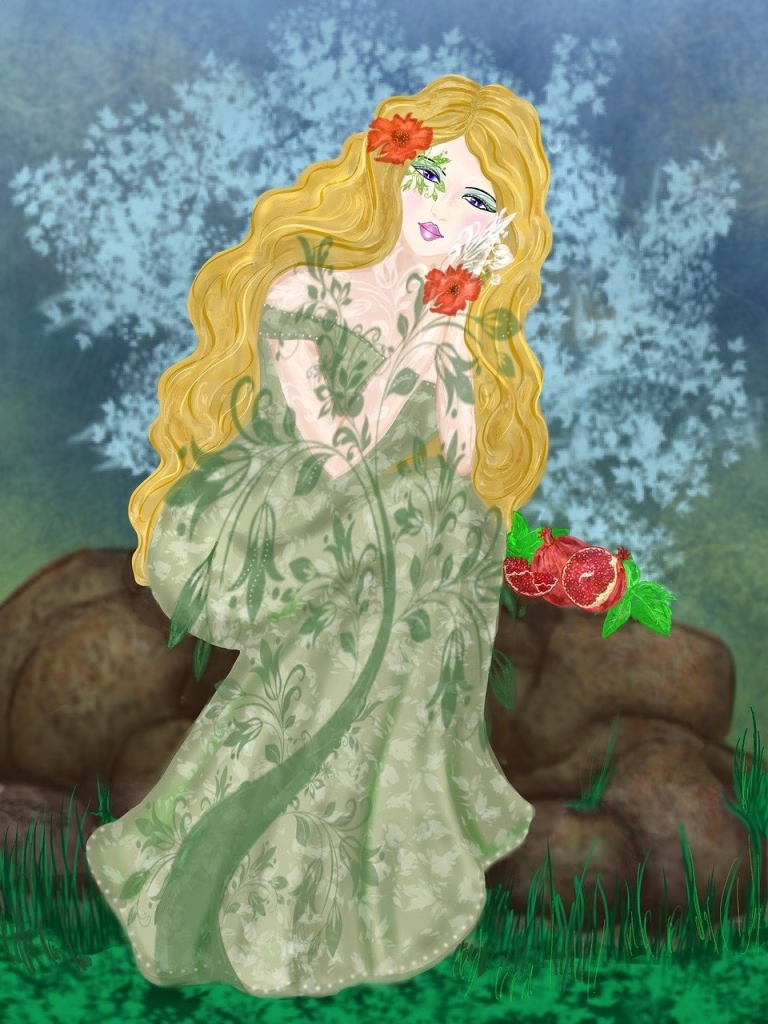
Mythology: A Captivating Guide to Greek Mythology, Egyptian Mythology, Norse Mythology, Celtic Mythology and Roman Mythology
One day, while Persephone, Artemis, Athena and the Oceanids were gathering flowers from the field, Hades cracked open his grandmother, the Earth, reached through the cleft and kidnapped his niece. Because he had been wearing his helmet of invisibility, no one saw him do it.
Demeter was so distraught that her daughter was missing, she stopped nurturing the plants toward harvest. Finally, Helios looked down upon his aunt and told her that her daughter had been taken by Hades. In despair, Demeter lost hope and could not fulfill her timely duties. Soon, people started to starve. Cries and prayers were heard by all the gods asking that they would return order to nature. The weeping and howling became so intense that Zeus demanded that Hades return Persephone to her mother.
Hades agreed to return her, but before she left, he fed her pomegranate seeds as a parting gesture. When Hermes, the messenger god, arrived to escort Persephone back to the world above, the spring goddess had already tasted food in the underworld. By divine law, she was now obligated to return to Hades for a third of each year. These became known as the winter months, because Persephone was not around to care for the plants.
*More can be read in the book.

Further Reading:
- Persephone
- Persephone: The Reluctant Underworld Goddess
- Persephone
- Persephone and the Seasons
- The myth of Hades and Persephone
- Persephone :: Queen of the Underworld
- Persephone
- PERSEPHONE

Folklore in a Nutshell by Ronel
Persephone, also called Cora, is the daughter of Zeus and Demeter. Some ancient writers argued that she’s the daughter of Nyx and even that Demeter was actually Rhea (Zeus’ mother). But it is mostly agreed that she’s the daughter of Zeus and Demeter.
The most famous myth surrounding her is how Hades abducted her and only her mother freaked out over it – Zeus probably approved as he only intervened when mortals started to starve because Demeter stopped helping the crops to grow. Persephone had eaten in the Underworld, Zeus negotiated that she’d stay half the year with her mother on Earth and the other half with Hades in the Underworld. There’s much more to the myth, but the search is primarily Demeter’s story, not Persephone’s. In some versions, Persephone only spends a third of the year with Hades. In some versions, it is Hecate who leads her from the Underworld, not Hermes sent by Zeus. But in all versions, eating in the Underworld is a taboo. It doesn’t really matter whether Persephone ate one or six pomegranate seeds, the point is that she ate something in the Underworld and thus belonged there.
Though the story of Hades and Persephone is couched as a romance, though she is made Queen of the Underworld, Hades had many mistresses – most famously the nymph Minthe whom Persephone turned into the mint plant when the nymph boasted that Hades would always be hers and that she was prettier than the goddess. Also, there’s the tale of Persephone and Aphrodite both being in love with Adonis. When the mortal chose Aphrodite, Persephone had a wild boar kill Adonis.
It has to be noted that Homer never mentioned the famous abduction, only calling Persephone Hades’ wife and queen. It was Hesiod who first told the story of her abduction (which had been since romanticised).
Persephone’s journey to the Underworld and then to Earth symbolises the relationship between the seasons and between life and death.
She has many powers and symbols. As Kore or Cora, she’s a vegetation goddess, the goddess of spring, and much more approachable as the “dreaded Persephone” who was Queen of the Underworld and ruled over spectres, ghosts, curses and the furies. Persephone’s symbols, as shown in art, are the pomegranate and its seeds, and she’s also depicted with sheaves of grain, and occasionally, a torch.
In some tales, the furies are Persephone’s children by Hades (instead of being the result of Ouranus being castrated by Kronos). Zeus is said to have seduced Persephone by pretending to be Hades (apparently his deceptive magic works on everyone) and she gave birth to Melinoe: half her body dark and the other light. Thus the deception was unveiled. Melinoe is a bringer of nightmares and madness. She’s similar to the furies and Hecate. Sometimes “Melinoe” is thought to be another name for Hecate.
A powerful goddess who rules her domain as an equal, not as merely a consort as Hera does with Zeus.

Persephone in Modern Culture
The Abandon Trilogy by Meg Cabot

The dark and dangerously seductive trilogy from bestselling teen author Meg Cabot.
Abandon: Last year, Pierce died – just for a moment. And when she was in the space between life and death, she met John: tall dark and terrifying, it’s his job to usher souls from one realm to the next. There’s a fierce attraction between them, but Pierce knows that if she allows herself to fall for John she will be doomed to a life of shadows and loneliness in the underworld. But now things are getting dangerous for her, and her only hope is to do exactly what John says . . .
Underworld: Seventeen-year-old Pierce Oliviera isn’t dead. Not this time. But she’s been taken by John Hayden, Lord of the Underworld, to the place between heaven and hell where spirits gather before their final journey. John claims it’s to protect her from the Furies, who are hell-bent on vengeance against him. But could he have other reasons for keeping Pierce close? When she learns that the people she loves back home are in mortal danger, can she convince John to release her to save them— or will the price he asks for her freedom prove too high?
Awaken: Seventeen-year-old Pierce Oliviera knew that by accepting the undying love of John Hayden she’d be forced to live forever in the one place she’s always dreaded most: the Underworld. The sacrifice seemed worth it, but now her happiness and safety in the realm are threatened. The Furies have discovered that John has broken one of their strictest rules and revived a dead soul. If the balance of life and death isn’t restored, both the Underworld and Pierce’s home on Earth will be wiped out by the Furies’ wrath. Pierce has already cheated death once . . . can she do it again?
Read my reviews: Abandon | Underworld | Awaken
A Touch of Darkness (Hades x Persephone #1) by Scarlett St Clair

Persephone is the Goddess of Spring by title only. The truth is, since she was a little girl, flowers have shriveled at her touch. After moving to New Athens, she hopes to lead an unassuming life disguised as a mortal journalist.
Hades, God of the Dead, has built a gambling empire in the mortal world and his favorite bets are rumored to be impossible.
After a chance encounter with Hades, Persephone finds herself in a contract with the God of the Dead and the terms are impossible: Persephone must create life in the Underworld or lose her freedom forever.
The bet does more than expose Persephone’s failure as a Goddess, however. As she struggles to sow the seeds of her freedom, love for the God of the Dead grows—and it’s forbidden.
The Goddess Test by Aimee Carter

Every girl who had taken the test has died.
Now it’s Kate’s turn.
It’s always been just Kate and her mom—and her mother is dying. Her last wish? To move back to her childhood home. So Kate’s going to start at a new school with no friends, no other family and the fear that her mother won’t live past the fall.
Then she meets Henry. Dark. Tortured. And mesmerizing. He claims to be Hades, god of the Underworld—and if she accepts his bargain, he’ll keep her mother alive while Kate tries to pass seven tests.
Kate is sure he’s crazy—until she sees him bring a girl back from the dead. Now saving her mother seems crazily possible. If she succeeds, she’ll become Henry’s future bride and a goddess.
If she fails…
Percy Jackson series by Rick Riordan
Persephone is the Greek goddess of the springtime and vegetation. She is the niece and wife of Hades, therefore being the Queen of the Underworld. Her Roman counterpart is Proserpina.
The Sword of Hades: When Percy, Thalia Grace, and Nico di Angelo were brought to the Underworld by Persephone who appeared above them and told them that her husband’s new sword (forged from one of keys of Hades) was stolen during its creation. She gave them a flower (a yellow carnation) to point them in the direction of the thief. She stated that its petals will fall and when all of them would have fallen, the thief would have escaped.
Learn more here.
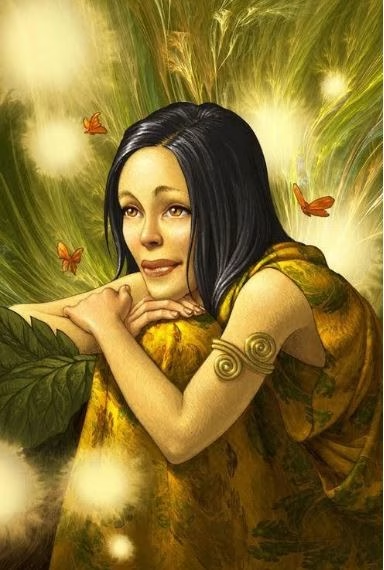
Disney’s Hercules
Persephone (known in Roman as Proserpina) is a goddess that appears in the 1997 film, Hercules. She is also the wife of the god of the Underworld, Hades. She is the goddess of the underworld, spring, nature and the earth.
Learn more here.
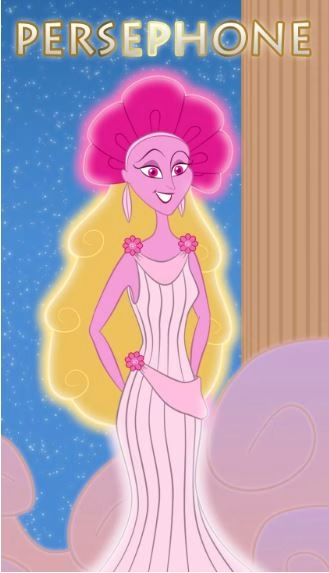
Hercules: The Legendary Journeys TV series
Persephone is the daughter of Demeter. She is queen of the Underworld, spending six months of every year with her lover, Hades, and the other six with her mother, Demeter. This arrangement was devised by Hercules as a compromise to make all three Olympians happy.
Persephone herself wanted to be with Hades, but realized that she would miss her mother if she stayed in the underworld full-time. (HTLJ “The Other Side“)
Learn more here.
Persephone in My Writing
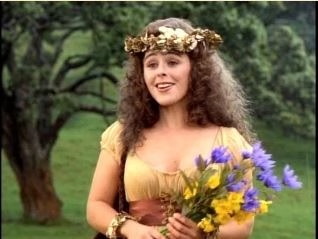
Origin of the Fae: Persephone
Persephone and Hades fell in love, but her mother had someone specific in mind for her: Apollo. Hades spoke to Zeus an the two agreed that Persephone would make a great Queen of the Underworld. And though she sometimes misses her overbearing mother, she’s found her place in the world.
My Book
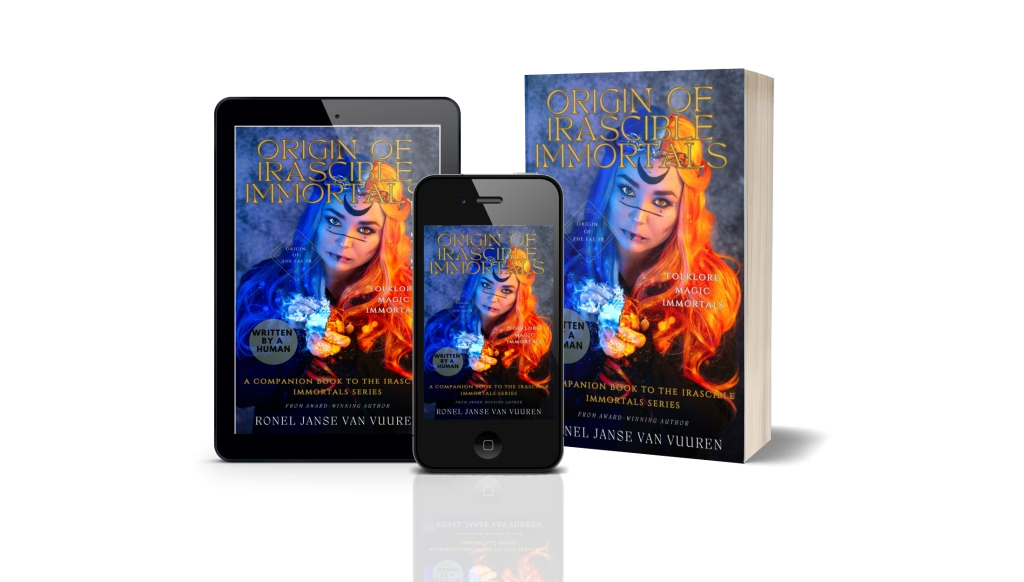
Origin of Irascible Immortals (Origin of the Fae #8)
If this tale has lingered with you, I would be glad to hear it.
Where did you first encounter this creature – through story, superstition, memory, or something half-remembered?
If you know other versions of its myth, feel free to leave them in the record below. Folklore survives by being spoken again.
Further fragments and interpretations of this creature can be found in my Pinterest grimoire.
If you wish to support the time and craft behind these folklore posts – researching old tales, gathering fragments, and shaping them into something worth reading – you may do so by buying me a coffee. It can be a single offering, or something you return to whenever the spirit moves you.




Persephone needs to get her a$$ in gear and get utp here so that we can have some spring this year.
LOL. She’s probably having a lot of fun with her husband right now 🙂
LOL Maybe.
Sooooo many interpretations of Persephone!
https://nydamprintsblackandwhite.blogspot.com/2026/04/q-is-for-queen.html
Isn’t it fun?