O is for Obdurate

I’m weaving folklore and book reviews into a single offering, shaped to reach a wider audience drawn to both. In years past, interest has surfaced in fragments of each; now, I’m gathering those threads into April alone, so the rest of the year remains quiet and deliberate.
If you came only for today’s book review, you may follow the link here.
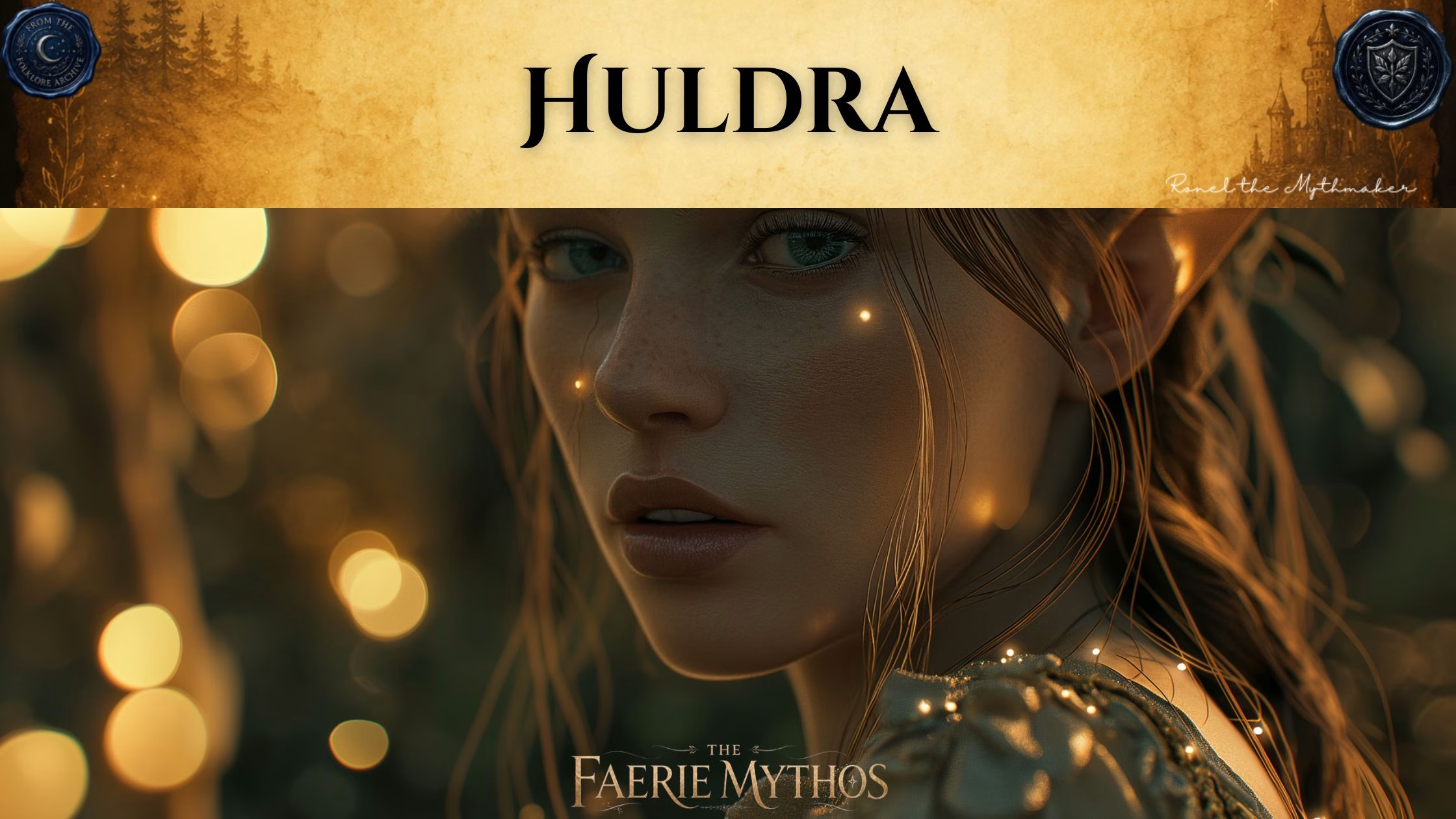
Huldra are what faery women are supposedly all about: beautiful and deadly.

Folklore
The Fairy Mythology by Thomas Keightley [1828]
The Elle-Maids.
There lived a man in Aasum, near Odense, who, as he was coming home one night from Seden, passed by a hill that was standing on red pillars, and underneath there was dancing and great festivity. He hurried on past the hill as fast as he could, never venturing to cast his eyes that way. But as he went along, two fair maidens came to meet him, with beautiful hair floating over their shoulders, and one of them held a cup in her hand, which she reached out to him that he might drink of it. The other then asked him if he would come again, at which he laughed, and answered, Yes. But when he got home he became strangely affected in his mind, was never at ease in himself, and was continually saying that he had promised to go back. And when they watched him closely to prevent his doing so, he at last lost his senses, and died shortly after.
The Elle-Maid near Ebeltoft.
A farmer’s boy was keeping cows not far from Ebeltoft. There came to him a very fair and pretty girl, and she asked him if he was hungry or thirsty. But when he perceived that she guarded with the greatest solicitude against his getting a sight of her back, he immediately suspected that she must be an Elle-maid, for the Elle-people are hollow behind. He accordingly would give no heed to her, and endeavoured to get away from her; but when she perceived this, she offered him her breast that he should suck her. And so great was the enchantment that accompanied this action, that he was unable to resist it. But when he had done as she desired him, he had no longer any command of himself, so that she had now no difficulty in enticing him with her.
He was three days away, during which time his father and mother went home, and were in great affliction, for they were well assured that he must have been enticed away. But on the fourth day his father saw him a long way off coming home, and he desired his wife to set a pan of meat on the fire as quick as possible. The son then came in at the door, and sat down at the table without saying a word. The father, too, remained quite silent, as if every thing was as it ought to be. His mother then set the meat before him, and his father bid him eat, but he let the food lie untouched, and said that he knew now where he could get much better food. The father then became highly enraged, took a good large switch, and once more ordered him to take[Pg 91] his food. The boy was then obliged to eat, and as soon as he had tasted the flesh he ate it up greedily, and instantly fell into a deep sleep. He slept for as many days as the enchantment had lasted, but he never after recovered the use of his reason.

The Element Encyclopedia of Magical Creatures by John and Caitlín Matthews
HULDRA
Huldra is a Norse fairy or wood nymph. She has a beautiful appearance but conceals a long tail beneath her robe. She lives in a mountain where she guards her cattle. The Huldra folk are very musical and travelling musicians who stray near to their homes often hear their tunes and reproduce them in country dances.
*More can be read in the book.

Element Encyclopedia of Fairies by Lucy Cooper
Huldra
In Scandinavian folklore the huldra is a beautiful creature of the forest. Her back is hollow like an old tree trunk and she has a cow’s tail (sometimes it is a fox’s tail). To see her from behind is to break the spell, and she will appear as ugly.
Huldra desire to be human and, in order to achieve this, must marry a man. They are kind to charcoal burners and will watch over their kiln while they rest. In exchange the charcoal burners leave provisions for them. Despite this kindness huldra can also be malevolent, luring men into the forest to seduce them; should the man not satisfy her, she might kill him, or else he is likely to die of exhaustion.
Like fairies, huldra abduct human children and replace them with changelings.
*More can be read in the book.

The Forest in Folklore and Mythology by Alexander Porteous
In the Scandinavian countries there was a Wood-Wife known as Huldra, who sometimes appeared as young and beautiful, but at other times she was old and ugly; and some accounts of her say that she was lovely only in front, while behind she was hideous and hollow. She had a tail which she was ever anxious to conceal, and was often heard singing a doleful melody called huldrslaat. She was frequently to be seen in the forests as an aged woman clad in grey, marching in front of her floack and carrying a milk-pail.
*More can be read in the book.

Encyclopedia of Fairies in World Folklore and Mythology by Theresa Bane
Huldra
In Norwegian folklore it is believed an individual fairy-woman or nymph named Huldra (“covered” or “secret”) lives in the forest and mountains. Descriptions of Huldra vary across the country, sometimes she is said to be beautiful but when seen from behind revealed to be hollow; other times she is said to be blue-skinned. In areas where she is known as Skogsnerte (“blue”) she is said to be blue coloured and wearing a green petticoat. As Huldra, as she is most commonly known, she is said to be beautiful, wearing a blue petticoat and a white snood that nearly hides her long, cowlike tail; a physical trait she is most embarrassed of. Particularly fond of brindled colored cattle, she keeps a handsome and thriving heard of hornless cows. In the mountains her song can be hear over a great distance, a low and mournful tune.
Huldrafolk (plural: Huldre)
In regions sporadic throughout the country Huldra is not thought of as an individual being but rather a race of fairy. The Huldre, or Huldre-folk as they are also know, are said to live in the mountains, wearing nothing but green colored clothing and raise herds of blue cattle known to yield copious amounts of milk. Huldre-men tend to their herds in pasture lands mortals have abandoned.
Elle-Maid
The elle-maids of German and Scandinavian lore are a nocturnal species of fairy. Similar to the cruel and lovely Korrigan of Brittany, they dance in the grass with such grace that when they offer themselves to a young man resistance is seldom met. These elves are known to also sit by the roadside with food and wine, offering a cup to men as they pass; should any accept and drink the wine, they will go insane. Hauntingly beautiful when seen from the front, the elle-maid is revealed to be hollow when seen from behind.
*More can be read in the book.

Further Reading:
- Hulder
- Huldra in Norse Mythology: Myths, Powers, and Symbols
- Skogsrå and Huldra: The femme fatale of the Scandinavian forests

Folklore in a Nutshell by Ronel
[piece]

Huldra in Modern Culture
Bramble: The Mountain King game
The Skogsrå is an antagonist in Bramble the Mountain King. A dangerous forest spirit who regularly lured men out to their deaths at night by seducing them with her beauty before cruelly killing them and using their sacrifices in order to strengthen her own magic.
She was a shapeshifter that mimicked what men wanted to see in order to lure them away. When they were close enough to touch her, she transformed into something monstrous. She ripped their chests open, hung them up in trees, and drew strange powers from their still-beating hearts. And no one would ever see them again.
Learn more here.

Huldra in My Writing
Origin of the Fae: Huldra
[origin of fae]
Antifreeze (Faery Tales #13)

If this tale has lingered with you, I would be glad to hear it.
Where did you first encounter this creature – through story, superstition, memory, or something half-remembered?
If you know other versions of its myth, feel free to leave them in the record below. Folklore survives by being spoken again.
Further fragments and interpretations of this creature can be found in my Pinterest grimoire.
If you wish to support the time and craft behind these folklore posts – researching old tales, gathering fragments, and shaping them into something worth reading – you may do so by buying me a coffee. It can be a single offering, or something you return to whenever the spirit moves you.



Beautigul images as always. She was a new fairy for me.
Thanks! She’s new to me, too.