
Neutral Hermes
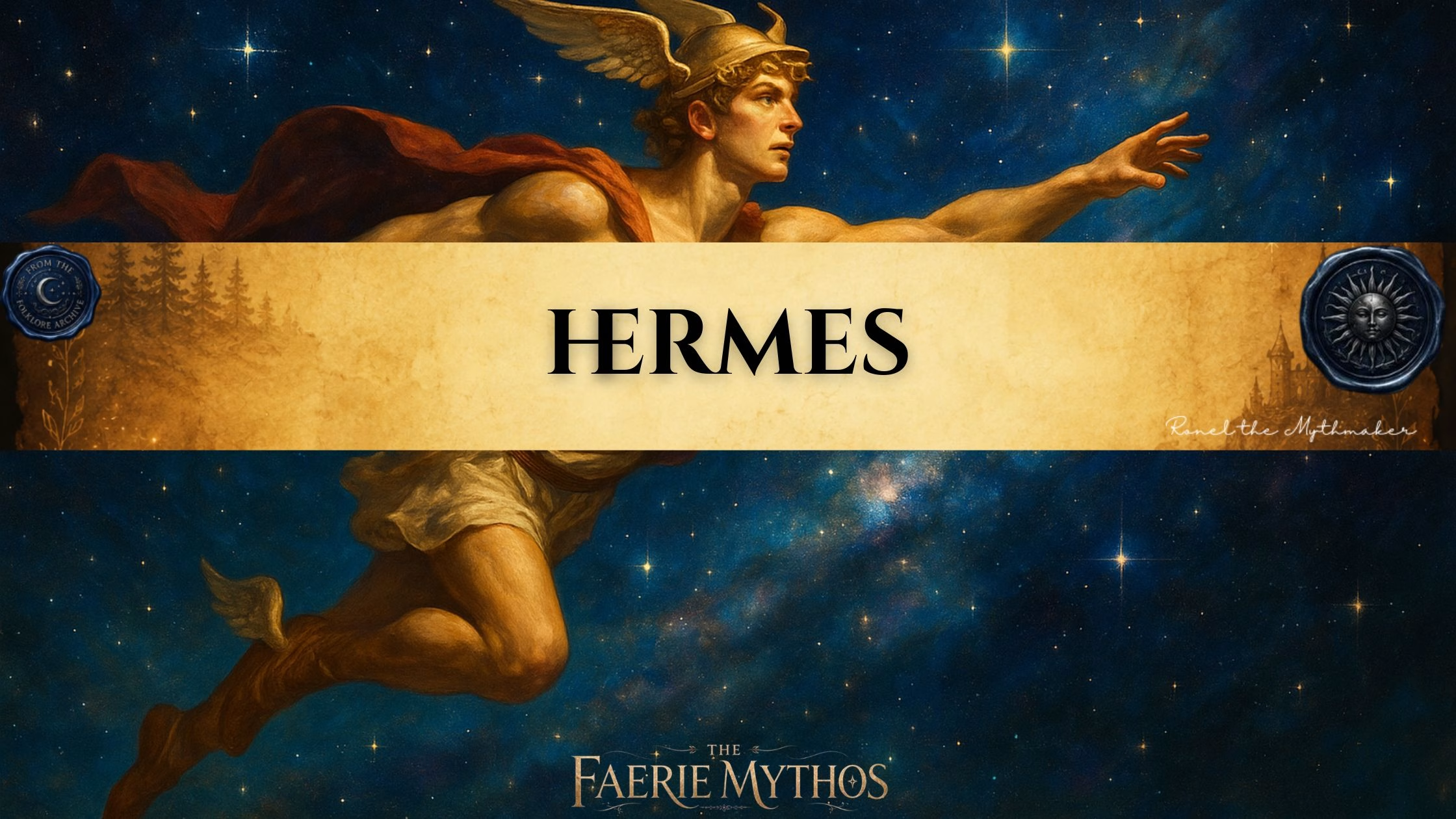
N is for Neutral

I’m weaving folklore and book reviews into a single offering, shaped to reach a wider audience drawn to both. In years past, interest has surfaced in fragments of each; now, I’m gathering those threads into April alone, so the rest of the year remains quiet and deliberate.
If you came only for today’s book review, you may follow the link here.
The messenger of the gods, the patron god of thieves, and he has a lot of other things connected to him, too.

Folklore
Dictionary of Greek and Roman Biography and Mythology by William Smith [1844]
HERMES (Hermês, Hermeias, Dor. Hermas), a son of Zeus and Maia, the daughter of Atlas, was born in a cave of Mount Cyllene in Arcadia (Hom. Od. viii. 335, xiv. 435, xxiv. 1; Hymn. in Merc. 1, &c.; Ov. Met. i. 682, xiv. 291), whence he is called Atlantiades or Cyllenius; but Philostratus (Icon. i. 26) places his birth in Olympus.
In the first hours after his birth, he escaped from his cradle, went to Pieiria, and carried off some of the oxen of Apollo. (Hom. Hymn. in Merc. 17.) In the Iliad and Odyssey this tradition is not mentioned, though Hermes is characterised as a cunning thief. (Il. v. 390, xxiv. 24.) Other accounts, again, refer the theft of the oxen to a more advanced period of the life of the god. (Apollod. iii. 10. § 2; Anton. Lib. 23.) In order not to be discovered by the traces of his footsteps, Hermes put on sandals, and drove the oxen to Pylos, where he killed two, and concealed the rest in a cave. (Comp. the different stratagems by which he escaped in Horn. Hymn. in Merc. 75, &c., and Anton. Lib. l. c.) The skins of the slaughtered animals were nailed to a rock, and part of their flesh was prepared and consumed, and the rest burnt; at the same time he offered scrifices to the twelve gods, whence he is probably called the inventor of divine worship and sacrifices. (Hom. Hymn. in Merc. 125, &c.; Diod. i. 16.) Hereupon he returned to Cyllene, where he found a tortoise at the entrance of his native cave. He took the animal’s shell, drew strings across it, and thus invented the lyre and plectrum. The number of strings of his new invention is said by some to have been three and by others seven, and they were made of the guts either of oxen or of sheep. (Hom. l. c. 51; Diod. i. 16, v. 75; Orph. Argon. 381; Horat. Carm. i. 10. 6.) Apollo, by his prophetic power, had in the meantime discovered the thief, and went to Cyllene to charge him with it before his mother Maia. She showed to the god the child in its cradle; but Apollo took the boy before Zeus, and demanded back his oxen. Zeus commanded him to comply with the demand of Apollo, but Hermes denied that he had stolen the cattle. As, however, he saw that his assertions were not believed, he conducted Apollo to Pylos, and restored to him his oxen; but when Apollo heard the sounds of the lyre, he was so charmed that he allowed Hermes to keep the animals. Hermes now invented the syrinx, and after having disclosed his inventions to Apollo, the two gods concluded an intimate friendship with each other. (Hom. l.c. 514, &c.) Apollo presented his young friend with his own golden shepherd’s staff, taught him the art of prophesying by means of dice, and Zeus made him his own herald, and also of the gods of the lower world. According to the Homeric hymn (533, &c.), Apollo refused to teach Hermes the art of prophecy, and referred him for it to the three sisters dwelling on Parnassus; but he conferred upon him the office of protecting flocks and pastures (568; comp. Lucian, Dial. Deor. 7; Ov. Met. ii. 683, &c.).
The principal feature in the traditions about Hermes consists in his being the herald of the gods, and in this capacity he appears even in the Homeric poems; his original character of an ancient Pelasgian, or Arcadian divinity of nature, gradually disappeared in the legends. As the herald of the gods, he is the god of skill in the use of speech and of eloquence in general, for the heralds are the public speakers in the assemblies and on other occasions. (Il. i. 333, iv. 193, vii. 279, 385, viii. 517, xi. 684; comp. Orph. Hymn. 27. 4; Aelian, H. A. x. 29; Hor. Carm. i. 10. 1.) As an adroit speaker, he was especially employed as messenger, when eloquence was required to attain the desired object. (Od. i. 38, Il. xxiv. 390; Hom. Hymn. in Cer. 335.) Hence the tongues of sacrificial animals were offered to him. (Aristoph. Pax, 1062; Athen. i. p. 16.) As heralds and messengers are usually men of prudence and circumspection.
Hermes was also the god of prudence and skill in all the relations of social intercourse. (Il. xx. 35, xxiv. 282, Od. ii. 38.) These qualities were combined with similar ones, such as cunning both in words and actions, and even fraud, perjury, and the inclination to steal; but acts of this kind were committed by Hermes always with a certain skill, dexterity, and even gracefulness. Examples occur in the Homeric hymn on Hermes (66, 260, 383; comp. Eustath. ad Hom. p. 1337; Hom. Il. v. 390, xxiv. 24; Apollod. i. 6. § 3).
Being endowed with this shrewdness and sagacity, he was regarded as the author of a variety of inventions, and, besides the lyre and syrinx, he is said to have invented the alphabet, numbers, astronomy, music, the art of fighting, gymnastics, the cultivation of the olive tree, measures, weights, and many other things. (Plut. Sympos. ix. 3; Diod. l.c. and v. 75; Hygin. Fab. 277.) The powers which he possessed himself he conferred upon those mortals and heroes who enjoyed his favour, and all who had them were under his especial protection, or are called his sons. (Od. x. 277, &c., xv. 318, &c., xix. 397; Soph. Philoct. 133; Hes. Op. 67; Eustath. ad Hom. pp. 18, 1053.)
He was employed by the gods and more especially by Zeus on a variety of occasions which are recorded in ancient story. Thus he conducted Priam to Achilles to fetch the body of Hector (Il. xxiv. 336), tied Ixion to the wheel (Hygin. Fab. 62), conducted Hera, Aphrodite, and Athena to Paris (Hygin. Fab. 92; Paus. v. 19. § 1), fastened Prometheus to Mount Caucasus (Serv. ad Virg. Eclog. vi. 42), rescued Dionysus after his birth from the flames, or received him from the hands of Zeus to carry him to Athamas (Apollod. iii. 4. § 3; Apollon. Rhod. iv. 1137), sold Heracles to Omphale (Apollod. ii. 6. § 3), and was ordered by Zeus to carry off Io, who was metamorphosed into a cow, and guarded by Argus; but being betrayed by Hierax, he slew Argus. (Apollod. ii. 1. § 3.) From this murder he is very commonly called Argeiphontês. (Il. xxiv. 182; comp. Schol. ad Aeschyl. Prom. 563; Ov. Met. i. 670, &c.) In the Trojan war Hermes was on the side of the Greeks. (Il. xx. 72, &c.) His ministry to Zeus is not confined to the offices of herald and messenger, but he is also the charioteer and cupbearer. (Hom. Od. i. 143, Il. xxiv. 178, 440, Hymn. in Cer. 380; Eustath. ad Hom. p. 1205.)
As dreams are sent by Zeus, Hermes, the hêgêtôr oneirôn, conducts them to man, and hence he is also described as the god who had it in his power to send refreshing sleep or to take it away. (Hom. Hymn. in Merc. 14, Il. ii. 26, xxiv. 343, &c.)
Another important function of Hermes was to conduct the shades of the dead from the upper into the lower world, whence he is called psuchopompos, nekropomtos, psuchagôgos, &c. (Hom. Od. xxiv. 1, 9, Hymn. in Cer. 379, &c.; Eustath. ad Hom. p. 561; Diog. Laërt. viii. 31; Hygin. Fab. 251.)
The idea of his being the herald and messenger of the gods, of his travelling from place to place and concluding treaties, necessarily implied the notion that he was the promoter of social intercourse and of commerce among men, and that he was friendly towards man. (Od. xix. 135, Il. xxiv. 333.) In this capacity he was regarded as the maintainer of peace, and as the god of roads, who protected travellers, and punished those who refused to assist travellers who had mistaken their way. (Il. vii. 277, &c.; Theocrit. xxv. 5; Aristoph. Plut. 1159.) Hence the Athenian generals, on setting out on an expedition, offered sacrifices to Hermas, surnamed Hegemonius, or Agetor; and numerous statues of the god were erected on roads, at doors and gates, from which circumstance he derived a variety of surnames and epithets.
As the god of commerce, he was called diemporos, empolaios, palinkapêlos, kerdemporos, agoraios, &c. (Aristoph. Plut. 1155; Pollux, vii. 15; Orph. Hymn. xxvii. 6; Paus. i. 15. § 1, ii. 9. §. 7, iii. 11. § 8, &c.); and as commerce is the source of wealth, Hermes is also the god of gain and riches, especially of sudden and unexpected riches, such as are acquired by commerce. As the giver of wealth and good luck (ploutodotês), he also presided over the game of dice, and those who played it threw an olive leaf upon the dice, and first drew this leaf. (Hom. Il. vii. 183; Aristoph. Pax, 365; Eustath. ad Hom. p. 675.)
We have already observed that Hermes was considered as the inventor of sacrifices, and hence he not only acts the part of a herald at sacrifices (Aristoph. Pax, 433), but is also the protector of sacrificial animals, and was believed in particular to increase the fertility of sheep. (Hom. Hymn. in Merc. 567, &c., Il. xiv. 490, xvi. 180, &c; Hes. Theog. 444.) For this reason he was especially worshipped by shepherds, and is mentioned in connection with Pan and the Nymphs. (Hom. Od. xiv. 435; Eustath. ad Hom. p. 1766; Aristoph. Thesm. 977; Paus. viii. 16. § 1; ix. 34. § 2; Schol. ad Soph. Philoct. 14, 59.) This feature in the character of Hermes is a remnant of the ancient Arcadian religion, in which he was the fertilising god of the earth, who conferred his blessings on man; and some other traces of this character occur in the Homeric poems. (Il. xxiv. 360, Od. viii. 335, xvi. 185, Hymn. in Merc. 27.)
Another important function of Hermes was his being the patron of all the gymnastic games of the Greeks. This idea seems to be of late origin, for in the Homeric poems no trace of it is found; and the appearance of the god, such as it is there described, is very different from that which we might expect in the god of the gymnastic art. But as his images were erected in so many places, and among them, at the entrance of the gymnasia, the natural result was, that he, like Heracles and the Dioscuri, was regarded as the protector of youths and gymnastic exercises and contests (Pind. Nem. x. 53), and that at a later time the Greek artists derived their ideal of the god from the gymnasium, and represented him as a youth whose limbs were beautifully and harmoniously developed by gymnastic exercises. Athens seems to have been the first place in which he was worshipped in this capacity. (Pind. Pyth. ii. 10, Isthm. i. 60; Aristoph. Plut. 1161.)
The numerous descendants of Hermes are treated of in separate articles. It should be observed that the various functions of the god led some of the ancients to assume a plurality of gods of this name. Cicero (de Nat. Deor. iii. 22) distinguishes five, and Servius (ad Aen. i. 301, iv. 577) four; but these numbers also include foreign divinities, which were identified by the Greeks with their own Hermes.
The most ancient seat of his worship is Arcadia, the land of his birth, where Lycaon, the son of Pelasgus, is said to have built to him the first temple. (Hygin. Fab. 225.) From thence his worship was carried to Athens, and ultimately spread through all Greece. The festivals celebrated in his honour were called Hermaia. (Dict. of Ant. s, v.) His temples and statues (Dict. of Ant. s.v. Hermae) were extremely numerous in Greece. The Romans identified him with Mercury.
Among the things sacred to him we may mention the palm tree, the tortoise, the number four, and several kinds of fish; and the sacrifices offered to him consisted of incense, honey, cakes, pigs, and especially lambs and young goats. (Paus. vii. 22. § 2; Aristoph. Plut. 1121, 1144; Hom. Od. xiv. 435, xix. 397; Athen. i. p. 16.)
The principal attributes of Hermes are:–
1. A travelling hat, with a broad brim, which in later times was adorned with two little wings; the latter, however, are sometimes seen arising from his locks, his head not being covered with the hat.
2. The staff (rhabdos or skêptron): it is frequently mentioned in the Homeric poems as the magic staff by means of which he closes and opens the eyes of mortals, but no mention is made of the person or god from whom he received it, nor of the entwining serpents which appear in late works of art. According to the Homeric hymn and Apollodorus, he received it from Apollo; and it appears that we must distinguish two staves, which were afterwards united into one: first, the ordinary herald’s staff (Il. vii. 277, xviii. 505), and secondly, a magic staff, such as other divinities also possessed. (Lucian, Dial. Deor. vii. 5; Virg. Aen. iv. 242, &c.) The white ribbons with which the herald’s staff was originally surrounded were changed by later artists into two serpents (Schol. ad Thuc. i. 53; Macrob. Sat. i. 19; comp. Hygin. Poet. Astr. ii. 7; Serv. ad Aen. iv. 242, viii. 138), though the ancients themselves accounted for them either by tracing them to some feat of the god, or by regarding them as symbolical representations of prudence, life, health, and the like. The staff, in later times, is further adorned with a pair of wings, expressing the rapidity with which the messenger of the gods moved from place to place.
3. The sandals (pedila.) They were beautiful and golden, and carried the god across land and sea with the rapidity of wind; but Homer no where says or suggests that they were provided with wings. The plastic art, on the other hand, required some outward sign to express this quality of the god’s sandals, and therefore formed wings at his ancles, whence he is called ptênopedilos, or alipes. (Orph. Hymn. xxvii. 4; Ov. Met. xi. 312.)
In addition to these attributes, Hermes sometimes holds a purse in his hands. Several representations of the god at different periods of his life, as well as in the discharge of his different functions, have come down to us.

Mythology: A Captivating Guide to Greek Mythology, Egyptian Mythology, Norse Mythology, Celtic Mythology and Roman Mythology
Hermes—messenger god and deity of thieves
Mercury (Hermes) is a god with many responsibilities, including, commerce, financial gain, messages, communication, eloquence in communication, poetry, divination, travelers, boundaries, thieves, trickery, and luck.
*More can be read in the book.

Further Reading:
- Hermes
- Hermes – The Trickster God and the Messenger of the Olympians
- Hermes: Messenger of The Greek Gods
- Hermes :: The Messenger of the Gods
- Hermes
- HERMES

Folklore in a Nutshell by Ronel
[piece]

Hermes in Modern Culture
Disney’s Hercules
Hermes is an Olympian God, serving as a royal messenger of the Gods, from the 1997 Disney animated feature film Hercules.
In the animated series, taking place during Hercules’ training years on Phil’s Island, Hermes makes occasional appearances and sometimes joins Hercules on one of his misadventures. For example, in “Hercules and the Bacchanal“, he volunteers alongside Hercules in watching over Phil’s island as the satyr leaves for the weekend.
Learn more here.

Hercules: The Legendary Journeys TV series
Hermes is the messenger of the Gods. His special sandals enable to move at fly super speed. According to Hercules, he is a good friend with Aphrodite. He is known as a notorious trickster.
Learn more here.

Percy Jackson series by Rick Riordan
As the messenger of gods, Hermes would often serve as the intermediary between the gods and the mortal world. As a result, Hermes became the only major Olympian that could freely enter the realm of any other god without an invitation. One of his tasks would also be to lead the souls of the deceased to Charon in the Underworld.
The Sea of Monsters: He appears to Percy Jackson on the beach where he motivates the young demigod into going on a quest, despite the fact Tantalus denied his request. The god also lends some help to Percy and his friends by supplying them with some handy magical items such as a thermos, which acts as a compass and releases winds from the four corners of the earth, and some magical vitamins. Percy is at first hesitant to accept help from Hermes as the last time a god helped him, he almost got killed but accepts the items in the end. The real reason behind Hermes’s actions is the hope that Percy will bring Luke, one of his numerous sons, back from the side of Kronos.
Learn more here.

Hermes in My Writing
[origin of fae]
My Book
Origin of Irascible Immortals (Origin of the Fae #8)
[book extract image with link]
If this tale has lingered with you, I would be glad to hear it.
Where did you first encounter this creature – through story, superstition, memory, or something half-remembered?
If you know other versions of its myth, feel free to leave them in the record below. Folklore survives by being spoken again.
Further fragments and interpretations of this creature can be found in my Pinterest grimoire.
If you wish to support the time and craft behind these folklore posts – researching old tales, gathering fragments, and shaping them into something worth reading – you may do so by buying me a coffee. It can be a single offering, or something you return to whenever the spirit moves you.







That’s quite a variety of depictions, isn’t it? @samanthabwriter from
Balancing Act
Absolutely!
You know what’s super amusing? That staff, the symbol most associated with Hermes the messenger … in the United States, it’s often used as the symbol for healthcare. Caduceus – trade, negotiation, alchemy; commerce, thieves, and messengers.
Rod of Asclepius – medicine, healing, wisdom.
And that’s really a big note on the healthcare of the United States. Wisdom? Nah. Thieves! 🫣
Who knew Hermes was also the messenger of social commentary thousands of years later? LOL