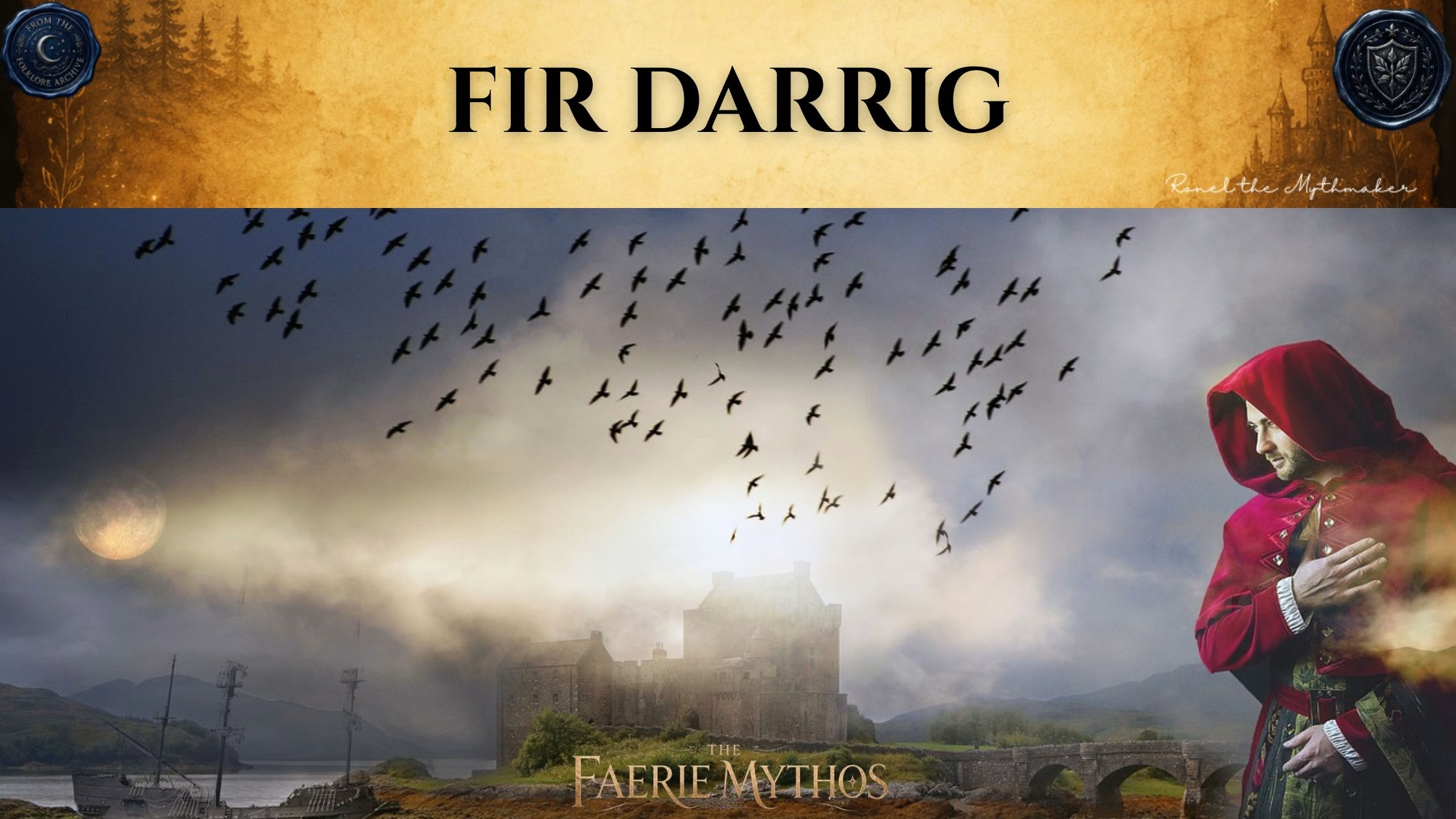
Fir Darrig: The Trickster in Red
I is for Incorrigible

I’m weaving folklore and book reviews into a single offering, shaped to reach a wider audience drawn to both. In years past, interest has surfaced in fragments of each; now, I’m gathering those threads into April alone, so the rest of the year remains quiet and deliberate.
If you came only for today’s book review, you may follow the link here.
I used this faery as one of Mab’s minions in “Queen of Nightmares” as this faery is associated with nightmares. But there’s more to him than just that.

Folklore
Fairy and Folk Tales of the Irish Peasantry by W. B. Yeats [1888]
Sometimes the fairies fancy mortals, and carry them away into their own country, leaving instead some sickly fairy child, or a log of wood so bewitched that it seems to be a mortal pining away, and dying, and being buried. …if such fairies there be they must be among the solitary spirits—Pookas, Fir Darrigs, and the like.
The Far Darrig (fear dearg), which means the Red Man, for he wears a red cap and coat, busies himself with practical joking, especially with gruesome joking. This he does, and nothing else.
FAR DARRIG IN DONEGAL.
Pat Diver, the tinker, was a man well-accustomed to a wandering life, and to strange shelters; he had shared the beggar’s blanket in smoky cabins; he had crouched beside the still in many a nook and corner where poteen was made on the wild Innishowen mountains; he had even slept on the bare heather, or on the ditch, with no roof over him but the vault of heaven; yet were all his nights of adventure tame and commonplace when compared with one especial night.
During the day preceding that night, he had mended all the kettles and saucepans in Moville and Greencastle, and was on his way to Culdaff, when night overtook him on a lonely mountain road.
He knocked at one door after another asking for a night’s lodging, while he jingled the halfpence in his pocket, but was everywhere refused.
Where was the boasted hospitality of Innishowen, which he had never before known to fail? It was of no use to be able to pay when the people seemed so churlish. Thus thinking, he made his way towards a light a little further on, and knocked at another cabin door.
An old man and woman were seated one at each side of the fire.
“Will you be pleased to give me a night’s lodging, sir?” asked Pat respectfully.
“Can you tell a story?” returned the old man.
“No, then, sir, I canna say I’m good at story-telling,” replied the puzzled tinker.
“Then you maun just gang further, for none but them that can tell a story will get in here.”
This reply was made in so decided a tone that Pat did not attempt to repeat his appeal, but turned away reluctantly to resume his weary journey.
“A story, indeed,” muttered he. “Auld wives fables to please the weans!”
As he took up his bundle of tinkering implements, he observed a barn standing rather behind the dwelling-house, and, aided by the rising moon, he made his way towards it.
It was a clean, roomy barn, with a piled-up heap of straw in one corner. Here was a shelter not to be despised; so Pat crept under the straw, and was soon asleep.
He could not have slept very long when he was awakened by the tramp of feet, and, peeping cautiously through a crevice in his straw covering, he saw four immensely tall men enter the barn, dragging a body, which they threw roughly upon the floor.
They next lighted a fire in the middle of the barn, and fastened the corpse by the feet with a great rope to a beam in the roof. One of them then began to turn it slowly before the fire. “Come on,” said he, addressing a gigantic fellow, the tallest of the four—”I’m tired; you be to tak’ your turn.”
“Faix an’ troth, I’ll no turn him,” replied the big man. “There’s Pat Diver in under the straw, why wouldn’t he tak’ his turn?”
With hideous clamour the four men called the wretched Pat, who, seeing there was no escape, thought it was his wisest plan to come forth as he was bidden.
“Now, Pat,” said they, “you’ll turn the corpse, but if you let him burn you’ll be tied up there and roasted in his place.”
Pat’s hair stood on end, and the cold perspiration poured from his forehead, but there was nothing for it but to perform his dreadful task.
Seeing him fairly embarked in it, the tall men went away.
Soon, however, the flames rose so high as to singe the rope, and the corpse fell with a great thud upon the fire, scattering the ashes and embers, and extracting a howl of anguish from the miserable cook, who rushed to the door, and ran for his life.
He ran on until he was ready to drop with fatigue, when, seeing a drain overgrown with tall, rank grass, he thought he would creep in there and lie hidden till morning.
But he was not many minutes in the drain before he heard the heavy tramping again, and the four men came up with their burthen, which they laid down on the edge of the drain.
“I’m tired,” said one, to the giant; “it’s your turn to carry him a piece now.”
“Faix and troth, I’ll no carry him,” replied he, “but there’s Pat Diver in the drain, why wouldn’t he come out and tak’ his turn?”
“Come out, Pat, come out,” roared all the men, and Pat, almost dead with fright, crept out.
He staggered on under the weight of the corpse until he reached Kiltown Abbey, a ruin festooned with ivy, where the brown owl hooted all night long, and the forgotten dead slept around the walls under dense, matted tangles of brambles and ben-weed.
No one ever buried there now, but Pat’s tall companions turned into the wild graveyard, and began digging a grave.
Pat, seeing them thus engaged, thought he might once more try to escape, and climbed up into a hawthorn tree in the fence, hoping to be hidden in the boughs.
“I’m tired,” said the man who was digging the grave; “here, take the spade,” addressing the big man, “it’s your turn.”
“Faix an’ troth, it’s no my turn,” replied he, as before. “There’s Pat Diver in the tree, why wouldn’t he come down and tak’ his turn?”
Pat came down to take the spade, but just then the cocks in the little farmyards and cabins round the abbey began to crow, and the men looked at one another.
“We must go,” said they, “and well is it for you, Pat Diver, that the cocks crowed, for if they had not, you’d just ha’ been bundled into that grave with the corpse.”
Two months passed, and Pat had wandered far and wide over the county Donegal, when he chanced to arrive at Raphoe during a fair.
Among the crowd that filled the Diamond he came suddenly on the big man.
“How are you, Pat Diver?” said he, bending down to look into the tinker’s face.
“You’ve the advantage of me, sir, for I havna’ the pleasure of knowing you,” faltered Pat.
“Do you not know me, Pat?” Whisper—”When you go back to Innishowen, you’ll have a story to tell!”
[A gruesome practical joke, indeed!]

The Encyclopedia of Celtic Mythology and Folklore by Patricia Monaghan
Far Darrig (Fear Darrig; pl., Fir Darrig)
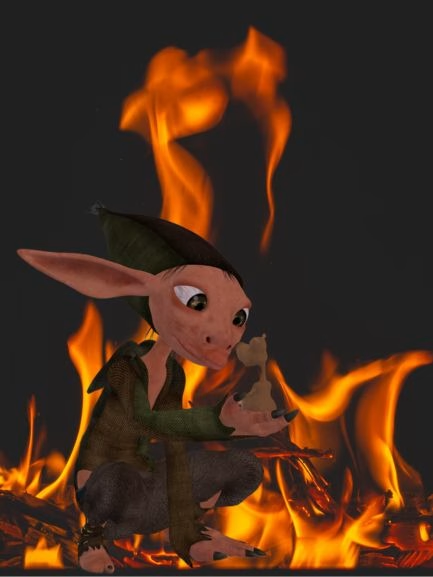
Irish folkloric figure. Red is the color of fairyland, and thus the Far Darrig (“red man”) is one of the mysterious beings who inhabited that world. Dressing characteristically in red, he was a mischievous and rather ugly, short, and annoying Irish fairy who believed his practical jokes were entertaining, when in fact they were appalling and cruel. It was unlucky at any time to refuse a request from the Far Darrig, who could be quite imaginative in his punishments. The Far Darrig sat by the fire, smoking a pipe and thinking; he would eat a repast left by a friendly family but did not like to be spied upon. His presence in a house brought good fortune.
*More can be read in the book.
Element Encyclopedia of Fairies by Lucy Cooper
Fir Darrig
A solitary fairy of Irish tradition. The name means Red Man, as he is said to wear a red cap and coat. Given to practical joking of a more than merely mischievous nature, such as substituting human babies with changelings, he is of a “sluttish, slouching, jeering” appearance, according to W.B. Yeats’ Fairy and Folk Tales of the Irish Peasantry (1888).
*More can be read in the book.

Encyclopedia of Fairies in World Folklore and Mythology by Theresa Bane
Far Darric
Far Darric was a fairy practical joker from Irish folklore; he presides over evil dreams and nightmares.
Fir Darrig
Variations: Fear Durgs, Fir Dhearga, Rat Boys
A species of Formorian, the fir darrig (“red man”) are malevolent and malicious practical jokers. Possibly originating in Scotland, these Irish fairies are described as looking rather ratlike, having dark hair and skin, fat-bodied, long snouts, and skinny tails. The clothing they wear is extremely shabby and worn, looking as if it were pulled from a sewer. They are carrion eaters, preferring fish. Typically these fairies can be found along polluted coastlines, at coastal ruins, in damps raths, or in marches near the sea. When they can, they deeply enjoy the warmth of a fireplace.
Some lore claims the fir darrig were once humans, unfortunate individuals who had wandered into fairyland and are now trying to warn others not to do the same. Unfortunately, their way of thinking has changed and in attempting to warn they end up using deadly tricks in an attempt to convey their message.
Rath
Variations: Burghs, Fairy Knowe, Fairy Hill, Fairy Mound
In Ireland a rath is the traditional home of a fairy; it is described as looking like a mound of earth or one of the countries many prehistoric earthen mounds. The inside is called the Brugh. Although Irish fay are typically one a few inches tall, inside the mounds, the space was vast; sometimes they are seen departing the rath mounted upon their tiny horses.
Red Man
Variations: Far Darrig, Fear Dearg, Fir Darrig
Akin to the leprechaun, the short and stocky, yellow-faced read man (“far darrig”) of Irish folklore is named for his choice of attire. From his red top hat to the toe-tips of his red wool stockings this fairy take tremendous delight in causing mischief and playing gruesome practical jokes, as mortal terror amuses it. Usually the red man plans his tricks so well in advance its prey is caught before they realize they are in of fairy protection.
With the ability to move about invisibly the red man, a master of mimicry and ventriloquism will terrorize men by making scary and strange sounds. Its favourite trick of this sort is to make the sound of a dead man laughing emit from a grave. It can also make the sound of angels singing, bird calls, and waves crashing against the rocks.
*You can read more in the book.

Further Reading:
- Far Darrig: The Mysterious Trickster of Irish Folklore
- An Fear Dearg – the red man
- Far Darrig
- Far Darrig
- The Fearful Far Darrig
- Far darrig
- The Leprechaun’s Evil Twin | The Far Darrig (Fear Dearg)

Folklore in a Nutshell by Ronel
[piece]

Fir Darrig in Modern Culture
I could only find this YouTube video, which is quite a scary story. (If you know a story featuring this faery, tell me in the comments!)
Fir Darrig in My Writing
Origin of the Fae: Fir Darrig
[origin of fae]
Wings (Faery Tales #14)

If this tale has lingered with you, I would be glad to hear it.
Where did you first encounter this creature – through story, superstition, memory, or something half-remembered?
If you know other versions of its myth, feel free to leave them in the record below. Folklore survives by being spoken again.
Further fragments and interpretations of this creature can be found in my Pinterest grimoire.
If you wish to support the time and craft behind these folklore posts – researching old tales, gathering fragments, and shaping them into something worth reading – you may do so by buying me a coffee. It can be a single offering, or something you return to whenever the spirit moves you.

One Comment
Comments are closed.