Y is for Yule
I’m weaving folklore and book reviews into a single offering, shaped to reach a wider audience drawn to both. In years past, interest has surfaced in fragments of each; now, I’m gathering those threads into April alone, so the rest of the year remains quiet and deliberate.
If you came only for today’s book review, you may follow the link here.

As I’m also promoting my Faery Tales series this month, I had to choose folklore creatures that feature in the books for the A-Z, which is why the creature and letter are a bit twisted to fit together. LOL.

Yule is celebrated around the time of the Winter Solstice (December 21–22 in the Northern Hemisphere; June 20–21 in the Southern Hemisphere), though usually everyone sticks with December.

Folklore
Scandinavian Folk-Lore: Illustrations of the Traditional Beliefs of the Northern Peoples by William A. Craigie [1896]
Odin the Hunter
A woman in Svendstrup [Svenstrup?] was up one morning before daybreak to brew the Christmas ale, and had let the two doors of the brew-house stand open. These were right opposite each other, and by and by three hounds came running in and began to lap the ale out of a vessel. She guessed they were Un’s hounds, and was afraid, but thought it best to make friends with them, so she went up and patted them, saying, “Poor things.”
They then ran away again, but it was not for nothing that she had been so friendly with them, for when she went outside after daybreak she found a gold horse-shoe lying outside one of the doors.

The Krampus and the Old, Dark Christmas: Roots and Rebirth of the Folkloric Devil by Al Ridenour
Gaude is sometimes said to be the wife of Odin, the commonly cited leader of the Wütende Heer (“furious” or “raging” army), a ghostly nocturnal horde traversing skies especially around Christmas. Sometimes she rides alongside Odin, or at other times, she is said herself to lead the host of phantoms. Some folklorists even see in her name a regional corruption of the name “Wodan” (Odin/Wotan), and regard her as little more than a female aspect of the Norse god. In this sense, she is also often identified with the better-known consorts to the god, Freya or Frigg.
The motif of the Furious Army strongly overlaps with myths of the Wild Hunt (Wilde Jagd). The latter, as previously mentioned, can be led by Holda and differs primarily in the absences of slain soldiers among the specters. The seasonal apparition of Perchta’s company of wandering souls, usually portrayed as unbaptized infants or other lost souls, is also often compared with these, though unlike the raging spirit of the Wild Hunt or Furious Army, Perchta’s train is usually imagined as quiet and somber, closer to the Canon Episcopi’s description of witches who, “traverse great spaces of earth in the silence of the dead of night … to be subject to her laws as of a Lady, and on fixed nights be called to her service.” Such supernatural flights on the Christmas Ember Nights too are part of this family of folkloric phenomena.
All these species of ghostly perambulations through winter skies, just like the seasonal burning of effigies to drive off maleficent influence, should again remind us how the Christmas season was formerly a time of menacing supernatural activity.

Encyclopedia of Fairies in World Folklore and Mythology by Theresa Bane
The 13th Century Poetic Edda is a complication of stories and poems from Scandinavian history, some as early 985AD. In this work and from Snorri Sturluson’s Prose Edda we learn about Odin riding an eight-legged horse named Sleipnir, that can leap great distances. At Yule, Odin leads a great hunting party through the sky in celebration
In some traditions of Odin’s Yule time ride, children could place their boots near the chimney filled with treats for Sleipnir and Odin would reward them for their kindness with food, candy or gifts.
The Yule Riders – when the inhabitants of Hel return to earth.
Yule, or Jól (pronounciation: “yoh-l”) was the name of the time between the Winter Solstice and the Jólablót – “Yule Sacrifice” – which originally may have happened on the 12th of January.
The dangerous powers that dominated mid-winter must have been fearsome things to people who in so many ways were dependent on their natural environment. There are some elements from later Norwegian folklore which may represent aspects of heathen survivals. One of these is the Oskoreia, or rather the “Ásgardr-riders”, the immortal souls of dead ancestors who ride through the nights of winter. The Oskoreia gathering is also known as the Jólareia, Jólaskreia, and Imberkulludn. I have not been able to translate the latter one yet, but the two before just mean the “Yule Riders”. The Yule Riders, consisting of various creatures of the Underworld and the souls of the dead made a fearsome gathering as they rode the dark lands of winter, and dangerous to those who crossed their paths, especially to those of impure intentions.
Some may recognize this image as somewhat similar to other continental folkloristic themes such as “The Wild Hunt” and similar.
*More can be read in the book.

Further Reading:

Folklore in a Nutshell by Ronel
This season of feasting, drinking, and sacrifice was observed across Northern Europe to appease the dark powers of winter and to welcome the returning light of the new sun. In the far northern regions, as the Winter Solstice approached, daylight dwindled to only a few fleeting hours, with the sun barely rising before sinking once more. On the longest night, a dim stretch of twilight lingered briefly before the world was swallowed again by darkness. Many ancient cultures understood this as a time when Otherworldly forces were at their most active. It was the season of the Yule Riders, when the King and Queen of the Underworld were said to ride across the night sky with a host of spirits and spectral beings. Yule logs were burned, and other protective rites were performed. Offerings and sacrifices were left out in the hope that these wandering powers would pass by without troubling the household—and perhaps even grant prosperity in return.
Yule was also believed to bring visits from supernatural beings. Across Northern Europe, folklore frequently tells of encounters with berserkers, trolls, and the undead draugar, all said to wander more freely during this liminal time of year.
As mentioned earlier, Yule is deeply rooted in the supernatural. The Wild Hunt—also known as Odensjakt (“Odin’s Hunt”)—was believed to thunder through the forests. In folklore, it is also called the Oskoreia, a spectral procession of Yule Riders made up of Underworld beings and restless spirits of the dead. These forces were said to roam the earth during the Winter Solstice, the coldest and darkest point of the year, often coinciding with Christmastime. Because this was the longest night, many believed the boundary between the living and the dead grew thin. To cross paths with the Yule Riders was seen as a deeply ominous sign.

Yule Riders in Modern Culture
[sources]
Yule Riders in My Writing
Origin of the Fae: Yule Riders
They know exactly what is in the hearts of mortals.
When Krampus goes on an eating spree (naughty children), they will go out to find him.
Antifreeze (Faery Tales #)

If this tale has lingered with you, I would be glad to hear it.
Where did you first encounter this creature – through story, superstition, memory, or something half-remembered?
If you know other versions of its myth, feel free to leave them in the record below. Folklore survives by being spoken again.
Further fragments and interpretations of this creature can be found in my Pinterest grimoire.
If you wish to support the time and craft behind these folklore posts – researching old tales, gathering fragments, and shaping them into something worth reading – you may do so by buying me a coffee. It can be a single offering, or something you return to whenever the spirit moves you.
Thanks for the information. I find your posts really interesting, and as I’ve said before, I love the images.
Thank you for explaining the difference between the Furious Army and the Dark Hunt.
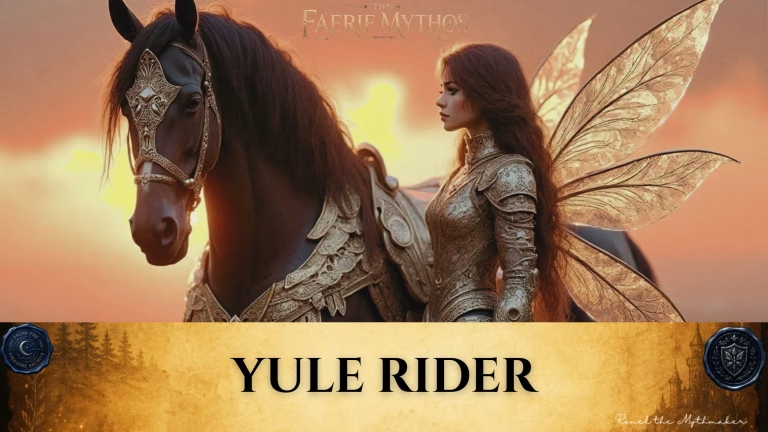
I like the “golden woman” Yule Rider image.
Excellent post.