Mountains in Folklore | The Faeries and Folklore Podcast
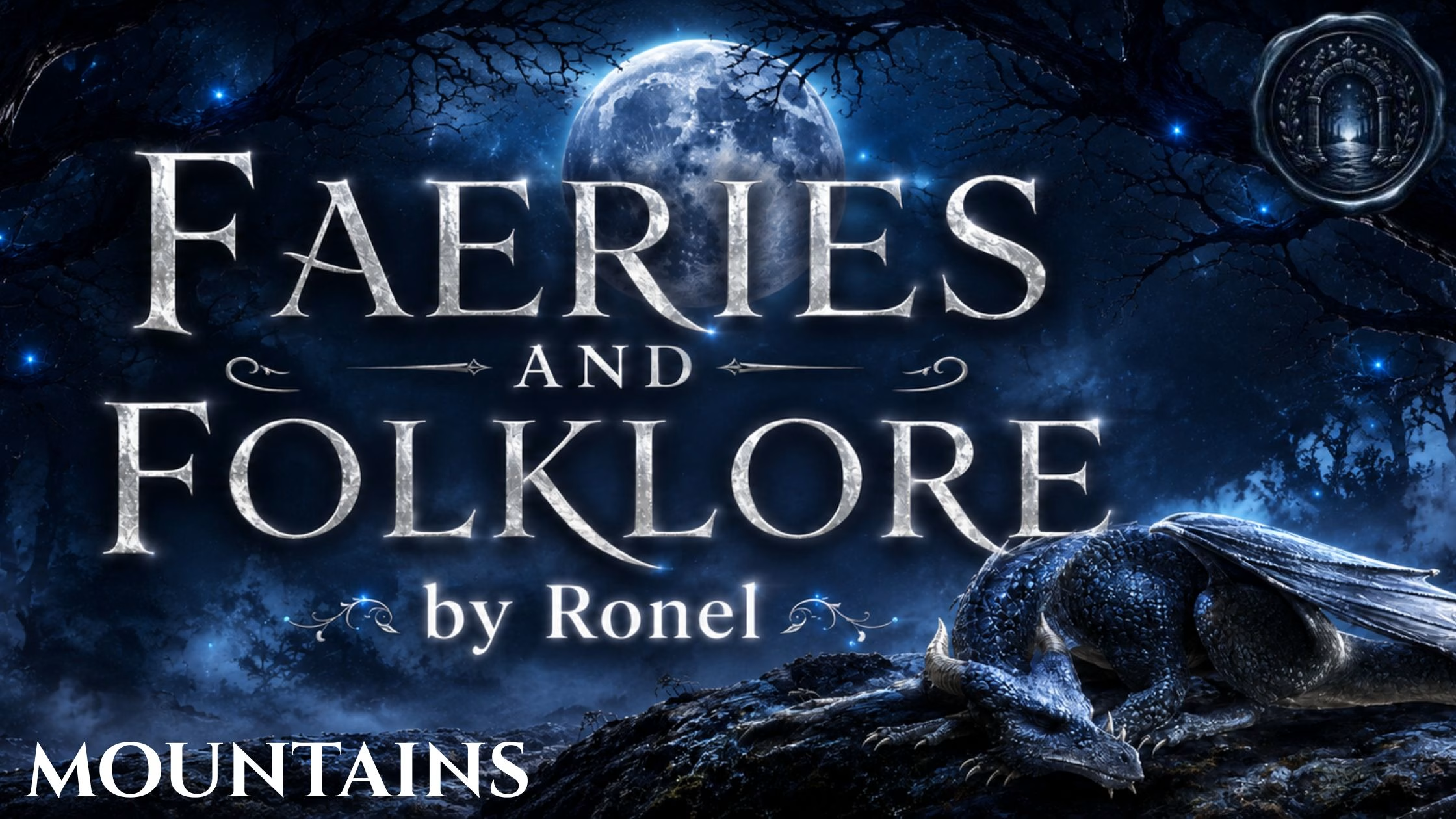
Episode 14: The Fae Realm: Mountains
The folklore of mountains in a nutshell, how I reimagined it for my writing, and mountain translated into Afrikaans.
Written and narrated by Ronel Janse van Vuuren.
Copyright 2021 Ronel Janse van Vuuren — All rights reserved.
Learn more about mountains here.
Get the transcript here.
Music: Secrets by David Fesliyan (FesliyanStudios.com) and Dramatic Heartbeat by FesliyanStudios.com
Transcript
You’re listening to the Faeries and Folklore podcast by Ronel.
I’m dark fantasy author Ronel Janse van Vuuren. With nearly a decade of digging around in dusty folklore books, researching creatures of imagination that ignited my curiosity, I’m here to share the folklore in a nutshell and how I reimagined it for my writing in an origin of the fae.
This is the Faeries and Folklore podcast.
Hi, I’m your host Ronel Janse van Vuuren. You can just call me Ronel. In today’s episode, we’re continuing our exploration of the fae realm.
This episode is brought to you by my book Once… Tales, Myths and Legends of Faerie available in eBook, paperback and audiobook. Go to ronelthemythmaker.com/my-books for more.
We’re continuing our exploration of the fae realm.
Today’s subject: Mountains
Folklore in a Nutshell by Ronel
All over the world, mountains are believed to be magical. They are eternal, silent witnesses to history.
The Judaculla Rock teems with Native American carvings. One specific glyph is believed to be the seven-fingered handprint of the giant Judaculla, left there when he jumped from his perch high on the mountain. It is said that this rock serves as a boundary between this world and the spirit world.
A Cherokee legend has it that the Connestee people invited them to visit near a waterfall, behind which a cave led to another world. The Connestee invited their guests to come and live with them there. Only one man refused. As he left, there was no longer a cave but a solid rock wall.
In the Pacific Northwest, many Native American tribes believe that powerful spirits (ones you really don’t want to mess with) lived on top of mountains. Some have malevolent powers, some are capricious and vindictive, and others are almost human-like in their romantic entanglements with other mountains.
Mountains have been sacred in many religions and legends. Some, like Mount Olympus, is the home of the Greek gods. Mount Etna is believed to be the home of Vulcan, the Roman god of fire and the forge.
For the ancient Inca, mountains and death were intricately linked. The Inca could sense the reservoir of spirituality in the mountains and believed that some parts of the mountains acted as portals to the gods so they built their villages there. Once a year, they would make a ritual child sacrifice to their gods at the top of the mountain.
Because sacred mountains are viewed as the source of hallowed powers and the homes of spirits, access to these mountains are often restricted. This restriction can come in the form of climbing being banned or a specific society giving the mountain a wide berth. These mountains are also often protected by laws to keep them conserved.
In South Africa, we have Table Mountain which draws the most attention from folklore. The mountain has a fabulous cloud that just appears whenever it feels like. The “tablecloth” has so many origin stories: one myth says it resulted from the San Mantis god smothering a blaze on the slopes of the mountain with a giant white karos (animal pelt), another tells the story of a smoking contest between the Devil and the pirate Van Hunks. As for the mountain itself, a Xhosa tale tells of the dragon of the seas battling against four giants and the giants ultimately becoming the mountain to keep the land safe from the sea. Mountain ghosts also live on Table Mountain. Aintjie Somers, a slave who worked herself to death and came back as a gnome-like spirit to avenge her hard life, is the most well-known of these ghosts. To instil good behaviour in children, the old saying is still said in the Cape today: “Be good or Aintjie Somers will get you”. The mountain has also been likened to a hostile and vindictive giant who causes turmoil on the sea, stopping anyone who tries to pass – the giant, of course, was defeated and became a motionless mountain allowing explorers like Vasco da Gama to round the tip of Africa and get to India.
Whether you believe that mountains are the homes of deities, the entrance to the spirit realm or sentient in themselves, one thing is for certain: they are magical.
And now for my interpretation of the fae in an origin of the fae: Mountains
Mountains are the eternal landmarks of the realms. Various pathways exist within them to connect the realms. Mountains are also the homes of various fae and it is connected to the life-force of the realms and those who reside in them.
Various fae are manifestations of the mountains. They are bound to them. Oreads (mountain nymphs) are one example. Their job is to keep their mountains safe (from excavation, modernisation, pollution, etc.). These fae have the power to cause avalanches, storms and other natural phenomena.
As a little bonus, let’s look at the translation of mountain into Afrikaans: Berg.
I hope that you’ve enjoyed this episode of the faeries and folklore podcast and that you’ve learned something new about faerie.
Remember that you can get a transcript of this episode in the description. If you’re new to the podcast, why not go and grab your free copy of Unseen, the second book in the Faery Tales series, on my website ronelthemythmaker.com? Loads of folklore, magic and danger await! Take care!
Available at
Audible | Podbean | Amazon Music | Spotify | Youtube | iHeart Radio | Player FM | Listen Notes | Apple Podcasts | TuneIn
Enjoying the podcast?
If you’ve enjoyed this episode, you can support the time and care that goes into researching, writing, recording, and producing the Faeries & Folklore Podcast by buying me a coffee.
Your support is always appreciated, whether it’s a one-time thank you or an occasional coffee whenever you feel like it. Every contribution helps me continue sharing the folklore, myths, and legends that inspire the Faerie Mythos.
You can now own the backlist seasons as audiobooks. All proceeds go to hosting the podcast. Exclusively available from Ronel’s store.

One Comment
Comments are closed.