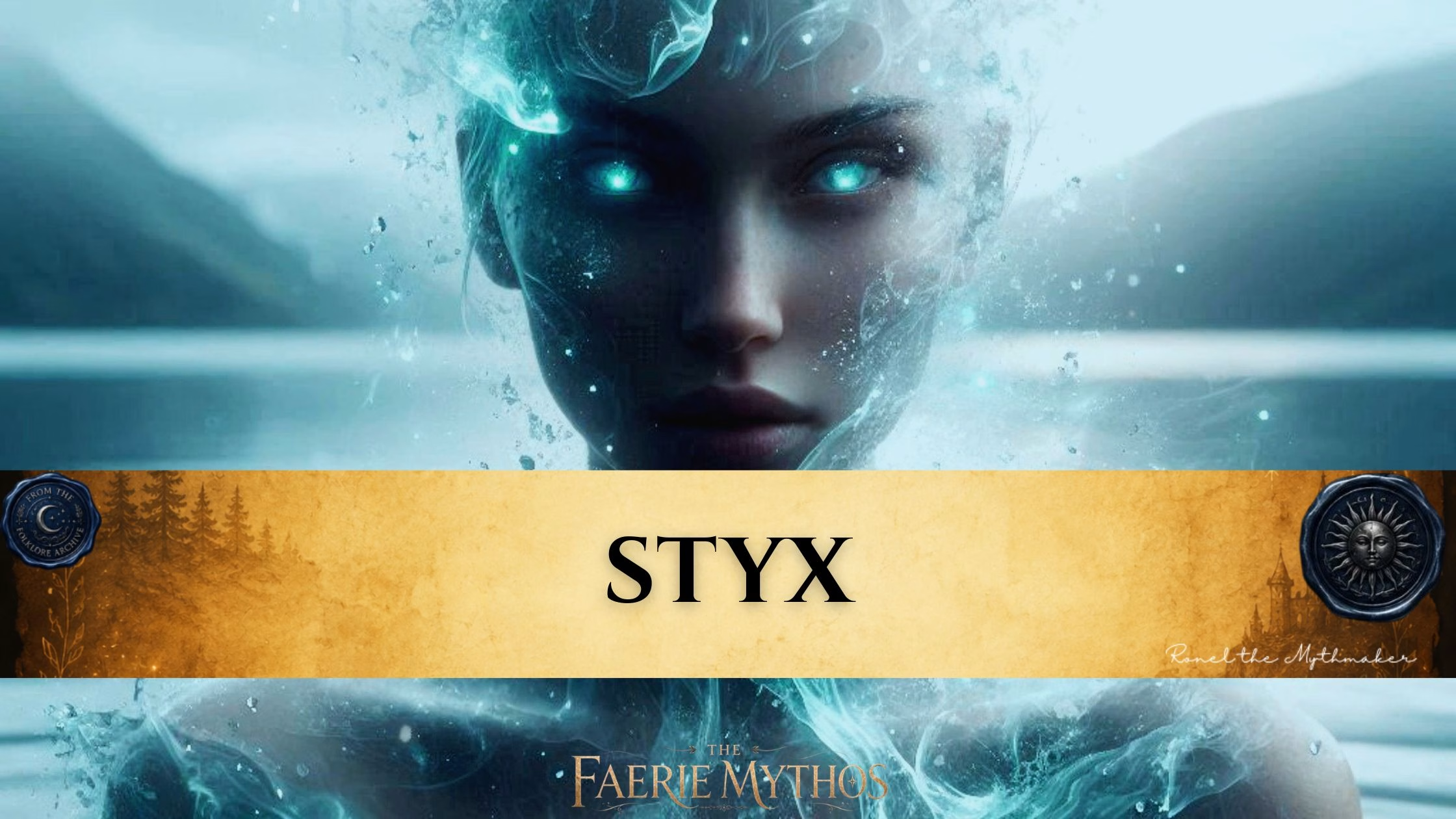
S is for Styx

I’m weaving folklore and book reviews into a single offering, shaped to reach a wider audience drawn to both. In years past, interest has surfaced in fragments of each; now, I’m gathering those threads into April alone, so the rest of the year remains quiet and deliberate.
If you came only for today’s book review, you may follow the link here.
The river on which gods make oaths… And the goddess who enforces it!
Folklore
Dictionary of Greek and Roman Biography and Mythology by William Smith [1844]
STYX (Stux), connected with the verb stugeô, to hate or abhor, is the name of the principal river in the nether world, around which it flows seven times. (Hom. Il. ii. 755, viii. 369. xiv. 271; Virg. Georg. iv. 480, Aen. vi. 439.) Styx is described as a daughter of Oceanus and Tethys (Hes. Theog. 361 ; Apollod. i. 2. § 2; Callim. Hymn. in Jov. 36), and as a nymph she dwelt at the entrance of Hades, in a lofty grotto which was supported by silver columns. (Hes. Theog. 778.) As a river Styx is described as a branch of Oceanus, flowing from its tenth source (789), and the river Cocytus again is a branch of the Styx. (Hom. Od. x. 511.) By Pallas Styx became the mother of Zelus (zeal), Nice (victory), Bia (strength), and Cratos (power). She was the first of all the immortals that took her children to Zeus, to assist him against the Titans; and, in return for this, her children were allowed for ever to live with Zeus, and Styx herself became the divinity by whom the most solemn oaths were sworn. (Hes. Theog. 383 ; Hom. Od. v. 185, xv. 37; Apollod. i. 2. § 5; Apollon. Rhod. ii. 191; Virg. Aen. vi. 324, xii. 816; Ov. Met. iii. 290; Sil. Ital. xiii. 568.) When one of the gods was to take an oath by Styx, Iris fetched a cup full of water from the Styx, and the god, while taking the oath, poured out the water. (Hes. Theog 775.) Zeus became by her the father of Persephone (Apollod. i. 3. § 1), and Peiras the father of Echidna. (Paus. viii. 18. § 1.)

Brewer’s Dictionary of Phrase and Fable [1870]
Stygian
Infernal; pertaining to Styx, the fabled river of hell.
Styx
The river of Hate, called by Milton “abhorred Styx, the flood of burning hate” (Paradise Lost). It was said to flow nine times round the infernal regions.
Styx, the dread oath of gods.

Mythology: A Captivating Guide to Greek Mythology, Egyptian Mythology, Norse Mythology, Celtic Mythology and Roman Mythology
And after such treatment was complete, she took him down to the River Styx, in the underworld realm of Hades—one of Zeus’s older brothers. There, she held her son by his heel and dipped him into the magical Styx waters. Every part of young Achilles touched by those waters was made immune to death.
Thetis, of course, missed a spot. After this, whenever anyone had a deadly weakness it was frequently called their “Achilles heel.”
*More can be read in the book.

Further Reading:
- Styx
- STYX
- Styx
- Styx: The Goddess of Oaths, the River of the Underworld
- Styx: The Titan Goddess of Sacred Oaths & The River Styx
- STYX: the First GOD to Betray the TITANS and Join ZEUS
- The Final Journey: Crossing the Styx
- Styx
Folklore in a Nutshell by Ronel
In Greek Mythology, Styx is one of the rivers of the Underworld. As shown by Statius, the river was somewhat accessible to the living as Thetis dipped her young son Achilles in the Styx so he would be invulnerable except for his heel where she’d held him. In the Odyssey and Iliad, swearing on the river Styx is a binding oath that even the gods held irrevocable. Homer calls the Styx the “dread river of oath”.
According to Hesiod, the Styx is a goddess and the daughter of Oceanus – and the one who kept those who made oaths made on her waters accountable. She could be seen as the enforcer of oaths.
She sided with Zeus and the gods against the Titans and that’s why even Zeus honours the oaths sworn by the water of Styx. She’s the mother of Zelus (“Glory”), Nike (“Victory”), Kratos (“Strength”), and Bia (“Violence”) with the Titan Pallas. Her father, Oceanus, counselled her to take Zeus’ side in the war with the Titans for the sake of her children. So she did. And was the first ally of the young god.
According to ancient Greek sources, the Styx is an offshoot of the river Acheron which is the barrier between the Underworld and the living. But ancient Roman sources believed the Styx to be the river souls had to cross to enter the Underworld.
Sometimes seen as a nymph instead of a goddess because of her parentage, she is described as dwelling in a grotto at the entrance to Hades which is supported by silver columns.
She’s a strong, feared goddess and a wise mother. Cross her and her wailing, toxic waters at your own risk.

Styx in Modern Culture
Hercules: The Legendary Journeys TV series
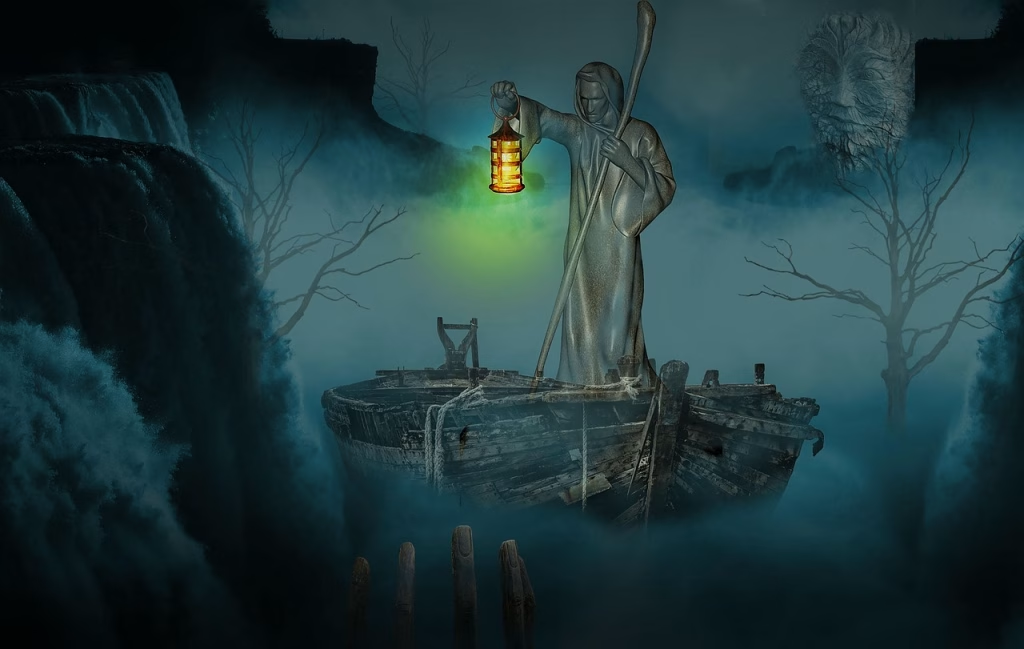
This stagnant waterway runs in a tunnel. That tunnel is an interplanar gateway between an air-filled cave at the bottom of the Alconian Lake in the Known World and Underworld. The souls of the dead of the Greco-Roman culture line up here to await their turn. Charon’s skiff is the only way to traverse the gateway. You can jump in and swim (although the water is icy cold and filled with all kind of supernatural germs), but without the skiff, there’s no way for you to pass over to Tartarus, no matter how far you swim.
For all its foulness, Styx is in fact composed of holy water, thus forming an effective barrier for holding the underworld spirits back.
Read more about the River Styx here.
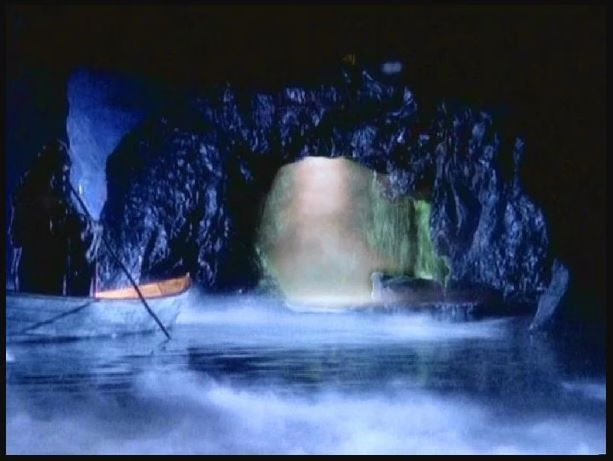
Disney’s Hercules (Movie and TV series)
River Styx: Also known as the Pit of Death, this river carries the dead to the Underworld, where they spend the rest of eternity floating in its waters. The River Styx can be deadly to mortals and causes them to swiftly age and kill them if they spend too long in it. In the episode “Hercules and the River Styx” of the animated series, it is revealed that the river is also a Goddess that only reveals herself to those who wield Poseidon‘s Trident. It is also revealed that the river marks the border of Hades’ domain. Technically, Styx is in fact a nymph and will live for as long as her river flows.
Learn more about Styx here.

Percy Jackson books by Rick Riordan
According to Percy, the river is very polluted, being filled with pretty much anything you could imagine: broken toys, ripped up diplomas, etc. – the scrapheap of human miseries. The river is filled with lost hopes and dreams, as well as wishes that never came true. The river was claimed to be created by the Titan, Tethys, and was fed by salty springs from the bottom of the ocean.
The River Styx is also where Stygian Iron is cooled to make it indestructible, as well as where Stygian ice is formed. Heroes who bathe in it become invulnerable (only Achilles, Luke Castellan, and Percy Jackson have successfully done this, though). Styx was also a goddess – similar to the rivers Phlegethon, Acheron, and Lethe being associated with deities – and a daughter of Oceanus and Tethys. She was the wife of Pallas and bore him Zeus’ four winged enforcers: Kratos, Nike, Zelus, and Bia (and sometimes Eros). Styx supported Zeus in the Titanomachy, being the first to aid Zeus in the First Titan War against Kronos and his Titan Army. For this, her name was honored by being used in binding oaths.
Learn more about Styx here.

When Apollo encountered her in his dream, Styx had ebony hair that was wafting in the cold current. Her face appeared delicate and sublime. Her obsidian eyes gleamed with absolute hatred.
Styx’s purple and black dress billowed around her like volcanic smoke. Her lipstick, eye shadow, and mascara were all expertly done in shades of midnight. In another one of Apollo’s dreams, Styx was wearing black silky robes.
Learn more about Styx here.
Styx in My Writing
Origin of the Fae: Styx
Styx is the eldest daughter of Oceanus, who advised her to take Zeus’ deal to keep her powers – and to keep her children safe.
But being the first to do so is not the reason Zeus respects oaths made on her river: she’s a powerful goddess who can hold the pain of death, keep those who rebel against death (either by not having the correct death rites performed at the time of their death or by trying to escape the Underworld), take away immortality of anyone foolish enough to walk into her river (being made invulnerable is reserved for mortals), and poison anything she wants. Her children aren’t called “Glory”, “Victory”, “Strength” and “Violence” for nothing.
She lives in a beautiful grotto supported by silver columns, filled with beautiful greenery and sweet, cool air. She prefers to be on her own, not being part of the intense politics of Olympus.
My Book
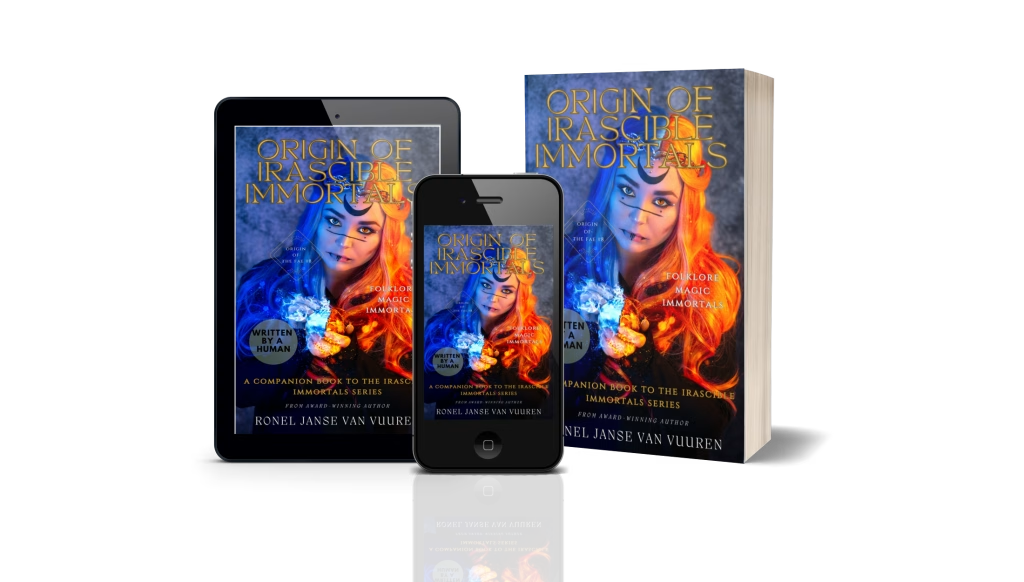
Origin of Irascible Immortals (Origin of the Fae #8)
If this tale has lingered with you, I would be glad to hear it.
Where did you first encounter this creature – through story, superstition, memory, or something half-remembered?
If you know other versions of its myth, feel free to leave them in the record below. Folklore survives by being spoken again.
Further fragments and interpretations of this creature can be found in my Pinterest grimoire.
If you wish to support the time and craft behind these folklore posts – researching old tales, gathering fragments, and shaping them into something worth reading – you may do so by buying me a coffee. It can be a single offering, or something you return to whenever the spirit moves you.



I never thought of Styx being a goddess. Interesting.
https://nydamprintsblackandwhite.blogspot.com/2026/04/s-is-for-shabti.html
It makes sense if you think that the gods always swear by this river that an actual goddess would enact punishment if the vow is broken.