P is for Poseidon

I’m weaving folklore and book reviews into a single offering, shaped to reach a wider audience drawn to both. In years past, interest has surfaced in fragments of each; now, I’m gathering those threads into April alone, so the rest of the year remains quiet and deliberate.
If you came only for today’s book review, you may follow the link here.
I first heard about Poseidon in an animated TV series that explained Greek myths. I can’t find it online, but it was great to watch as a kid in the 90s.

Folklore
The Dictionary of Greek and Roman Biography and Mythology [1844] by William Smith
POSEIDON (Poseidôn), the god of the Mediterranean sea. His name seems to be connected with potos, pontos and potamos, according to which he is the god of the fluid element. (Müller, Proleg. p. 290.)
He was a son of Cronos and Rhea (whence he is called Kronios and by Latin poets Saturnius, Pind. Ol. vi. 48; Virg. Aen. v. 799.) He was accordingly a brother of Zeus, Hades, Hera, Hestia and Demeter, and it was determined by lot that he should rule over the sea. (Hom. Il. xiv. 156, xv. 187, &c.; Hes. Theog, 456.) Like his brothers and sisters, he was, after his birth, swallowed by his father Cronos, but thrown up again. (Apollod. i. 1. § 5, 2. § 1.)
In the earliest poems, Poseidon is described as indeed equal to Zeus in dignity, but weaker. (Hom. Il. viii. 210, xv. 165, 186, 209; comp. xiii. 355, Od. xiii. 148.) Hence we find him angry when Zeus, by haughty words, attempts to intimidate him; nay, he even threatens his mightier brother, and once he conspired with Hera and Athena to put him into chains (Hom. Il. xv. 176, &c., 212, &c.; comp. i. 400.); but, on the other hand, we also find him yielding and submissive to Zeus (viii. 440).
The palace of Poseidon was in the depth of the sea near Aegae in Euboea (xiii. 21; Od. v. 381), where he kept his horses with brazen hoofs and golden manes. With these horses he rides in a chariot over the waves of the sea, which become smooth as he approaches, and the monsters of the deep recognise him and play around his chariot. (Il. xiii. 27, comp. Virg. Aen. v. 817, &c., i. 147; Apollon. Rhod. iii. 1240, &c.) Generally he himself put his horses to his chariot, but sometimes he was assisted by Amphitrite. (Apollon. Rhod. i. 1158, iv. 1325; Eurip. Androm. 1011; Virg. Aen. v. 817.) But although he generally dwelt in the sea, still he also appears in Olympus in the assembly of the gods. (Hom. II. viii. 440, xiii. 44, 352, xv. 161, 190, xx. 13.)
Being the ruler of the sea (the Mediterranean), he is described as gathering clouds and calling forth storms, but at the same he has it in his power to grant a successful voyage and save those who are in danger, and all other marine divinities are subject to him. As the sea surrounds and holds the earth, he himself is described as the god who holds the earth (gaiêochos), and who has it in his power to shake the earth (enosichthôn, kinêtêr gas).
He was further regarded as the creator of the horse, and was accordingly believed to have taught men the art of managing horses by the bridle, and to have been the originator and protector of horse races. (Hom. Il. xxiii. 307, 584; Pind. Pyth. vi.50 ; Soph. Oed. Col. 712, &c.)
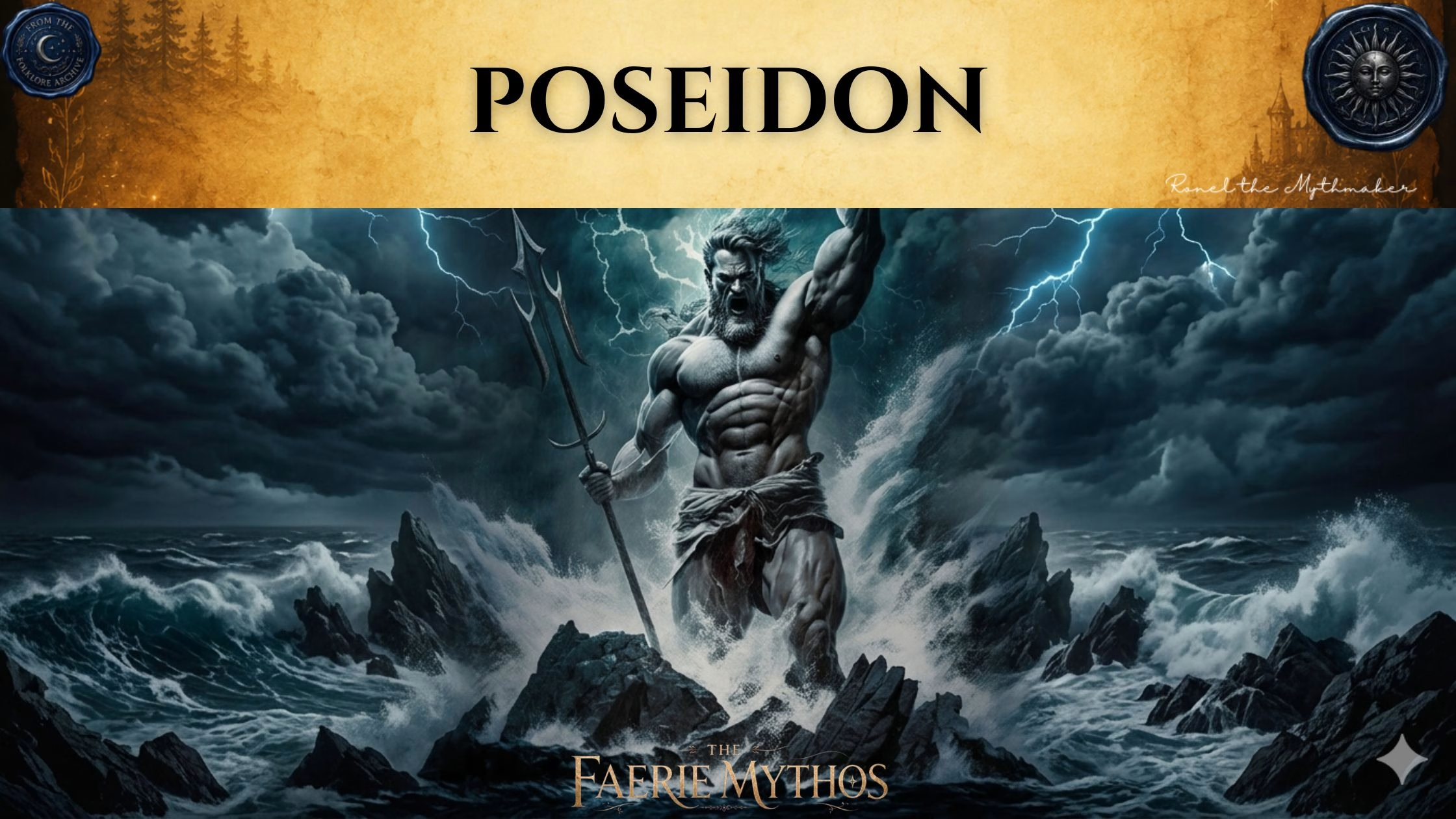
The symbol of Poseidon’s power was the trident, or a spear with three points, with which he used to shatter rocks, to call forth or subdue storms, to shake the earth, and the like.
Poseidon was married to Amphitrite, by whom he had three children, Triton, Rhode, and Benthesicyme (Hes. Theog. 930; Apollod. i. 4. § 6, iii. 15. § 4); but he had besides a vast number of children by other divinities and mortal women.
In works of art, Poseidon may be easily recognised by his attributes, the dolphin, the horse, or the trident (Paus. x. 36. § 4), and he was frequently represented in groups along with Amphitrite, Tritons, Nereids, dolphins, the Dioscuri, Palaemon, Pegasus, Bellerophontes, Thalassa, Ino, and Galene. (Paus. ii. 1. § 7.)

Greek Mythology: A Captivating Guide to the Ancient Gods, Goddesses, Heroes and Monsters by Matt Clayton
Poseidon was given reign over the oceans and seas. It seems a strange combination, but Poseidon is also known for horses and earthquakes.
Poseidon couldn’t seem to help himself. He found the nearest shelter, dragged Medusa inside and made love to her. Athena was not pleased to find her uncle getting nasty in one of his own temples. She couldn’t very well chastise him. After all, he was close family. But Medusa? Athena cursed the female by turning her beautiful hair into snakes. Thereafter, anyone who looked upon her would immediately turn to stone because of their own deathly fright… But note that one of the offspring of Poseidon and Medusa was a flying horse.
*More can be read in the book.

The Greek Myths by Robert Graves
When Zeus, Poseidon, and Hades, after deposing their father Cronus, shook lots in a helmet for the lordship of the sky, sea, and murky underworld, leaving the earth common to all, Zeus won the sky, Hades the underworld, and Poseidon the sea. Poseidon, who is equal to his brother Zeus in dignity, though not in power, and of a surly, quarrelsome nature, at once set about building his under-water palace off Aegae in Euboea. In its spacious stables he keeps white chariot horses with brazen hooves and golden manes, and a golden chariot at the approach of which storms instantly cease and sea-monsters rise, frisking, around it.
Needing a wife who would be at home in the sea-depths, he courted Thetis the Nereid; but when it was prophesied by Themis that any son born to Thetis would be greater than his father, he desisted, and allowed her to marry a mortal named Peleus. Amphitrite, another Nereid, whom he next approached, viewed his advances with repugnance, and fled to the Atlas Mountains to escape him… Amphitrite bore Poseidon three children: Triton, Rhode, and Benthesicyme; but he caused her almost as much jealousy as Zeus did Hera by his love affairs with goddesses, nymphs, and mortals.
Poseidon is greedy of earthly kingdoms, and once claimed possession of Attica by thrusting his trident into the acropolis at Athens, where a well of sea-water immediately gushed out and is still to be seen; when the South Wind blows you may hear the sound of the surf far below. Later, during the reign of Cecrops, Athene came and took possession in a gentler manner, by planting the first olive-tree beside the well. Poseidon, in a fury, challenged her to single combat, and Athene would have accepted had not Zeus interposed and ordered them to submit the dispute to arbitration. Presently, then, they appeared before a divine court, consisting of their supernal fellow-deities, who called on Cecrops to give evidence. Zeus himself expressed no opinion, but while all the other gods supported Poseidon, all the goddesses supported Athene. Thus, by a majority of one, the court ruled that Athene had the better right to the land, because she had given it the better gift.
He boasts of having created the horse, though some say that, when he was newly born, Rhea gave one to Cronus to eat; and of having invented the bridle, though Athene had done so before him; but his claim to have instituted horse-racing is not disputed. Certainly, horses are sacred to him.
*More can be read in the book.

The Witch Book: The Encyclopedia of Witchraft, Wicca, and Neo-paganism by Raymond Buckland
The trident is the alchemical sign for water, from its association with Poseidon, Greek god of the sea and creator of waters. Son of Kronos and Rhea, and brother of Zeus, Poseidon split the earth with his trident, earning himself the title “Earth Shaker,” according to Homer.
Poseidon, the Greek god of the sea, was said to have created the horse-whipping up the wave tops, the thunder of the surf sounding like the thunder of hooves.
*More can be read in the book.

Further Reading:
- Poseidon
- Poseidon
- Poseidon
- Poseidon in Greek Mythology: Myths, Powers, and Family Tree
- Poseidon
- Poseidon :: Greek God of the Sea
- 10 Myths About the Greek God Poseidon
- Poseidon – God of the Seas and Rivers

Folklore in a Nutshell by Ronel
In Greek mythology, Poseidon is the brother of Zeus and Hades. They had divided the universe among themselves: Zeus got the sky, Poseidon the sea, and Hades the underworld. Poseidon is known as the god of the sea, earthquakes and horses. His weapon of choice, and main symbol, is the trident which was fashioned by the Cyclopes.
The Romans equated him with Neptune.
Horses are sacred to him. In some tales, one was offered to his father Cronos in his place and he was thrown into the sea to protect him. In other tales, he had created horses. He is the father of Arion, the immortal horse, and Pegasus, the winged horse.
His wife is the nymph Amphitrite. They had several children together, including Triton, the half man half fish messenger of the ocean. He was as faithful to her as Zeus was to Hera… which means, not at all. He also took what he wanted with force, as in the case of Medusa who refused his advances, and even Demeter who turned herself into a horse to flee from him. Medusa is the mother of Pegasus and Demeter the mother of Arion.
Poseidon’s trident is the symbol of his power over the sea, storms, earthquakes and the creation and destruction within his domain.
Poseidon always wanted to stretch his domain further than the oceans. So he became the god of springs as well. He tried to conquer Athens by thrusting his trident into the earth and a salt water spring erupted. But Athena planted an olive tree and the people chose her as their patron goddess. In another version, he gave them the first horse, but they still chose Athena. He helped build the walls of the city of Troy, but when the king backpedalled on their arrangement, Poseidon sent a sea monster to ravage the land.
Violent and ill-tempered, Poseidon isn’t someone to mess with. Just ask Minos who didn’t sacrifice the bull he should’ve and the consequences Poseidon created: Pasiphae’s curse that resulted in the Minotaur.

Poseidon in Modern Culture
SMITE video game
Deep beneath the turbulent tides of the ocean lingers a God of idle rage. What must it be like to live forever in the shadow of your brother? To be denied again and again that which you desire, despite the power of the wrathful seas at your command? So Poseidon broods on his throne at the ocean floor.As a child, Poseidon and his brother, Hades, were consumed by their father, Cronus. Powerless to escape, it was left to mighty Zeus to free them and slay their patron. Together, they defeated the last of the Titans and ushered in a new age of dominance for Olympian Gods, but their freedom, their very lives, Zeus would never let either brother forget were owed to him. Even as the heavens, the underworld, and the seas were divided among them, Zeus positioned himself as king of all, and what was Poseidon to do but be thankful he had been spared a fate in his father’s belly? So he retired to his new realm and began the pursuit of gathering worshipers.Soon rose a great ocean front city of mankind, and Poseidon presented himself as their God, but another had already come, Athena, Zeus’ daughter. A competition was held – each God would offer a gift and the people would select their sponsor. Confident, Poseidon drove his Trident, a trophy from the battle against the Titans, into the ground and a limitless spring emerged, but the people found the water salty and undrinkable. Athena extended her hand and a graceful olive tree rose from the earth. Wood, food, and oil, all from one gift. The people decided and the city was called Athens.It may be that Poseidon never desired greatness as Zeus did. Had his father never consumed him, had he never been made God of the Sea, had his brother never crowned himself King of the Gods, Poseidon might have lived contentedly, but that chance is gone. Now, with the very tides at his command, an army of sea beasts at his back, and the formidable Kraken at his call, the glowering God of the deep seeks to quench his thirsty rage and plunge all the world in endless, wrathful seas.
Learn more.

Percy Jackson novels by Rick Riordan
Poseidon is the Greek god of the sea, storms, earthquakes, droughts, floods and horses. He is the son of the Titans Kronos and Rhea, as well as one of the Big Three. His Roman counterpart is Neptune. He is also the patron god of Corinth and his cabin in Camp Half-Blood.
Over the centuries the Olympians moved west to the countries that held the seats of their great power and influence. During World War II, Zeus’ and Poseidon’s demigod children fought together against Hades’ own demigod children.
After Percy survives the attack during his first game of Capture the Flag at camp, Poseidon claims him as his own son. This causes discord among the gods of Olympus as it is proof that Poseidon had not honored the sacred oath on River Styx that was made between the Big Three after World War II.
Learn more here.

Marvel comic books
Poseidon is a member of the Olympians, a group of humanoid beings that hail from the pocket dimension of Olympus. He was worshiped by the humans of Ancient Greece and the Roman Empire. He is the god of horses,[11] and the sea,[11][1] of Oceans,[3] Storm and Earthquakes,[citation needed] Patron god of Atlantis[1] He was worshiped by the Atlanteans as Father Neptune.[2]
However, Poseidon often fought his relatives over patronage of lands, and eventually claimed Atlantis, where he married the goddess Cleito and fathered the first ten Atlantean kings.
After many centuries, mortal worship of the Olympians faded. Zeus and the other Olympians gradually withdrew from Earth except for Poseidon, who was still honored by the Atlanteans and actively watched over Atlantis and its people, unlike many Olympians who had few or no worshippers left on Earth.[29
Learn more here.

Poseidon in My Writing
Origin of the Fae: Poseidon
Poseidon has the power to shape-shift. He has the power to cleanse the waters of the earth when needed. He has retreated to his home in the sunken city of Atlantis, not bothering with the mortal realm for a very long time. His sons Triton and Pegasus have tried to reason with him, telling him that he was needed, but he refused their pleas. Because of his mismanagement of his domains, pollution has gotten out of hand.
His wife, Amphitrite, has been making his life a living hell because of his past sins – especially the assaults on vulnerable young women. He believes that he deserves whatever she meets out. Amphitrite is worried that he has given up on life and doesn’t know of any other way to reach him.
Triton runs the day-to-day operations of Poseidon’s realm, hoping that his father will take an interest again.
Despite ruling the seas, he’s a lot like his brother who wants to rule everything…
See this immortal in action in my writing:
Symphony of Destruction (Irascible Immortals #6)

As a salmon, Poseidon made quick work of swimming through the ocean currents into a river leading inland. The water close to land was disgusting – much more than he could remember it ever being. And the river wasn’t much better: the fresh water tasted even worse than the rivers Alpheus and Peneus had after Hercules had convinced the nymphs to help him clean the Augean stables.
Symphony of Destruction, Irascible Immortals #6, Ronel Janse van Vuuren
If this tale has lingered with you, I would be glad to hear it.
Where did you first encounter this creature – through story, superstition, memory, or something half-remembered?
If you know other versions of its myth, feel free to leave them in the record below. Folklore survives by being spoken again.
Further fragments and interpretations of this creature can be found in my Pinterest grimoire.
If you wish to support the time and craft behind these folklore posts – researching old tales, gathering fragments, and shaping them into something worth reading – you may do so by buying me a coffee. It can be a single offering, or something you return to whenever the spirit moves you.



Love the moniker, Poseidon the petulant. Once again, this is a god I best identify form the Percy Jackson series, although he is credited with more nasty deeds than good ones. Love the song too. One of my favorites.
Yeah, it was a bit disconcerting to see that he is as bad as Zeus. I’m glad you’re enjoying the posts 🙂
Love them.
This is an amazing post about posidon. I don’t think I knew so much.
Thanks! I’m glad you learned something new, I like to go on a deep delve for each post.
Very important figure in Greek mythology. Although, most of those gods just seemed like not nice people. Wouldn’t want to run into them, that’s for sure.
I know, right? Thanks for visiting.