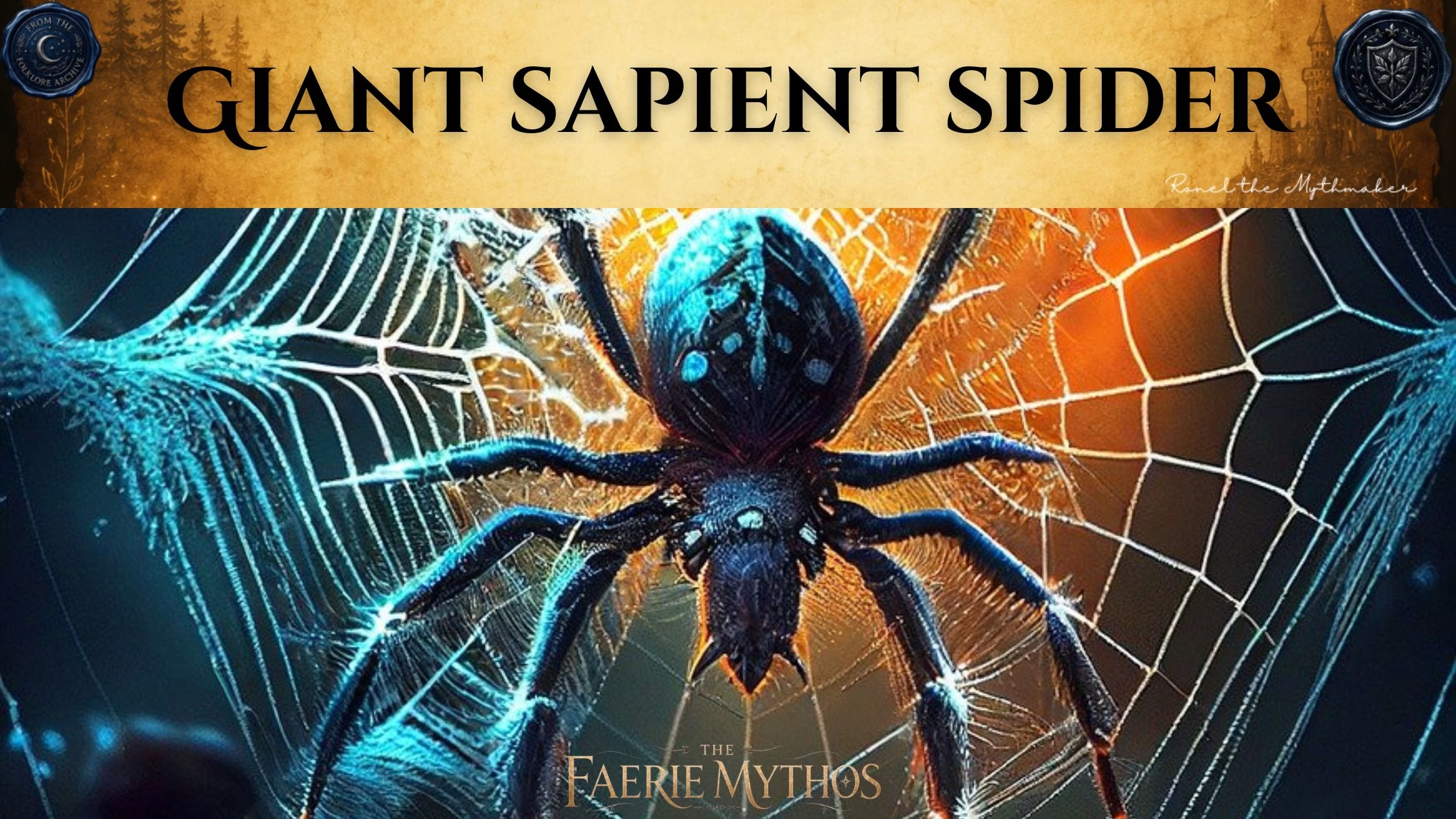
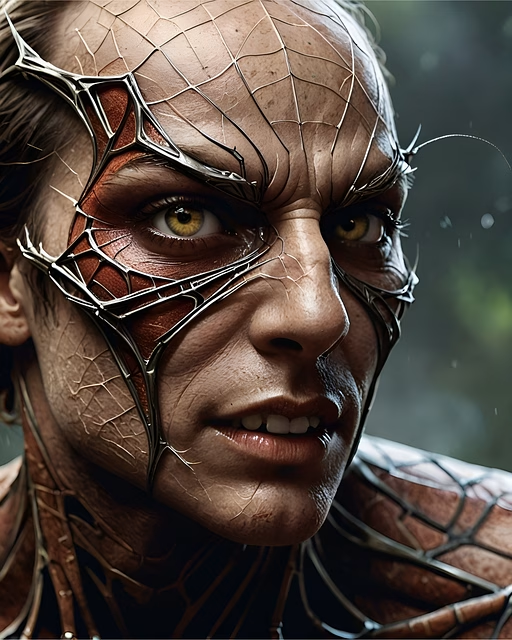
Giant Sapient Spider
H is for Halitosis

I’m weaving folklore and book reviews into a single offering, shaped to reach a wider audience drawn to both. In years past, interest has surfaced in fragments of each; now, I’m gathering those threads into April alone, so the rest of the year remains quiet and deliberate.
If you came only for today’s book review, you may follow the link here.
I thought it would be fun to point out that scary, giant spiders have bad breath… Because how else will they terrify people? LOL.

I’m not looking just at giant spiders, but those with sapient intelligence (meaning they are almost like humans in how they think and act). Surprisingly, there are quite a few.
Folklore
The Divine Comedy of Dante Alighieri [1321]
Purgatorio: Canto XII
O mad Arachne! so I thee beheld
E’en then half spider, sad upon the shreds
Of fabric wrought in evil hour for thee!

The Element Encyclopedia of Magical Creatures by John and Caitlín Matthews
CACUS
In Greek myth, Cacus was the half human, half spider, three-headed, fire-breathing son of Volcanus, daughter of Medusa. He lived on the Aventine plain in the land of the Etruscans where corpses were burned. Casus’ name means ‘wicked’.
DJIEIEN
A vast and hideous spider monster from the traditions of the Native American Seneca people. Generally, it was indestructible, keeping its heart buried under its lodge, much like the giants of later fairy tales whose hearts were often hidden in a separate place. The story is told of the hero Oth-eigwendha, who encountered the Djieien and, in his struggle with it, ripped a branch from a nearby tree and struck at the monster in an attempt to kill it. His stroke missed the loathsome creature but went into the earth and pierced its heart, killing it instantly.
SPIDER
The spider is one of the great creating creatures, feared and respected the world over. As the weaving goddess of fate, she makes the web of all life, spinning the thread from her own abdomen, stretching through time and space.
The bite of the spider was said to cause outbreaks of tarantism, an epidemic of dancing that afflicts those who suffer from it with extraordinary, wild dancing, which goes on for hours. Tarantism is centred upon Southern Italy where it is part of the ancient mysteries that have become incorporated into Catholicism, especially the rites of the Virgin and certain local saints. Sacred ecstatic and purification dances from early times are still found in these regions. Those who fall into tarantism, which can manifest as a manic or catatonic state, are believed to have been bitten by a spider and need to be attended by musicians who create the correct rhythms and cadences to match the afflicted person. Music that accompanies the tarantella dance is a ceaselessly spinning melody accompanied by violins, tambourines and castanets. On hearing the music, the tarantata (the one afflicted) will immediately dance to the rhythm until the affliction is worked out. Afterwards, the tarantata is an initiate of the spiderknowledge, quite calm and self-possessed again. Those who have been bitten by a poisonous spider in any part of the world – and lived to speak of it – often report strange, web-like dreams and preternatural knowledge of things.
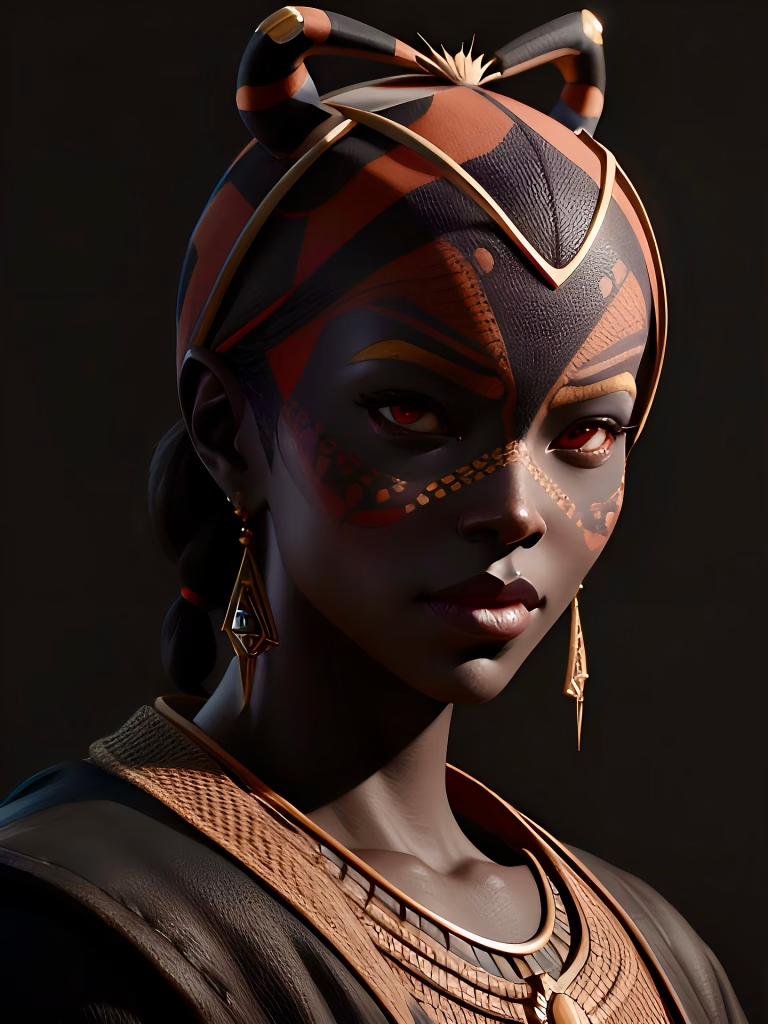
Spider Woman
In Japan, there is another Spider Woman, but she is less beneficent than the Hopi creator. Japanese Spider Woman lived in a mountain hideaway with her rundown human servants. When the hero Raiko was travelling at night, he saw a mysterious skull flying into a cave. Going to investigate it, he found himself caught in a huge sticky web. The weaver of the web seemed to be a human woman of great loveliness but it was really the evil Spider Woman. He struck out with his sword and the woman fled. Raiko’s servant Tsuna rescued his master and together they discovered the white Spider lying with a sword sticking out of her distended body. As the hero split her open, the skulls of her many human victims tumbled out, followed by her spider children. Raiko and Tsuna had their work cut out to kill each of these monstrous offspring.
TSUCHI-GUMO
A giant malignant spider from the folk traditions of old Japan, Tsuchi-Gumo is described as a creature so huge that it was believed impossible to kill. It hunted humans for sport as well as food and destroyed everything that crossed its path. In the end, it was killed by being trapped in its own cave. A huge mesh of steel wire was stretched across the cave-mouth, then the people built fires so that it was roasted to death.
*More can be read in the book.
Encyclopedia of Beasts and Monsters in Myth, Legend and Folklore by Theresa Bane
Djieien
In the folklore of the Seneca people of the northeastern United States of America, Djieien (“spider”) was a fierce spider as large as a man is tall; it attacked with reckless abandon because it could not suffer a fatal wound as it hid its heart in a secret place underground. The hero and warrior Othegwenhda, who was half human and half spirit, discovered the location of Djieien’s heart and destroyed it.
Earth Spider
Variations: Tsuchi’gumo (“earth hider”), Tsuchigumo
A monstrous green spider from ancient Japanese folklore, the earth spider was depicted as having a catlike head, pointed ears, and whiskers; it also had white blood. Living inside the mysterious Mount Katsuragi, the floor of its lair was covered with the skeletal remains of its victims. Once when the hero Yorimitsu cut off its head, 1,990 grew back in its place.
Spider Hengeyokai
In Japanese folklore spider hengeyokai are creatures described as having burning red eyes and sharp teeth; they have the ability to shape-shift into the form of beautiful women.
*More can be read in the book.

A Wizard’s Bestiary: A Menagerie of Myth, Magic and Mystery by Oberon Zell-Ravenheart
Cacus (Greek, “Wicked”)—This monster of Greco-Roman myth was the progeny of Hephaestos and the Gorgon Medusa. It had a huge, spherical body on long legs, similar to a gigantic misshapen spider. Three fire-breathing, venom-spewing, humanoid heads sprouted from its scrawny neck. It hid by day in a cave above the River Tiber in Etruria, Italy, emerging at night to ravage any living creatures it could find, dragging them back to its lair. Heracles encountered and killed it as he returned from his 10th Labor.
Tsuchi-Gumo—A monstrous invincible spider of Japanese legend. It preyed upon the populace until it was finally trapped in its cave with a steel net, and then roasted to death in a fire.
*More can be read in the book.

Further Reading:
- Tsuchigumo Sōshi
- Tsuchigumo
- Cultural depictions of spiders
- Arachnids in folklore and myths
- Aiapæc
- Anansi
- Arachne
- Areop-Enap
- Great Goddess of Teotihuacan
- Iktomi
- Jorōgumo
- Spider Grandmother
- The symbolic spider that wove its way through history
Folklore in a Nutshell by Ronel
[piece]

Giant Sapient Spider in Modern Culture
I only found two giant spiders that fit the bill. Smaller spiders that are sapient are Charlotte in the book (and movies) Charlotte’s Web and the Black Widow in the film Corpse Bride. Interestingly, the small spiders are friends to the main character while the giant spiders are antagonists and straight up villains.
Harry Potter
Aragog (c. 1942 – 20 April 1997) was an Acromantula owned by Rubeus Hagrid. Like the rest of his species, Aragog had a taste for human flesh and was able to communicate with humans vocally. In his youth, he was the size of a Pekingese and near the end of his life was about the size of a small elephant with an eighteen-foot leg span.
Learn more here.

Middle-Earth
Giant, sapient spiders, also known as the Children of Ungoliant, lived in particularly dark and perilous places in Middle-earth. Those who spoke were vicious and malevolent creatures, and their presence was typically considered to be a burden.
The hobbit Bilbo Baggins and his thirteen Dwarf companions encountered giant spiders in Mirkwood on their Quest to the Lonely Mountain. They managed to capture and entangle each of the Dwarves in their webs (except for Thorin Oakshield who was captured by Thranduil’s Elves after the Dwarves intruded on the third and final feast). Only Bilbo’s magic Ring and his Elven blade (Sting) allowed them to escape from being eaten.[3]
Frodo Baggins and Samwise Gamgee encountered the lone, giant spider Shelob in her lair, within caves in the Pass of Cirith Ungol, as they were trying to enter Mordor in their quest to destroy the One Ring. Frodo was ambushed by her twice, and paralyzed by her poison on the second encounter.[4] Sam used Sting to attack Shelob and wound her, which caused her to flee.
Learn more here.

There are two humanoid spiders I found.
Spider-Man
Friendly-neighborhood Spider-Man is an altruistic amazing super hero who lives up to using his spider-like powers with great responsibility. Peter Parker has gained through the bit of a radioactive spider as a high school student and started to swing across the city to fight crime and protect innocents after his selfishness indirectly resulted in the death of his beloved Uncle Ben.
Learn more here.

Grimm TV series
A Spinnetod (SPIN-nuh-tod; Ger. Spinne “spider” + Tod “death”) is a spider-like Wesen that first appeared in “Tarantella“.
They have been called the Black Widows of the Wesen world, and according to Monroe, there aren’t many Spinnetods around.
When they woge, chelicerae emerge from their mouth, their eyes grow black or bright blue, including the sclera and iris, and their hands become gray and wrinkled, as well as clawed.
Spinnetods exhibit autotomy; that is, they can “drop” a segment of a limb (such as a finger) and regenerate it within a matter of days. Much like when an actual spider loses a leg, the lost segment of a Spinnetod’s limb can still “twitch.”
They, or at least female Spinnetods, are also extremely agile and fast. They can climb vertically with ease. Females are strong, stronger than both male Spinnetods and humans, and also appear to be as strong as Grimms.
They can secrete spider venom from their chelicerae as well, identified by the amino acid latroinsectotoxin.
Females are known to kill their mates shortly after copulation. This is evidenced by only one record of Spinnetods in Marie Kessler’s library, an account passed along from a Japanese Grimm to another Grimm visiting Singapore.
They have an attraction to shiny objects, such as watches, and dislike water. It is not known why Spinnetods are attracted to shiny objects, and even Spinnetods themselves do not understand the attraction.
Learn more here.

I also remembered that I used to love this anime series.
Spider Riders
Unlike the normal-sized spiders of the outer world the spiders of the Inner World grow to at least three feet tall and at least five feet in length. These spiders posses an exo-skeleton of natural armor. But the battle spiders’ (as spiders of the Inner World are most often referred too) most unique ability is the power of speech. Battle Spiders can communicate with both Humans and Invectids with ease.
They are very fast and have endurance that allows them to run long and far. Offensively, they can fire organically-generated webs from natural orifices near the front and back of their bodies, these webs are highly versatile and can be used for many purposes. Such as swinging their bulk across chasms, spin bridges, and ensnare their enemies. Some Spiders can live over a hundred years as Battle Spider Venus was alive and part of a great battle that occurred years before the story began.
Learn more here.

Giant Sapient Spider in My Writing
Origin of the Fae: Giant Sentient Spider
[origin of fae]
Spider in Afrikaans: Spinnekop
Wings (Faery Tales #14)

If this tale has lingered with you, I would be glad to hear it.
Where did you first encounter this creature – through story, superstition, memory, or something half-remembered?
If you know other versions of its myth, feel free to leave them in the record below. Folklore survives by being spoken again.
Further fragments and interpretations of this creature can be found in my Pinterest grimoire.
If you wish to support the time and craft behind these folklore posts – researching old tales, gathering fragments, and shaping them into something worth reading – you may do so by buying me a coffee. It can be a single offering, or something you return to whenever the spirit moves you.


I hate spiders and bad breath in that order, but two in one? No thanks.
I know, right? I thought that the two combined would make for a true monster 🙂
Definitely!