Elves In All Their Forms
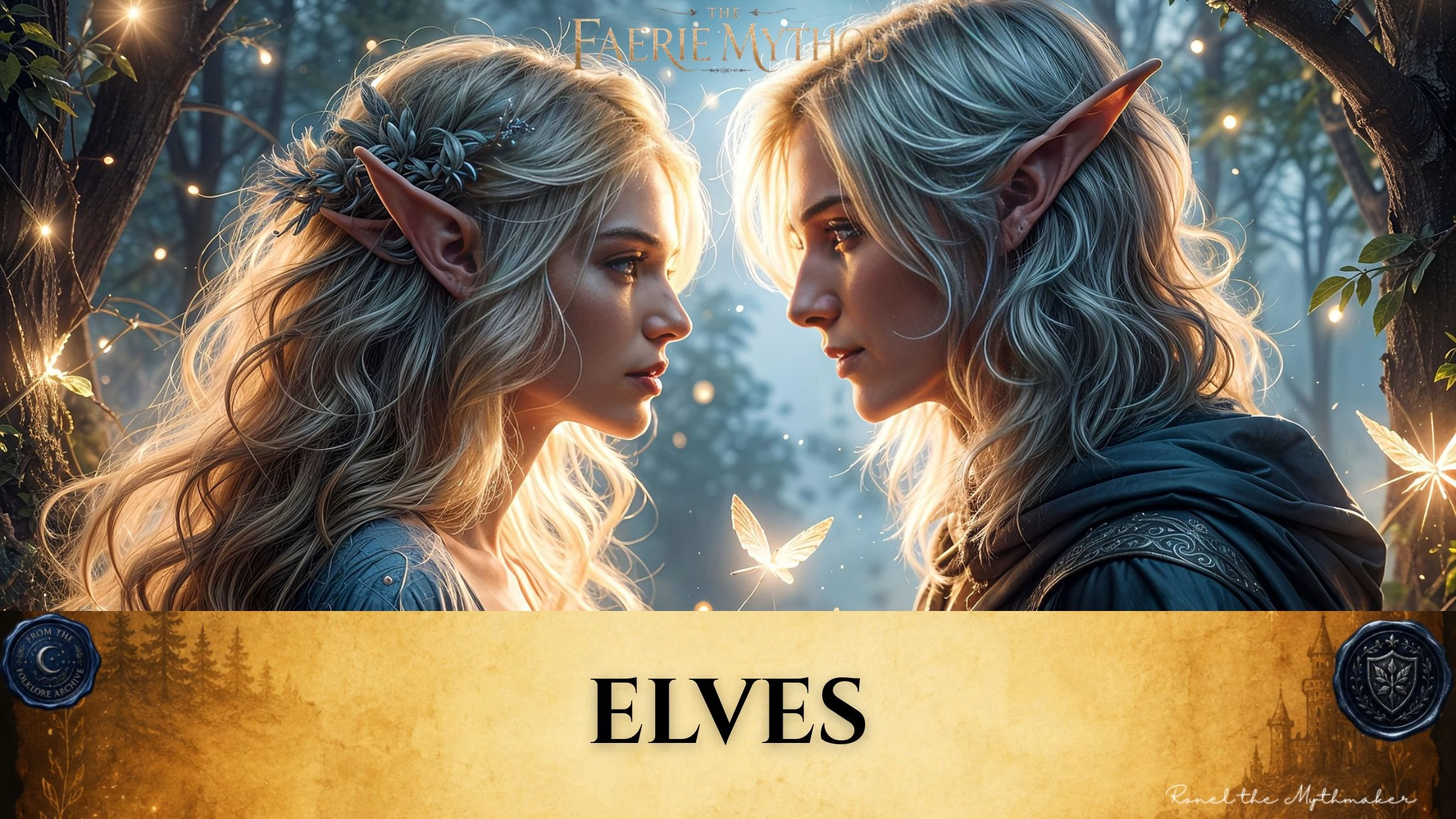
E is for Elf

I’m weaving folklore and book reviews into a single offering, shaped to reach a wider audience drawn to both. In years past, interest has surfaced in fragments of each; now, I’m gathering those threads into April alone, so the rest of the year remains quiet and deliberate.
If you came only for today’s book review, you may follow the link here.
Elves, mysterious and powerful, have been a popular subject of folklore and fiction for centuries.

Folklore
The Fairy Mythology by Thomas Keightley [1892]
ELVES.
Säg, kännar du Elfvornas glada slägt?
De bygga ved flodernas rand;
De spinna af månsken sin högtidsdrägt,
Med liljehvit spelande hand.
Stagnelius.
Say, knowest thou the Elves’ gay and joyous race?The banks of streams are their home;They spin of the moonshine their holiday-dress,With their lily-white hands frolicsome.
The Alfar still live in the memory and traditions of the peasantry of Scandinavia. They also, to a certain extent, retain their distinction into White and Black. The former, or the Good Elves, dwell in the air, dance on the grass, or sit in the leaves of trees; the latter, or Evil Elves, are regarded as an underground people, who frequently inflict sickness or injury on mankind; for which there is a particular kind of doctors called Kloka män,[128] to be met with in all parts of the country.
The Elves are believed to have their kings, and to celebrate their weddings and banquets, just the same as the dwellers above ground. There is an interesting intermediate class of them in popular tradition called the Hill-people (Högfolk), who are believed to dwell in caves and small hills: when they show themselves they have a handsome human form. The common people seem to connect with them a deep feeling of melancholy, as if bewailing a half-quenched hope of redemption.[129]
There are only a few old persons now who can tell any thing more about them than of the sweet singing that may occasionally on summer nights be heard out of their hills, when one stands still and listens, or, as it is expressed in the ballads, “lays his ear to the Elve-hill” (lägger sitt öra till Elfvehögg): but no one must be so cruel as, by the slightest word, to destroy their hopes of salvation, for then the spritely music will be turned into weeping and lamentation.[130]
The Norwegians call the Elves Huldrafolk, and their music Huldraslaat: it is in the minor key, and of a dull and mournful sound. The mountaineers sometimes play it, and pretend they have learned it by listening to the underground people among the hills and rocks. There is also a tune called the Elf-king’s tune, which several of the good fiddlers know right well, but never venture to play, for as soon as it begins both old and young, and even inanimate objects, are impelled to dance, and the player cannot stop unless he can play the air backwards, or that some one comes behind him and cuts the strings of his fiddle.[131]
The little underground Elves, who are believed to dwell[Pg 80] under the houses of mankind, are described as sportive and mischievous, and as imitating all the actions of men. They are said to love cleanliness about the house and place, and to reward such servants as are neat and cleanly.
There was one time, it is said, a servant girl, who was for her cleanly, tidy habits, greatly beloved by the Elves, particularly as she was careful to carry away all dirt and foul water to a distance from the house, and they once invited her to a wedding. Every thing was conducted in the greatest order, and they made her a present of some chips, which she took good-humouredly and put into her pocket. But when the bride-pair was coming there was a straw unluckily lying in the way, the bridegroom got cleverly over it, but the poor bride fell on her face. At the sight of this the girl could not restrain herself, but burst out a-laughing, and that instant the whole vanished from her sight. Next day, to her utter amazement, she found that what she had taken to be nothing but chips, were so many pieces of pure gold.[132]
A dairy-maid at a place called Skibshuset (the Ship-house), in Odense, was not so fortunate. A colony of Elves had taken up their abode under the floor of the cowhouse, or it is more likely, were there before it was made a cowhouse. However, the dirt and filth that the cattle made annoyed them beyond measure, and they gave the dairy-maid to understand that if she did not remove the cows, she would have reason to repent it. She gave little heed to their representations; and it was not very long till they set her up on top of the hay-rick, and killed all the cows. It is said that they were seen on the same night removing in a great hurry from the cowhouse down to the meadow, and that they went in little coaches; and their king was in the first coach, which was far more stately and magnificent than the rest. They have ever since lived in the meadow.[133]
The Elves are extremely fond of dancing in the meadows, where they form those circles of a livelier green which from them are called Elf-dance (Elfdans). When the country people see in the morning stripes along the dewy grass in the woods and meadows, they say the Elves have been dancing there. If any one should at midnight get within their circle, they become visible to him, and they may then illude him. It is not every one that can see the Elves; and one person may see them dancing while another perceives nothing. Sunday children, as they are called, i. e. those born on Sunday, are remarkable for possessing this property of seeing Elves and similar beings. The Elves, however, have the power to bestow this gift on whomsoever they please. People also used to speak of Elf-books which they gave to those whom they loved, and which enabled them to foretell future events.
The Elves often sit in little stones that are of a circular form, and are called Elf-mills (Elf-quärnor); the sound of their voice is said to be sweet and soft like the air.[134]
The Danish peasantry give the following account of their Ellefolk or Elve-people.
The Elle-people live in the Elle-moors. The appearance of the man is that of an old man with a low-crowned hat on his head; the Elle-woman is young and of a fair and attractive countenance, but behind she is hollow like a dough-trough. Young men should be especially on their guard against her, for it is very difficult to resist her; and she has, moreover, a stringed instrument, which, when she plays on it, quite ravishes their hearts. The man may be often seen near the Elle-moors, bathing himself in the sunbeams, but if any one comes too near him, he opens his mouth wide and breathes upon them, and his breath produces sickness and pestilence. But the women are most frequently to be seen by moonshine; then they dance their rounds in the high grass so lightly and so gracefully, that they seldom meet a denial when they offer their hand to a rash young man. It is also necessary to watch cattle, that they may not graze in any place where the Elle-people have been; for[Pg 82] if any animal come to a place where the Elle-people have spit, or done what is worse, it is attacked by some grievous disease which can only be cured by giving it to eat a handful of St. John’s wort, which had been pulled at twelve o’clock on St. John’s night. It might also happen that they might sustain some injury by mixing with the Elle-people’s cattle, which are very large, and of a blue colour, and which may sometimes be seen in the fields licking up the dew, on which they live. But the farmer has an easy remedy against this evil; for he has only to go to the Elle-hill when he is turning out his cattle and to say, “Thou little Troll! may I graze my cows on thy hill?” And if he is not prohibited, he may set his mind at rest.[135]

Element Encyclopedia of Fairies by Lucy Cooper
Elves
In Norse mythology, elves were divided into dark elves and light elves, in a similar way to the Scottish Unseelie and Seelie Court. Some people equate the dark elves with trolls.
According to Snorri Sturluson’s Gylfaginning (The Tricking of Gylfi) in the Prose Edda:
There is one place there that is called the Elf Home [Álfheimr, which is the elven city]. People live there that are named the light elves [Ljósálfar]. But the dark elves [Dökkálfar] live below the earth, in caves and the dark forest and they are unlike them in appearance – and more unlike them in reality. The Light Elves are brighter than the sun in appearance, but the Dark Elves are blacker than pitch.
The elves and the Norse Vanir spirits are closely affiliated. The Vanir god Freyr, spirit of vegetation, was said to have dominion over the elves and is sometimes referred to as the elven king.
*More can be read in the book.

The Forest in Folklore and Mythology by Alexander Porteous
In the Scandinavian countries groves and trees were appointed as the residence of the Elves after they had been worsted in a conflict with superior beings. In other countries groves were much frequented by fairies and other beings of popular superstition.
The Elves of Scandinavia, like the Fairies of England, were very fond of dancing in the moonlight in the meadows, and to them were attributed those circles of brilliant green so often seen on the grassy sward. The Elf man is said to have an aged appearance, and to wear a low-crowned hat; but the Elf maidens are young and attractive, though, like Huldra, they are hollow behind. They play on certain stringed instruments, and that so sweetly that young men had to be on their guard lest their hearts should be ravished. A species of Elves in Sweden were known as Grove Damsels, or Grove Folk. These lived in the groves and protected the trees.
*More can be read in the book.

Encyclopedia of Fairies in World Folklore and Mythology by Theresa Bane
Elf
The word elf is a generic word used worldwide to describe a wide array of fairy-folk… They answer to their own royalty having their own kings and queens and greatly enjoy celebrating and feasting banquets and weddings. Descriptions of these creatures, from their appearance to their dress, vary widely, as does their disposition and personalities.
Like British lore, elves are divided into two classes in Scandinavian, the Light Elves of the Seelie Court and the Dark Elves of the Unseelie Court. The voice of the elves in this part of the world is said to be soft and sweet, like the air.
…their fairyland is called Elfhame.
Ellyllon
In Wales, elves are called ellyllon; they are benevolent and described as being tiny, almost transparent beings… consume fairy butter, a fungus found in the roots of old trees and limestone crevices, and toadstools. Similar to the brownie, the ellyllon will help with household chores but leave forever if offended or if their privacy is intruded upon, however they are fonder of living in the wild and rocky northlands.
Alfa
In Scandinavian and Teutonic mythology the alfa (also known as elves) are divided up into two clans, the Liosalfar and the Svartalfar. Both species of elves are said to have been created from the maggots that ate the decomposing flesh of Ymir… Powerful beings, the alfas are seldom truly malicious toward mankind.
Clan Liosalfar (“light elves”) are light bringers; they are described as being tall, exceedingly beautiful, and having skin more white and pale than the sun. They live in Alfhime, a place between Earth and the Heavens.
Clan Svartalfar (“dark elves”) have very dark skin, and are described as being darker than a night sky without stars. Dwelling beneath the earth they are reputed as being magnificent smiths, creating magical armor and weapons.
*More can be read in the book.

Further Reading:
- Elf
- The Elves: One of the Most Fascinating Mythological Creatures
- elf
- Elves
- Elves & Dwarves in Norse Mythology
- Elves in Germanic Folklore

Folklore in a Nutshell by Ronel
For elves, their home is called Elfhame. They have their own royalty they answer to. Some are described as small and almost transparent, others as tall and exceedingly beautiful, and others darker than the night sky.
They even appear differently from one story to the next: from the elves in William Shakespeare’s A Midsummer Night’s Dream to the Brothers Grimm’s The Elves and the Shoemaker to the various elves in the work of Hans Christian Andersen (The Elf Mound, Thumbelina, etc.) and to the ever-popular JRR Tolkien’s elves in Middle-Earth. Though in the twenty-first century elves are thought to belong only in fantasy, in eras gone by they were believed to be real.
Elves, like fairies, were thought to be able to shape-shift into any size or form. Sometimes they were tiny, winged creatures obsessed with flowers. Other times they were described as little, bearded, old men. Mostly, though, elf maidens were seen as young and beautiful. Seriously, why not gorgeous young men who look a little like Ian Somerhalder or Bradley James? Anyhow, they lived like their human counterparts in kingdoms found in forests, meadows, mountains, hollowed-out tree trunks and other magical places.
Elves seem to have come from Norse mythology, though they were incorporated to folklore alongside fairies in Shakespeare’s time and by the time that steam engines were all the rage they were nothing more than cute magical creatures in fairy tales.
Whether tall and fierce or tiny and cute, elves have found their way into the stories of humans for time immemorial.

Elves in Modern Culture
In fantasy (movies, books and games) we are all familiar with the warrior-like elves who are far superior to humans in both intelligence and looks. They are usually marked by pointy ears, sharp senses, and a love of nature and also appreciation of art, music and beauty. They are often skilled archers. Elves are usually seen as threatening outsiders to the human cast in these stories. Elves are quite popular in modern fiction. Most of them look like the elves in The Lord of the Rings (see below), but a few are quite different.

In JK Rowling’s Harry Potter series house-elves are enslaved creatures who serve witches and wizards. They can obtain their freedom if their master presents them with clothes. And though they are looked down upon, they can perform magic that humans are incapable of – like transporting themselves into places protected by magic, such as Hogwarts. Dobby the house-elf shows this ability in Harry Potter and the Chamber of Secrets when he appears in the hospital wing after Harry’s accident.

In modern children’s folklore, Santa Claus typically has elves surrounding him who make all the toys. They have pointy ears, long noses, are tiny, and typically wear green with pointy hats. They, along with Santa, live in the North Pole. A few movies have turned this image of quaint magical creatures on its head.
In Arthur Christmas by Sony Pictures the elves are a lot like secret agents with one mission: get wrapped presents to all the children in the world on Christmas Eve.
In Rise of the Guardians by Dreamworks, Santa’s elves are weird little creatures who don’t really do anything at all.
Elves in My Writing
Origin of the Fae: Elves
Though they can look like the High Fae – tall, good-looking and irresistible to humans – their form in Faerie is that of pointy-eared, pale creatures, with ordinary looks and half the size they like to be in the mortal realm.
As with most Fae (that do not in any way resemble High Fae, but seen as creatures), they serve the High Fae. Usually they are bodyguards, but they have been relegated to the lowest ranks of servitude in many abodes. Just like other servants of the High Fae, they have magic that sometimes exceed that of those they serve.
In the Onyx Labyrinth only elves have power over the living stone that make their home. Everyone else, even High Fae, have to live by the Labyrinth’s whims.
Elves translated to Afrikaans: Elfies.
Antifreeze (Faery Tales #11)

If this tale has lingered with you, I would be glad to hear it.
Where did you first encounter this creature – through story, superstition, memory, or something half-remembered?
If you know other versions of its myth, feel free to leave them in the record below. Folklore survives by being spoken again.
Further fragments and interpretations of this creature can be found in my Pinterest grimoire.
If you wish to support the time and craft behind these folklore posts – researching old tales, gathering fragments, and shaping them into something worth reading – you may do so by buying me a coffee. It can be a single offering, or something you return to whenever the spirit moves you.



Loved the elves in Lord of the Rings.
Very informative. You put much time and effort into these posts. Thank you.
Sandra
I’m glad you enjoy them 🙂 Thanks for stopping by!