
M is for Maestro
I’m weaving folklore and book reviews into a single offering, shaped to reach a wider audience drawn to both. In years past, interest has surfaced in fragments of each; now, I’m gathering those threads into April alone, so the rest of the year remains quiet and deliberate.
If you came only for today’s book review, you may follow the link here.
No-one is quite as accomplished at the art of wailing than the god of it…

Folklore
Virgil, Aeneid 6. 132 ff (trans. Day-Lewis) (Roman epic C1st B.C.)
“[The Sibyl instructs Aeneas as they journey through the Underworld :] ‘Between there lies a forest, and darkly winds the river Cocytus round the place.’”

Plato, Republic 387c (trans. Shorey) :
“If they [the youth] are to be brave, must we not extend our prescription to include also the sayings that will make them least likely to fear death? Or do you suppose that anyone could ever become brave who had that dread in his heart? . . . Then we must further taboo in these matters the entire vocabulary of terror and fear [associated with the afterlife], Kokytos (Cocytus) named of lamentation loud, abhorred Styx, the flood of deadly hate, the people of the infernal pit and of the charnel-house, and all other terms of this type, whose very names send a shudder through all the hearers every year.”

Oppian, Halieutica 3. 485 (trans. Mair) (Greek poet C3rd A.D.)
“Mint (Mintha), men say, was once a maid beneath the earth, a Nymphe of Kokytos (Cocytus), and she lay in the bed of Aidoneus [Haides].”

The Divine Comedy of Dante Alighieri [1321]
Inferno: Canto XXXIV
Underneath each came forth two mighty wings,
Such as befitting were so great a bird;
Sails of the sea I never saw so large.
No feathers had they, but as of a bat
Their fashion was; and he was waving them,
So that three winds proceeded forth therefrom.
Thereby Cocytus wholly was congealed.
With six eyes did he weep, and down three chins
Trickled the tear-drops and the bloody drivel.
[Cocytus (or Treachery) is the ninth and lowest circle of The Underworld. Cocytus is referred to as a frozen lake rather than a river, although it originates from the same source as the other infernal rivers, the tears of a statue called The Old Man of Crete which represents the sins of humanity. Dante describes Cocytus as being the home of traitors and those who committed acts of complex fraud. Depending on the form of their treachery, inhabitants are buried in ice to a varying degree, anywhere from neck-high to completely submerged in ice. Cocytus is divided into four descending “rounds”, or sections.]
Explanation from Wikipedia.

Further Reading:
- Cocytus
- Who is in Cocytus? Greek Mythology Story
- Cocytus: The River of Wailing | Greek Mythology Story
- Cocytus
- KOKYTOS
- Top 5 Greek Mythology Rivers
Folklore in a Nutshell by Ronel
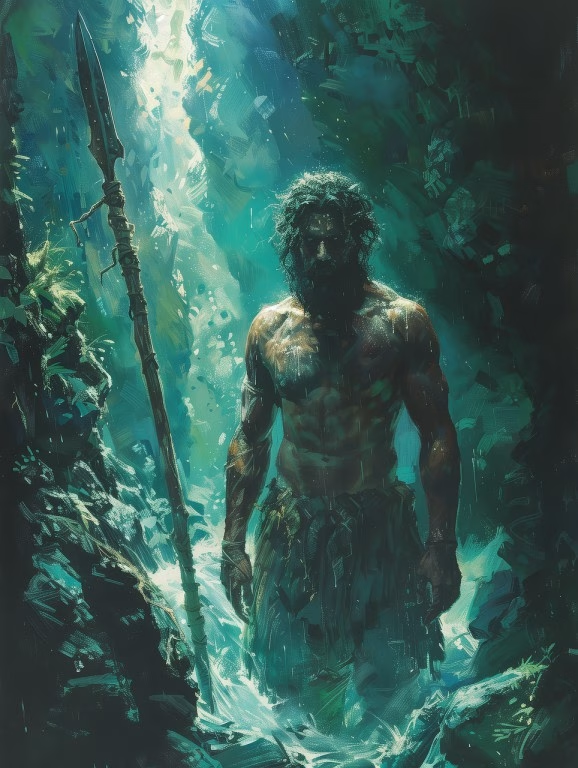
Cocytus (“Lamentation”) is sometimes depicted as a river and at other times as a large lake. It’s close to he entrance to the Underworld as those souls who cannot pay Charon, or haven’t been properly buried, stays on its banks waiting for eternity – or a hundred years, depending on the source. Cocytus flows into the river Acheron.
He is the father of the nymph Minthe who was one of Hades’ concubines and was turned into the plant “mint” by a jealous Persephone.
Virgil seems to have the most to say about Cocytus: overhanging yew trees, reeds in the sluggish water, describing it as a mere (lake), with the sound of screech-owl calls filling the air.
In Dante’s Inferno, it’s a frozen lake in the deepest circle of hell, being the harshest punishment for traitors who are frozen within it.
Whether river or lake, Cocytus is where wailing thrives in the Underworld.

Cocytus in Modern Culture
Hercules: The Legendary Journeys TV series
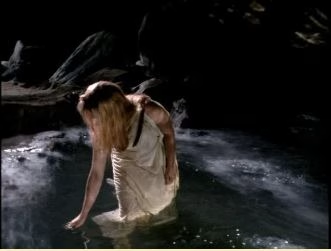
The River of Wailing is the first layer of Purgatory and one of the three rivers of memory. When visitors enter it they experience a barrage of images of betrayals, killings and death.When Gabrielle enters is engulfed with memories from “The Deliverer” and “When in Rome.” When she emerges from the water she is coated with blood.
Learn more here.
Percy Jackson series by Rick Riordan
The River Cocytus, sometimes spelled River Kokytos, is a river found in the Underworld. It is also known as “The River of Lamentation” or “The River of Wailing.”
The River Cocytus was described as a dark blue river, flowing in a vast cavern deep in Tartarus. The river was a ribbon of glittering, dark liquid with a smell of sulfur. It also appears to have a mind of its own, trying to attack Percy Jackson and Annabeth Chase with feelings of grief. Cocytus’ water is freezing cold, filled with millions of heartbroken voices, as if the river were made of distilled sadness. If dipped in, the person’s thoughts will become sad and miserable, having no purpose to live.
The House of Hades: Annabeth and Percy finally fall into the river after falling for a long period of time. Percy tries to create a whirlpool to get them out, but falls under the river’s spell, causing him to nearly drown in his hopelessness. Annabeth tells Percy to start talking about New Rome and their life together there, while Annabeth drags Percy and her to shore. Eventually, they reach the shore and escape the freezing water.
As Percy hones his hydrokinesis powers in Tartarus, he is eventually able to control the river, at least to a degree. During the confrontation at the Doors of Death, Percy summons the waters of Cocytus, splashing monsters with the cursed river and removing their will to fight him and Annabeth.
Learn more here.

Cocytus in My Writing
Origin of the Fae: Cocytus
One of the infernal rivers, Cocytus can cause hopelessness in anyone – mortal and immortal. He is most famous for being the father of Minthe, which is rather ridiculous. But Cocytus had cultivated this lack of attention as anything taking the limelight away from Zeus had always ended in tragedy for others. A wide river, there are parts of the water that is a bit sluggish so plant life thrives. Cocytus prefers to stay in his water form.
My Book
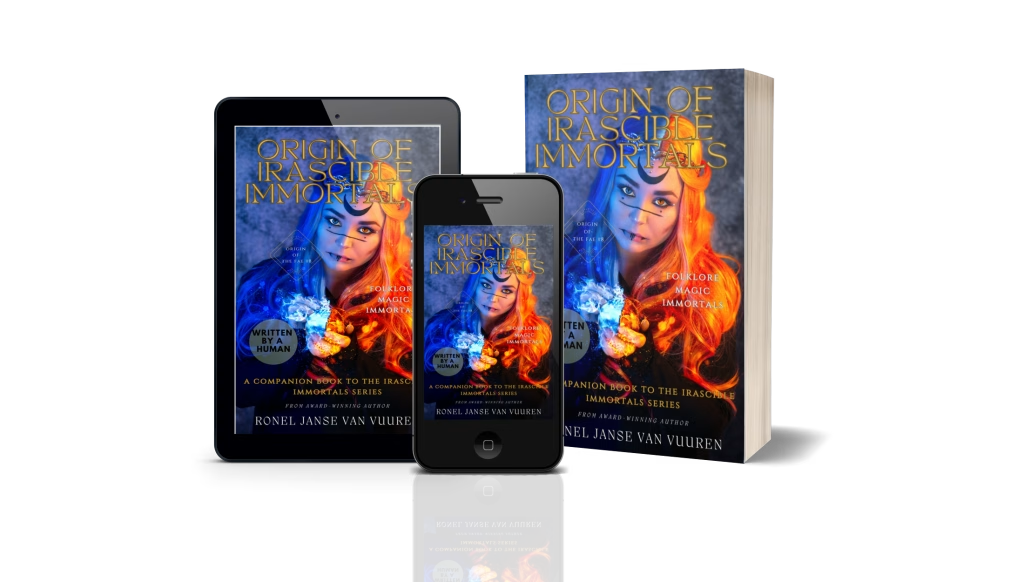
Origin of Irascible Immortals (Origin of the Fae #8)
If this tale has lingered with you, I would be glad to hear it.
Where did you first encounter this creature – through story, superstition, memory, or something half-remembered?
If you know other versions of its myth, feel free to leave them in the record below. Folklore survives by being spoken again.
Further fragments and interpretations of this creature can be found in my Pinterest grimoire.
If you wish to support the time and craft behind these folklore posts – researching old tales, gathering fragments, and shaping them into something worth reading – you may do so by buying me a coffee. It can be a single offering, or something you return to whenever the spirit moves you.
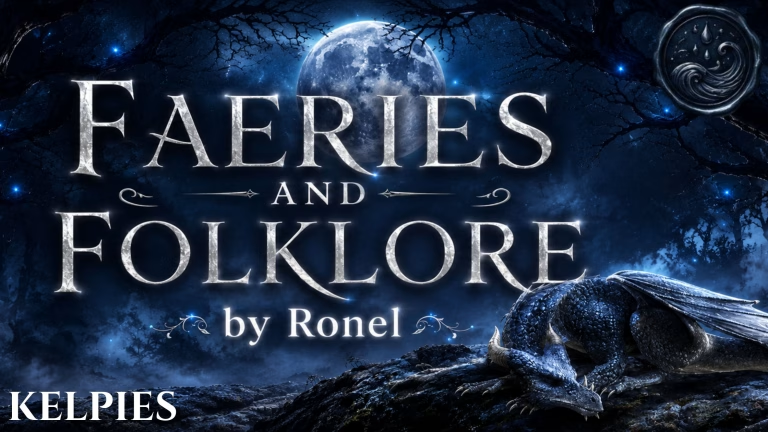
Interesting images, especially the blue ones since wailing and being miserable are often described as feeling blue.
Totally!
Really enjoyed this one. Completely new-to-me mythology 🙂 @samanthabwriter from
Balancing Act
Glad you liked it!
Not many books are on par with Dante’s Inferno (by whatever other titles, same book).
It’s a great story 🙂