Acheron: God and Infernal River of Woe
L is for Lasting

I’m weaving folklore and book reviews into a single offering, shaped to reach a wider audience drawn to both. In years past, interest has surfaced in fragments of each; now, I’m gathering those threads into April alone, so the rest of the year remains quiet and deliberate.
If you came only for today’s book review, you may follow the link here.
Woe just doesn’t end with this river…
Folklore
Dictionary of Greek and Roman Biography and Mythology by William Smith [1844]
ACHERON (Acherôn). In ancient geography there occur several rivers of this name, all of which were, at least at one time, believed to be connected with the lower world. The river first looked upon in this light was the Acheron in Thesprotia, in Epirus, a country which appeared to the earliest Greeks as the end of the world in the west, and the locality of the river led them to the belief that it was the entrance into the lower world. When subsequently Epirus and the countries beyond the sea became better known, the Acheron or the entrance to the lower world was transferred to other more distant parts, and at last the Acheron was placed in the lower world itself. Thus we find in the Homeric poems (Od. x. 513; comp. Paus. i. 17, § 5) the Acheron described as a river of Hades, into which the Pyriphlegeton and Cocytus are said to flow. Virgil (Aen. vi. 297, with the note of Servius) describes it as the principal river of Tartarus, from which the Styx and Cocytus sprang. According to later traditions, Acheron had been a son of Helios and Gaea or Demeter, and was changed into the river bearing his name in the lower world, because he had refreshed the Titans with drink during their contest with Zeus. They further state that Ascalaphus was a son of Acheron and Orphne or Gorgyra. (Natal. Com. iii. 1.) In late writers the name Acheron is used in a general sense to designate the whole of the lower world. (Virg. Aen. vii. 312; Cic. post redit. in Senat. 10; C. Nepos, Dion, 10.) The Etruscans too were acquainted with the worship of Acheron (Acheruns) from very early times, as we must infer from their Acheruntici libri, which among various other things treated on the deification of the souls, and on the sacrifices (Acheruntia sacra) by which this was to be effected. (Müller, Etrusker, ii. 27, &c.) The description of the Acheron and the lower world in general in Plato’s Phaedo (p. 112) is very peculiar, and not very easy to understand.
ACHERU′SIA (Acherousia limnê or Acherousis), a name given by the ancients to several lakes or swamps, which, like the various rivers of the name of Acheron, were at some time believed to be connected with the lower world, until at last the Acherusia came to be considered to be in the lower world itself. The lake to which this belief seems to have been first attached was the Acherusia in Thesprotia, through which the river Acheron flowed. (Thuc. i. 46; Strab. vii. p. 324.) Other lakes or swamps of the same name, and believed to be in connexion with the lower world, were near Hermione in Argolis (Paus. ii. 35. § 7), near Heraclea in Bithynia (Xen. Anab. vi. 2. § 2; Diod. xiv. 31), between Cumae and cape Misenum in Campania (Plin. H. N. iii. 5; Strab. v. p. 243), and lastly in Egypt, near Memphis. (Diod. i. 96.)
CATAE′BATES ( Kataibatês), occurs as a surname of several gods.Of Acheron, being the first river to which the shades descended in the lower world. Of Hermes, who conducted the shades into Hades. (Schol. ad Aristoph. Pac. 649.)

The Divine Comedy of Dante Alighieri [1321]
Inferno: Canto III
There sighs, complaints, and ululations loud
Resounded through the air without a star,
Whence I, at the beginning, wept thereat.
Languages diverse, horrible dialects,
Accents of anger, words of agony,
And voices high and hoarse, with sound of hands,
Made up a tumult that goes whirling on
For ever in that air for ever black,
Even as the sand doth, when the whirlwind breathes.
And I, who had my head with horror bound,
Said: “Master, what is this which now I hear?
What folk is this, which seems by pain so vanquished?”
And he to me: “This miserable mode
Maintain the melancholy souls of those
Who lived withouten infamy or praise.
…And when to gazing farther I betook me.
People I saw on a great river’s bank;
Whence said I: “Master, now vouchsafe to me,
That I may know who these are, and what law
Makes them appear so ready to pass over,
As I discern athwart the dusky light.”
And he to me: “These things shall all be known
To thee, as soon as we our footsteps stay
Upon the dismal shore of Acheron.”
The Tragedy of Macbeth by William Shakespeare [1606]
Act III, Scene 5
[Thunder. Enter the three Witches meeting HECATE]
First Witch. Why, how now, Hecate! you look angerly.
Hecate. Have I not reason, beldams as you are,
Saucy and overbold? How did you dare
To trade and traffic with Macbeth
In riddles and affairs of death;1455
And I, the mistress of your charms,
The close contriver of all harms,
Was never call’d to bear my part,
Or show the glory of our art?
And, which is worse, all you have done1460
Hath been but for a wayward son,
Spiteful and wrathful, who, as others do,
Loves for his own ends, not for you.
But make amends now: get you gone,
And at the pit of Acheron1465
Meet me i’ the morning: thither he
Will come to know his destiny:
Your vessels and your spells provide,
Your charms and every thing beside.
Brewer’s Dictionary of Phrase and Fable [1870]
Acheron
The “River of Sorrow”; one of the five rivers of the infernal regions.
“Sad Acheron of sorrow, black and deep,” Milton, Paradise Lost
Further Reading:
- Acheron
- Acheron
- AKHERON
- Acheron
- Acheron: The River of Woe in Greek Mythology
- Necromanteion of Acheron
Folklore in a Nutshell by Ronel
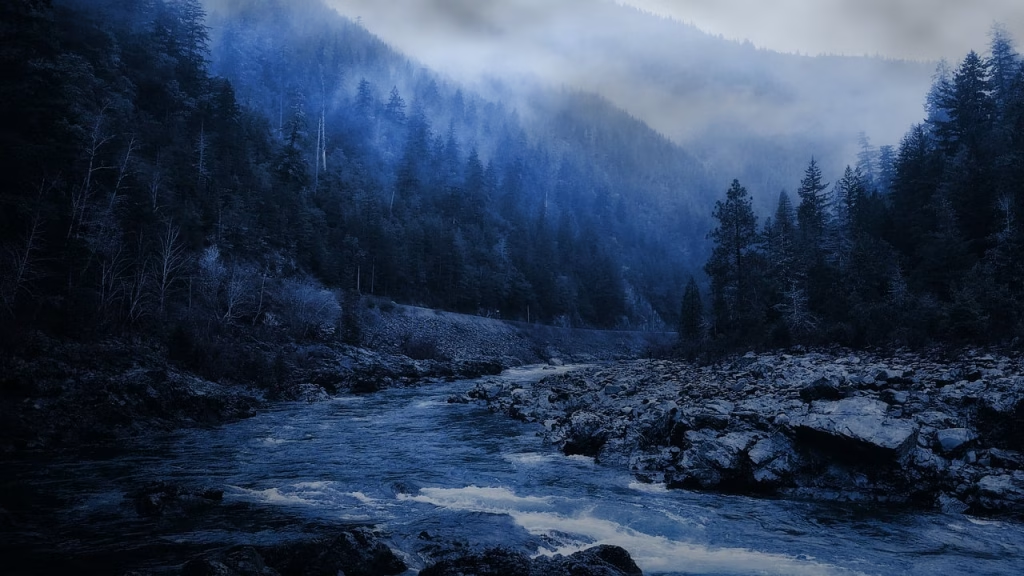
This river runs above ground in Greece and dips through dark gorges and even goes underground. The name of this river which runs through Hades (the underground places the river runs), traditionally means “River of Woe”.
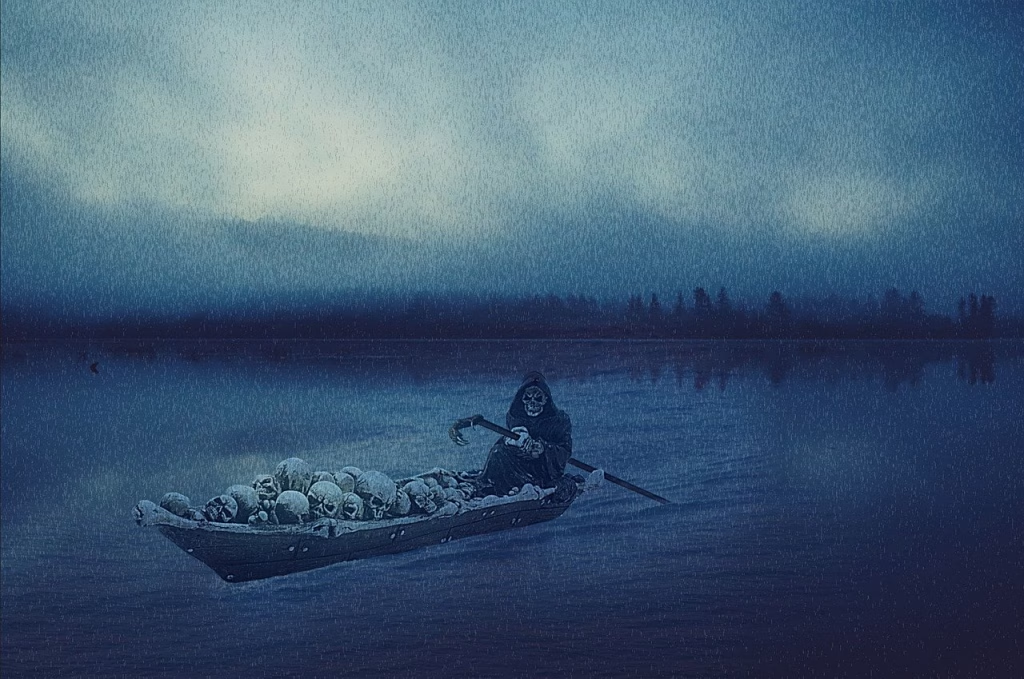
According to several Ancient Greek sources such as Plato, Acheron is the last boundary between the living and the dead, over which Charon ferries the souls who pay his fare. Unless you prefer to listen to Romans like Ovid, who gave Styx this honour…
This river is also a god. Acheron has an Underworld nymph as wife, though he is sometimes seen as the lover of the goddess Nyx.
Though not worshipped by mortals, an oracle of the dead could be found on the banks of the aboveground river. This oracle, sometimes called the Necromanteion, is the place – even a building of some sort – that people would visit to commune with the dead. Some believe it to be a temple of necromancy devoted to Hades and his queen, Persephone. This is where Odysseus met with a ghostly seer in the Odyssey.
Whether a river as seen by Plato or a lake as seen by Euripides, this entrance to Hades catches the pain of the newly deceased and keeps the living out. Perhaps a just punishment for Acheron who gave the thirsty Titans something to drink when they were battling Zeus…
Acheron in Modern Culture
Hercules: The Legendary Journeys TV series
The River of Woe is the second layer of Purgatory and the second river of memory. When a visitor enters this layer they are beset with images of their betrayal of other persons. When Gabrielle falls in she remembers things from “The Debt I & The Debt II“.
Learn more here.

Percy Jackson series by Rick Riordan
River Acheron is the fifth river of the Underworld. It is called the River of Pain as it is the ultimate punishment for many souls of the damned, especially murderers. This is the point where the daemon, a divinity or supernatural being of a nature between gods and humans, Charon, ferries the souls of the dead to the Underworld.
The Acheron is described as being about twenty feet across, with a roaring current that has thousands of voices crying out, shrieking in agony and pleading for mercy. The Acheron also has a malevolent and mesmerizing effect on whoever comes too close to it, blaming them for egregious sins they never committed and showing them their worst memories, trying to convince them to jump into the river. However, not all of the souls are guilty of terrible crimes against others, some are guilty of terrible crimes against themselves, harming themselves through destructive emotions and convincing themselves that they don’t deserve a place in the world.
The House of Hades: After escaping Nyx and her children through the Mansion of Night, Percy Jackson and Annabeth Chase reach the banks of Acheron. They hear the river’s malevolent mesmerizing voices, and Annabeth’s mind is “flooded” with images of all of the monsters that she had ever killed. Later on, Annabeth sees Zoë Nightshade, Bianca di Angelo, Silena Beauregard, and, most painful of all, Luke Castellan, along with his blood on her dagger. The Acheron claims that she could have prevented their deaths, and that Luke’s blood is entirely on her hands, making Annabeth the actual murderer. She begins to fear that Luke’s voice is among the those in the Acheron, punished for his crimes against Olympus. The river tries to force her to jump in and “share his punishment”, and Annabeth nearly does, though Percy intervenes just in time. Just as Nyx’s fearsome children are catching up to them, Percy grabs Annabeth and leaps over the Acheron, and manages to escape Night’s territory. Afterwards, they both continue their journey into the Heart of Tartarus, the location of the Doors of Death.
Learn more here.

Acheron in My Writing
Origin of the Fae: Acheron
Acheron was once a god free to go where he wished. Then he gave a couple of gods something to drink while they were arguing with the egotistic Zeus not long after he’d murdered his own father, and bam!, his essence was bound to a river which ran all over Greece and all through the Underworld once the upstart became king. More river than man, he stayed in the Underworld where he didn’t need to be under Zeus’ sky. He had been the lover of Nyx, though he has no progeny with her as far as he knows. He had been married to an Underworld nymph who helps with all the woe those crying on his banks try to drown him with. The gross rituals mortals observe in the Necromanteion is enough to push him into a rage and flood his banks.
My Book
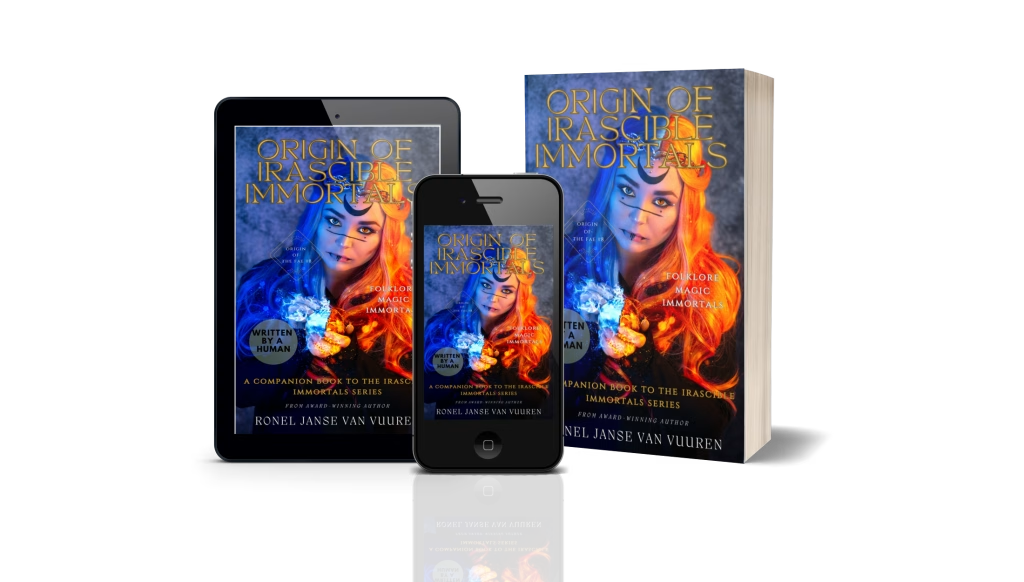
Origin of Irascible Immortals (Origin of the Fae #8)
If this tale has lingered with you, I would be glad to hear it.
Where did you first encounter this creature – through story, superstition, memory, or something half-remembered?
If you know other versions of its myth, feel free to leave them in the record below. Folklore survives by being spoken again.
Further fragments and interpretations of this creature can be found in my Pinterest grimoire.
If you wish to support the time and craft behind these folklore posts – researching old tales, gathering fragments, and shaping them into something worth reading – you may do so by buying me a coffee. It can be a single offering, or something you return to whenever the spirit moves you.