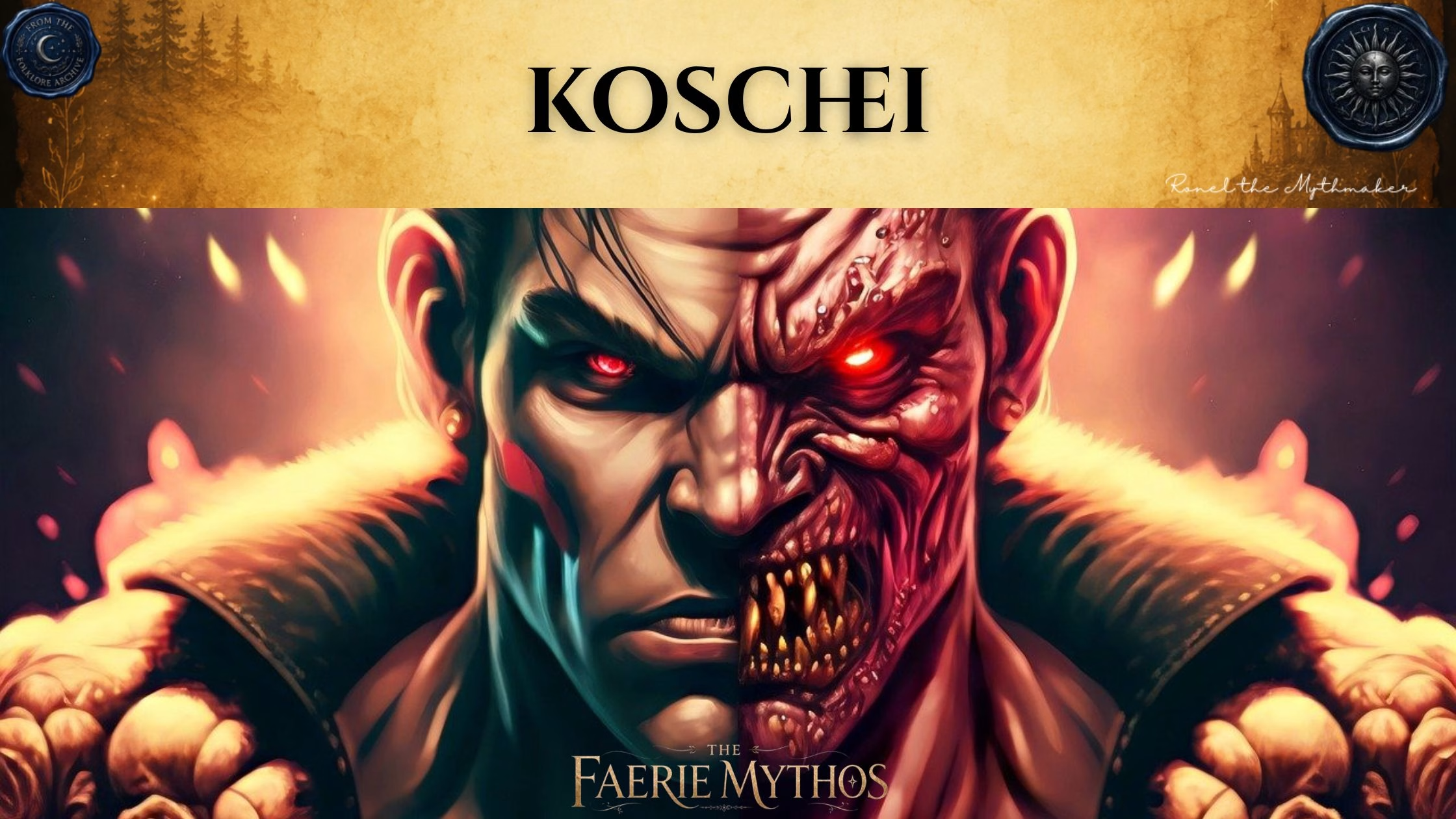
K is for Koschei

I’m weaving folklore and book reviews into a single offering, shaped to reach a wider audience drawn to both. In years past, interest has surfaced in fragments of each; now, I’m gathering those threads into April alone, so the rest of the year remains quiet and deliberate.
If you came only for today’s book review, you may follow the link here.
His soul is hidden in a needle, in an egg, in a duck, in a…

Folklore
All you need to know about Koschei is found in two stories…
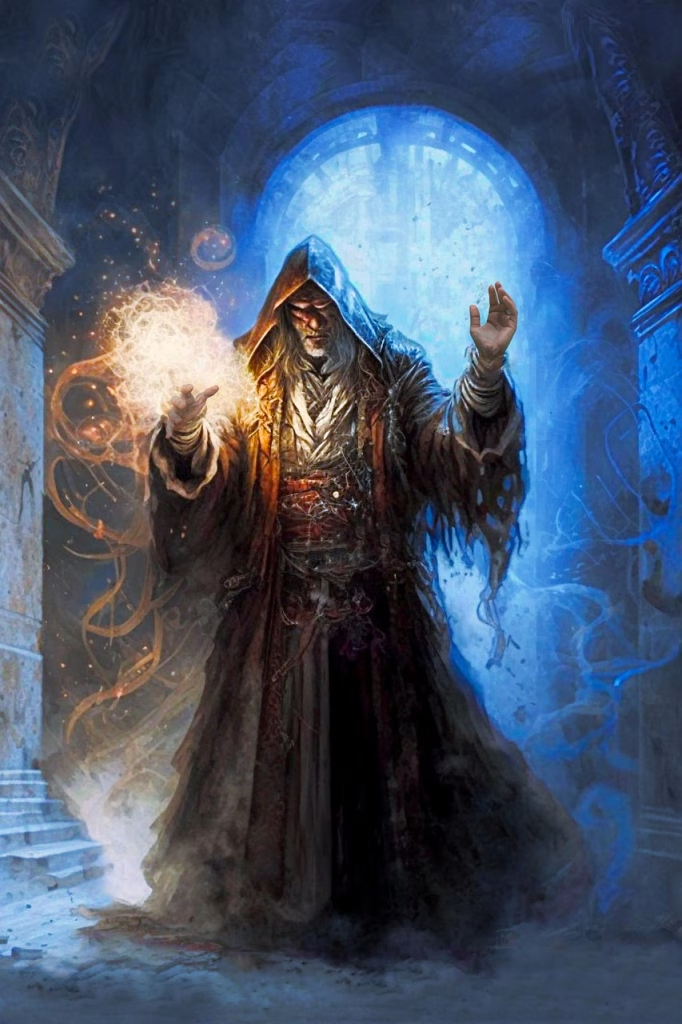
Russian Fairy Tales by W. R. S. Ralston [1873]
Koshchei the Deathless.
In a certain country there once lived a king, and he had three sons, all of them grown up. All of a sudden Koshchei the Deathless carried off their mother. Then the eldest son craved his father’s blessing, that he might go and look for his mother. His father gave him his blessing, and he went off and disappeared, leaving no trace behind. The second son waited and waited, then he too obtained his father’s blessing—and he also disappeared. Then the youngest son, Prince Ivan, said to his father, “Father, give me your blessing, and let me go and look for my mother.”
But his father would not let him go, saying, “Your brothers are no more; if you likewise go away, I shall die of grief.”
“Not so, father. But if you bless me I shall go; and if you do not bless me I shall go.”
[Pg 112]So his father gave him his blessing.
Prince Ivan went to choose a steed, but every one that he laid his hand upon gave way under it. He could not find a steed to suit him, so he wandered with drooping brow along the road and about the town. Suddenly there appeared an old woman, who asked:
“Why hangs your brow so low, Prince Ivan?”
“Be off, old crone,” he replied. “If I put you on one of my hands, and give it a slap with the other, there’ll be a little wet left, that’s all.”[113]
The old woman ran down a by-street, came to meet him a second time, and said:
“Good day, Prince Ivan! why hangs your brow so low?”
Then he thought:
“Why does this old woman ask me? Mightn’t she be of use to me?”—and he replied:
“Well, mother! because I cannot get myself a good steed.”
“Silly fellow!” she cried, “to suffer, and not to ask the old woman’s help! Come along with me.”
She took him to a hill, showed him a certain spot, and said:
“Dig up that piece of ground.”
Prince Ivan dug it up and saw an iron plate with twelve padlocks on it. He immediately broke off the padlocks, tore open a door, and followed a path leading underground. There, fastened with twelve chains, stood a heroic steed which evidently heard the approaching steps of a rider worthy to mount it, and so began to neigh and to struggle, until it broke all twelve of its chains. Then Prince Ivan put on armor fit for a hero, and bridled the horse, and saddled it with a Circassian saddle. And he gave the old woman money, and said to her:
“Forgive me, mother, and bless me!” then he mounted his steed and rode away.
Long time did he ride; at last he came to a mountain—a tremendously high mountain, and so steep that it was utterly impossible to get up it. Presently his brothers came that way. They all greeted each other, and rode on together, till they came [Pg 113]to an iron rock[114] a hundred and fifty poods in weight, and on it was this inscription, “Whosoever will fling this rock against the mountain, to him will a way be opened.” The two elder brothers were unable to lift the rock, but Prince Ivan at the first try flung it against the mountain—and immediately there appeared a ladder leading up the mountain side.
Prince Ivan dismounted, let some drops of blood run from his little finger into a glass, gave it to his brothers, and said:
“If the blood in this glass turns black, tarry here no longer: that will mean that I am about to die.” Then he took leave of them and went his way.
He mounted the hill. What did not he see there? All sorts of trees were there, all sorts of fruits, all sorts of birds! Long did Prince Ivan walk on; at last he came to a house, a huge house! In it lived a king’s daughter who had been carried off by Koshchei the Deathless. Prince Ivan walked round the enclosure, but could not see any doors. The king’s daughter saw there was some one there, came on to the balcony, and called out to him, “See, there is a chink in the enclosure; touch it with your little finger, and it will become a door.”
What she said turned out to be true. Prince Ivan went into the house, and the maiden received him kindly, gave him to eat and to drink, and then began to question him. He told her how he had come to rescue his mother from Koshchei the Deathless. Then the maiden said:
“It will be difficult for you to get at your mother, Prince Ivan. You see, Koshchei is not mortal: he will kill you. He often comes here to see me. There is his sword, fifty poods in weight. Can you lift it? If so, you may venture to go.”
Not only did Prince Ivan lift the sword, but he tossed it high in the air. So he went on his way again.
By-and-by he came to a second house. He knew now where to look for the door, and he entered in. There was his mother. With tears did they embrace each other.
Here also did he try his strength, heaving aloft a ball which weighed some fifteen hundred poods. The time came for [Pg 114]Koshchei the Deathless to arrive. The mother hid away her son. Suddenly Koshchei the Deathless entered the house and cried out, “Phou, Phou! A Russian bone[115] one usen’t to hear with one’s ears, or see with one’s eyes, but now a Russian bone has come to the house! Who has been with you? Wasn’t it your son?”
“What are you talking about, God bless you! You’ve been flying through Russia, and got the air up your nostrils, that’s why you fancy it’s here,” answered Prince Ivan’s mother, and then she drew nigh to Koshchei, addressed him in terms of affection, asked him about one thing and another, and at last said:
“Whereabouts is your death, O Koshchei?”
“My death,” he replied, “is in such a place. There stands an oak, and under the oak is a casket, and in the casket is a hare, and in the hare is a duck, and in the duck is an egg, and in the egg is my death.”
Having thus spoken, Koshchei the Deathless tarried there a little longer, and then flew away.
The time came—Prince Ivan received his mother’s blessing, and went to look for Koshchei’s death. He went on his way a long time without eating or drinking; at last he felt mortally hungry, and thought, “If only something would come my way!” Suddenly there appeared a young wolf; he determined to kill it. But out from a hole sprang the she wolf, and said, “Don’t hurt my little one; I’ll do you a good turn.” Very good! Prince Ivan let the young wolf go. On he went and saw a crow. “Stop a bit,” he thought, “here I shall get a mouthful.” He loaded his gun and was going to shoot, but the crow exclaimed, “Don’t hurt me; I’ll do you a good turn.”
Prince Ivan thought the matter over and spared the crow. Then he went farther, and came to a sea and stood still on the shore. At that moment a young pike suddenly jumped out of the water and fell on the strand. He caught hold of it, and thought—for he was half dead with hunger—“Now I shall have [Pg 115]something to eat.” All of a sudden appeared a pike and said, “Don’t hurt my little one, Prince Ivan; I’ll do you a good turn.” And so he spared the little pike also.
But how was he to cross the sea? He sat down on the shore and meditated. But the pike knew quite well what he was thinking about, and laid herself right across the sea. Prince Ivan walked along her back, as if he were going over a bridge, and came to the oak where Koshchei’s death was. There he found the casket and opened it—out jumped the hare and ran away. How was the hare to be stopped?
Prince Ivan was terribly frightened at having let the hare escape, and gave himself up to gloomy thoughts; but a wolf, the one he had refrained from killing, rushed after the hare, caught it, and brought it to Prince Ivan. With great delight he seized the hare, cut it open—and had such a fright! Out popped the duck and flew away. He fired after it, but shot all on one side, so again he gave himself up to his thoughts. Suddenly there appeared the crow with her little crows, and set off after the duck, and caught it, and brought it to Prince Ivan. The Prince was greatly pleased and got hold of the egg. Then he went on his way. But when he came to the sea, he began washing the egg, and let it drop into the water. However was he to get it out of the water? an immeasurable depth! Again the Prince gave himself up to dejection.
Suddenly the sea became violently agitated, and the pike brought him the egg. Moreover it stretched itself across the sea. Prince Ivan walked along it to the other side, and then he set out again for his mother’s. When he got there, they greeted each other lovingly, and then she hid him again as before. Presently in flew Koshchei the Deathless and said:
“Phoo, Phoo! No Russian bone can the ear hear nor the eye see, but there’s a smell of Russia here!”
“What are you talking about, Koshchei? There’s no one with me,” replied Prince Ivan’s mother.
A second time spake Koshchei and said, “I feel rather unwell.”
Then Prince Ivan began squeezing the egg, and thereupon Koshchei the Deathless bent double. At last Prince Ivan came [Pg 116]out from his hiding-place, held up the egg and said, “There is your death, O Koshchei the Deathless!”
Then Koshchei fell on his knees before him, saying, “Don’t kill me, Prince Ivan! Let’s be friends! All the world will lie at our feet.”
But these words had no weight with Prince Ivan. He smashed the egg, and Koshchei the Deathless died.
Ivan and his mother took all they wanted and started homewards. On their way they came to where the King’s daughter was whom Ivan had seen on his way, and they took her with them too. They went further, and came to the hill where Ivan’s brothers were still waiting for him. Then the maiden said, “Prince Ivan! do go back to my house. I have forgotten a marriage robe, a diamond ring, and a pair of seamless shoes.”
He consented to do so, but in the mean time he let his mother go down the ladder, as well as the Princess—whom it had been settled he was to marry when they got home. They were received by his brothers, who then set to work and cut away the ladder, so that he himself would not be able to get down. And they used such threats to his mother and the Princess, that they made them promise not to tell about Prince Ivan when they got home. And after a time they reached their native country. Their father was delighted at seeing his wife and his two sons, but still he was grieved about the other one, Prince Ivan.
But Prince Ivan returned to the home of his betrothed, and got the wedding dress, and the ring, and the seamless shoes. Then he came back to the mountain and tossed the ring from one hand to the other. Immediately there appeared twelve strong youths, who said:
“What are your commands?”
“Carry me down from this hill.”
The youths immediately carried him down. Prince Ivan put the ring on his finger—they disappeared.
Then he went on to his own country, and arrived at the city in which his father and brothers lived.
There he took up his quarters in the house of an old woman, and asked her:
[Pg 117]“What news is there, mother, in your country?”
“What news, lad? You see our queen was kept in prison by Koshchei the Deathless. Her three sons went to look for her, and two of them found her and came back, but the third, Prince Ivan, has disappeared, and no one knows where he is. The King is very unhappy about him. And those two Princes and their mother brought a certain Princess back with them; and the eldest son wants to marry her, but she declares he must fetch her her betrothal ring first, or get one made just as she wants it. But although they have made a public proclamation about it, no one has been found to do it yet.”
“Well, mother, go and tell the King that you will make one. I’ll manage it for you,” said Prince Ivan.
So the old woman immediately dressed herself, and hastened to the King, and said:
“Please, your Majesty, I will make the wedding ring.”
“Make it, then, make it, mother! Such people as you are welcome,” said the king. “But if you don’t make it, off goes your head!”
The old woman was dreadfully frightened; she ran home, and told Prince Ivan to set to work at the ring. But Ivan lay down to sleep, troubling himself very little about it. The ring was there all the time. So he only laughed at the old woman, but she was trembling all over, and crying, and scolding him.
“As for you,” she said, “you’re out of the scrape; but you’ve done for me, fool that I was!”
The old woman cried and cried until she fell asleep. Early in the morning Prince Ivan got up and awakened her, saying:
“Get up, mother, and go out! take them the ring, and mind, don’t accept more than one ducat for it. If anyone asks who made the ring, say you made it yourself; don’t say a word about me.”
The old woman was overjoyed and carried off the ring. The bride was delighted with it.
“Just what I wanted,” she said. So they gave the old woman a dish full of gold, but she took only one ducat.
“Why do you take so little?” said the king.
[Pg 118]“What good would a lot do me, your Majesty? if I want some more afterwards, you’ll give it me.”
Having said this the old woman went away.
Time passed, and the news spread abroad that the bride had told her lover to fetch her her wedding-dress or else to get one made, just such a one as she wanted. Well, the old woman, thanks to Prince Ivan’s aid, succeeded in this matter too, and took her the wedding-dress. And afterwards she took her the seamless shoes also, and would only accept one ducat each time and always said that she had made the things herself.
Well, the people heard that there would be a wedding at the palace on such-and-such a day. And the day they all anxiously awaited came at last. Then Prince Ivan said to the old woman:
“Look here, mother! when the bride is just going to be married, let me know.”
The old woman didn’t let the time go by unheeded.
Then Ivan immediately put on his princely raiment, and went out of the house.
“See, mother, this is what I’m really like!” says he.
The old woman fell at his feet.
“Pray forgive me for scolding you,” said she.
“God be with you,” said he.[116]
So he went into the church and, finding his brothers had not yet arrived, he stood up alongside of the bride and got married to her. Then he and she were escorted back to the palace, and as they went along, the proper bridegroom, his eldest brother, met them. But when he saw that his bride and Prince Ivan were being escorted home together, he turned back again ignominiously.
As to the king, he was delighted to see Prince Ivan again, and when he had learnt all about the treachery of his brothers, after the wedding feast had been solemnized, he banished the two elder princes, but he made Ivan heir to the throne.

The Red Fairy Book by Andrew Lang [1890]
THE DEATH OF KOSHCHEI THE DEATHLESS
In a certain kingdom there lived a Prince Ivan. He had three sisters. The first was the Princess Marya, the second the Princess Olga, the third the Princess Anna. When their father and mother lay at the point of death, they had thus enjoined their son: ‘Give your sisters in marriage to the very first suitors who come to woo them. Don’t go keeping them by you!’
They died, and the Prince buried them, and then, to solace his grief, he went with his sisters into the garden green to stroll. Suddenly the sky was covered by a black cloud; a terrible storm arose.
‘Let us go home, sisters!’ he cried.
Hardly had they got into the palace, when the thunder pealed, the ceiling split open, and into the room where they were came flying a falcon bright. The Falcon smote upon the ground, became a brave youth, and said:
‘Hail, Prince Ivan! Before I came as a guest, but now I have come as a wooer! I wish to propose for your sister, the Princess Marya.’
‘If you find favour in the eyes of my sister, I will not interfere with her wishes. Let her marry you, in God’s name!’
The Princess Marya gave her consent; the Falcon married her and bore her away into his own realm.
Days follow days, hours chase hours; a whole year goes by. One day Prince Ivan and his two sisters went out to stroll in the garden green. Again there arose a storm-cloud, with whirlwind and lightning.
‘Let us go home, sisters!’ cries the Prince. Scarcely had they entered the palace when the thunder crashed, the roof burst into a blaze, the ceiling split in twain, and in flew an eagle. The Eagle smote upon the ground and became a brave youth.
‘Hail, Prince Ivan! Before I came as a guest, but now I have come as a wooer!’
And he asked for the hand of the Princess Olga. Prince Ivan replied:
‘If you find favour in the eyes of the Princess Olga, then let her marry you. I will not interfere with her liberty of choice.’
The Princess Olga gave her consent and married the Eagle. The Eagle took her and carried her off to his own kingdom.
Another year went by. Prince Ivan said to his youngest sister:
‘Let us go out and stroll in the garden green!’
They strolled about for a time. Again there arose a storm-cloud, with whirlwind and lightning.
‘Let us return home, sister!’ said he.
They returned home, but they hadn’t had time to sit down when the thunder crashed, the ceiling split open, and in flew a raven. The Raven smote upon the floor and became a brave youth. The former youths had been handsome, but this one was handsomer still.
‘Well, Prince Ivan! Before I came as a guest, but now I have come as a wooer! Give me the Princess Anna to wife.’
‘I won’t interfere with my sister’s freedom. If you gain her affections, let her marry you.’
So the Princess Anna married the Raven, and he bore her away into his own realm. Prince Ivan was left alone. A whole year he lived without his sisters; then he grew weary, and said:
‘I will set out in search of my sisters.’
He got ready for the journey, he rode and rode, and one day he saw a whole army lying dead on the plain. He cried aloud, ‘If there be a living man there, let him make answer! Who has slain this mighty host?’
There replied unto him a living man:
‘All this mighty host has been slain by the fair Princess Marya Morevna.’
Prince Ivan rode further on, and came to a white tent, and forth came to meet him the fair Princess Marya Morevna.
‘Hail, Prince!’ says she; ‘whither does God send you? and is it of your free will or against your will?’
Prince Ivan replied, ‘Not against their will do brave youths ride!’
‘Well, if your business be not pressing, tarry awhile in my tent.’
Thereat was Prince Ivan glad. He spent two nights in the tent, and he found favour in the eyes of Marya Morevna, and she married him. The fair Princess, Marya Morevna, carried him off into her own realm.
They spent some time together, and then the Princess took it into her head to go a warring. So she handed over all the house-keeping affairs to Prince Ivan, and gave him these instructions:
‘Go about everywhere, keep watch over everything; only do not venture to look into that closet there.’
He couldn’t help doing so. The moment Marya Morevna had gone he rushed to the closet, pulled open the door, and looked in—there hung Koshchei the Deathless, fettered by twelve chains. Then Koshchei entreated Prince Ivan, saying:
‘Have pity upon me and give me to drink! Ten years long have I been here in torment, neither eating nor drinking; my throat is utterly dried up.’
The Prince gave him a bucketful of water; he drank it up and asked for more, saying:
‘A single bucket of water will not quench my thirst; give me more!’
The Prince gave him a second bucketful. Koshchei drank it up and asked for a third, and when he had swallowed the third bucketful, he regained his former strength, gave his chains a shake, and broke all twelve at once.
‘Thanks, Prince Ivan!’ cried Koshchei the Deathless, ‘now you will sooner see your own ears than Marya Morevna!’ and out of the window he flew in the shape of a terrible whirlwind. And he came up with the fair Princess Marya Morevna as she was going her way, laid hold of her and carried her off home with him. But Prince Ivan wept full sore, and he arrayed himself and set out a-wandering, saying to himself, ‘Whatever happens, I will go and look for Marya Morevna!’
One day passed, another day passed; at the dawn of the third day he saw a wondrous palace, and by the side of the palace stood an oak, and on the oak sat a falcon bright. Down flew the Falcon from the oak, smote upon the ground, turned into a brave youth, and cried aloud:
‘Ha, dear brother-in-law! how deals the Lord with you?’
Out came running the Princess Marya, joyfully greeted her brother Ivan, and began inquiring after his health, and telling him all about herself. The Prince spent three days with them; then he said:
‘I cannot abide with you; I must go in search of my wife, the fair Princess Marya Morevna.’
‘Hard will it be for you to find her,’ answered the Falcon. ‘At all events leave with us your silver spoon. We will look at it and remember you.’ So Prince Ivan left his silver spoon at the Falcon’s, and went on his way again.
On he went one day, on he went another day, and by the dawn of the third day he saw a palace still grander than the former one and hard by the palace stood an oak, and on the oak sat an eagle. Down flew the Eagle from the oak, smote upon the ground, turned into a brave youth, and cried aloud:
‘Rise up, Princess Olga! Hither comes our brother dear!’
The Princess Olga immediately ran to meet him, and began kissing him and embracing him, asking after his health, and telling him all about herself. With them Prince Ivan stopped three days; then he said:
‘I cannot stay here any longer. I am going to look for my wife, the fair Princess Marya Morevna.’
‘Hard will it be for you to find her,’ replied the Eagle. ‘Leave with us a silver fork. We will look at it and remember you.’
He left a silver fork behind, and went his way. He travelled one day, he travelled two days; at daybreak on the third day he saw a palace grander than the first two, and near the palace stood an oak, and on the oak sat a raven. Down flew the Raven from the oak, smote upon the ground, turned into a brave youth, and cried aloud:
‘Princess Anna, come forth quickly! our brother is coming.’
Out ran the Princess Anna, greeted him joyfully, and began kissing and embracing him, asking after his health and telling him all about herself. Prince Ivan stayed with them three days; then he said:
‘Farewell! I am going to look for my wife, the fair Princess Marya Morevna.’
‘Hard will it be for you to find her,’ replied the Raven. ‘Anyhow, leave your silver snuff-box with us. We will look at it and remember you.’
The Prince handed over his silver snuff-box, took his leave, and went his way. One day he went, another day he went, and on the third day he came to where Marya Morevna was. She caught sight of her love, flung her arms around his neck, burst into tears, and exclaimed:
‘Oh, Prince Ivan! why did you disobey me and go looking into the closet and letting out Koshchei the Deathless?’
‘Forgive me, Marya Morevna! Remember not the past; much better fly with me while Koshchei the Deathless is out of sight. Perhaps he won’t catch us.’
So they got ready and fled. Now Koshchei was out hunting. Towards evening he was returning home, when his good steed stumbled beneath him.
‘Why stumblest thou, sorry jade? Scentest thou some ill?’ The steed replied:
‘Prince Ivan has come and carried off Marya Morevna.’
‘Is it possible to catch them?’
‘It is possible to sow wheat, to wait till it grows up, to reap it and thresh it, to grind it to flour, to make five pies of it, to eat those pies, and then to start in pursuit—and even then to be in time.’ Koshchei galloped off and caught up Prince Ivan.
‘Now,’ says he, ‘this time I will forgive you, in return for your kindness in giving me water to drink. And a second time I will forgive you; but the third time beware! I will cut you to bits.’
Then he took Marya Morevna from him, and carried her off. But Prince Ivan sat down on a stone and burst into tears. He wept and wept—and then returned back again to Marya Morevna. Now Koshchei the Deathless happened not to be at home.
‘Let us fly, Marya Morevna!’
‘Ah, Prince Ivan! he will catch us.’
‘Suppose he does catch us. At all events we shall have spent an hour or two together.’
So they got ready and fled. As Koshchei the Deathless was returning home, his good steed stumbled beneath him.
‘Why stumblest thou, sorry jade? Scentest thou some ill?’
‘Prince Ivan has come and carried off Marya Morevna.’
‘Is it possible to catch them?’
‘It is possible to sow barley, to wait till it grows up, to reap it and thresh it, to brew beer, to drink ourselves drunk on it, to sleep our fill, and then to set off in pursuit—and yet to be in time.’
Koshchei galloped off, caught up Prince Ivan:
‘Didn’t I tell you that you should not see Marya Morevna any more than your own ears?’
And he took her away and carried her off home with him.
Prince Ivan was left there alone. He wept and wept; then he went back again after Marya Morevna. Koshchei happened to be away from home at that moment.
‘Let us fly, Marya Morevna!’
‘Ah, Prince Ivan! he is sure to catch us and hew you in pieces.’
‘Let him hew away! I cannot live without you.
So they got ready and fled.
Koshchei the Deathless was returning home when his good steed stumbled beneath him.
‘Why stumblest thou? Scentest thou any ill?’
‘Prince Ivan has come and has carried off Marya Morevna.’
Koshchei galloped off, caught Prince Ivan, chopped him into little pieces, put them into a barrel, smeared it with pitch and bound it with iron hoops, and flung it into the blue sea. But Marya Morevna he carried off home.
At that very time the silver articles turned black which Prince Ivan had left with his brothers-in-law.
‘Ah!’ said they, ‘the evil is accomplished sure enough!’
Then the Eagle hurried to the blue sea, caught hold of the barrel, and dragged it ashore; the Falcon flew away for the Water of Life, and the Raven for the Water of Death.
Afterwards they all three met, broke open the barrel, took out the remains of Prince Ivan, washed them, and put them together in fitting order. The Raven sprinkled them with the Water of Death—the pieces joined together, the body became whole. The Falcon sprinkled it with the Water of Life—Prince Ivan shuddered, stood up, and said:
‘Ah! what a time I’ve been sleeping!’
‘You’d have gone on sleeping a good deal longer if it hadn’t been for us,’ replied his brothers-in-law. ‘Now come and pay us a visit.’
‘Not so, brothers; I shall go and look for Marya Morevna.’
And when he had found her, he said to her:
‘Find out from Koshchei the Deathless whence he got so good a steed.’
So Marya Morevna chose a favourable moment, and began asking Koshchei about it. Koshchei replied:
‘Beyond thrice nine lands, in the thirtieth kingdom, on the other side of the fiery river, there lives a Baba Yaga. She has so good a mare that she flies right round the world on it every day. And she has many other splendid mares. I watched her herds for three days without losing a single mare, and in return for that the Baba Yaga gave me a foal.’
‘But how did you get across the fiery river?’
‘Why, I’ve a handkerchief of this kind—when I wave it thrice on the right hand, there springs up a very lofty bridge, and the fire cannot reach it.’
Marya Morevna listened to all this, and repeated it to Prince Ivan, and she carried off the handkerchief and gave it to him. So he managed to get across the fiery river, and then went on to the Baba Yaga’s. Long went he on without getting anything either to eat or to drink. At last he came across an outlandish bird and its young ones. Says Prince Ivan:
‘I’ll eat one of these chickens.’
‘Don’t eat it, Prince Ivan!’ begs the outlandish bird; ‘some time or other I’ll do you a good turn.’
He went on farther and saw a hive of bees in the forest.
‘I’ll get a bit of honeycomb,’ says he.
‘Don’t disturb my honey, Prince Ivan!’ exclaims the queen-bee; ‘some time or other I’ll do you a good turn.’
So he didn’t disturb it, but went on. Presently there met him a lioness with her cub.
‘Anyhow, I’ll eat this lion cub,’ says he; ‘I’m so hungry I feel quite unwell!’
‘Please let us alone, Prince Ivan!’ begs the lioness; ‘some time or other I’ll do you a good turn.’
‘Very well; have it your own way,’ says he.
Hungry and faint he wandered on, walked farther and farther, and at last came to where stood the house of the Baba Yaga. Round the house were set twelve poles in a circle, and on each of eleven of these poles was stuck a human head; the twelfth alone remained unoccupied.
‘Hail, granny!’
‘Hail, Prince Ivan! wherefore have you come? Is it of your own accord, or on compulsion?’
‘I have come to earn from you an heroic steed.’
‘So be it, Prince! You won’t have to serve a year with me, but just three days. If you take good care of my mares, I’ll give you an heroic steed. But if you don’t—why, then you mustn’t be annoyed at finding your head stuck on top of the last pole up there.’
Prince Ivan agreed to these terms. The Baba Yaga gave him food and drink, and bade him set about his business. But the moment he had driven the mares afield, they cocked up their tails, and away they tore across the meadows in all directions. Before the Prince had time to look round they were all out of sight. Thereupon he began to weep and to disquiet himself, and then he sat down upon a stone and went to sleep. But when the sun was near its setting the outlandish bird came flying up to him, and awakened him, saying:
‘Arise, Prince Ivan! The mares are at home now.’
The Prince arose and returned home. There the Baba Yaga was storming and raging at her mares, and shrieking:
‘Whatever did ye come home for?’
‘How could we help coming home?’ said they. ‘There came flying birds from every part of the world, and all but pecked our eyes out.’
‘Well, well! to-morrow don’t go galloping over the meadows, but disperse amid the thick forests.’
Prince Ivan slept all night. In the morning the Baba Yaga says to him:
‘Mind, Prince! if you don’t take good care of the mares, if you lose merely one of them—your bold head will be stuck on that pole!’
He drove the mares afield. Immediately they cocked up their tails and dispersed among the thick forests. Again did the Prince sit down on the stone, weep and weep, and then go to sleep. The sun went down behind the forest. Up came running the lioness.
‘Arise, Prince Ivan! The mares are all collected.’
Prince Ivan arose and went home. More than ever did the Baba Yaga storm at her mares and shriek:
‘Whatever did ye come back home for?’
‘How could we help coming back? Beasts of prey came running at us from all parts of the world, and all but tore us utterly to pieces.’
‘Well, to-morrow run off into the blue sea.’
Again did Prince Ivan sleep through the night. Next morning the Baba Yaga sent him forth to watch the mares.
‘If you don’t take good care of them,’ says she, ‘your bold head will be stuck on that pole!’
He drove the mares afield. Immediately they cocked up their tails, disappeared from sight, and fled into the blue sea. There they stood, up to their necks in water. Prince Ivan sat down on the stone, wept, and fell asleep. But when the sun had set behind the forest, up came flying a bee, and said:
‘Arise, Prince! The mares are all collected. But when you get home, don’t let the Baba Yaga set eyes on you, but go into the stable and hide behind the mangers. There you will find a sorry colt rolling in the muck. Do you steal it, and at the dead of night ride away from the house.’
Prince Ivan arose, slipped into the stable, and lay down behind the mangers, while the Baba Yaga was storming away at her mares and shrieking:
‘Why did ye come back?’
‘How could we help coming back? There came flying bees in countless numbers from all parts of the world, and began stinging us on all sides till the blood came!’
The Baba Yaga went to sleep. In the dead of the night Prince Ivan stole the sorry colt, saddled it, jumped on its back, and galloped away to the fiery river. When he came to that river he waved the handkerchief three times on the right hand, and suddenly, springing goodness knows whence, there hung across the river, high in the air, a splendid bridge. The Prince rode across the bridge and waved the handkerchief twice only on the left hand; there remained across the river a thin, ever so thin a bridge!
When the Baba Yaga got up in the morning the sorry colt was not to be seen! Off she set in pursuit. At full speed did she fly in her iron mortar, urging it on with the pestle, sweeping away her traces with the broom. She dashed up to the fiery river, gave a glance, and said, ‘A capital bridge!’ She drove on to the bridge, but had only got half-way when the bridge broke in two, and the Baba Yaga went flop into the river. There truly did she meet with a cruel death!
Prince Ivan fattened up the colt in the green meadows, and it turned into a wondrous steed. Then he rode to where Marya Morevna was. She came running out, and flung herself on his neck, crying:
‘By what means has God brought you back to life?’
‘Thus and thus,’ says he. ‘Now come along with me.’
‘I am afraid, Prince Ivan! If Koshchei catches us you will be cut in pieces again.’
‘No, he won’t catch us! I have a splendid heroic steed now; it flies just like a bird.’ So they got on its back and rode away.
Koshchei the Deathless was returning home when his horse stumbled beneath him.
‘What art thou stumbling for, sorry jade? Dost thou scent any ill?’
‘Prince Ivan has come and carried off Marya Morevna.’
‘Can we catch them?’
‘God knows! Prince Ivan has a horse now which is better than I.’
‘Well, I can’t stand it,’ says Koshchei the Deathless. ‘I will pursue.’
After a time he came up with Prince Ivan, lighted on the ground, and was going to chop him up with his sharp sword. But at that moment Prince Ivan’s horse smote Koshchei the Deathless full swing with its hoof, and cracked his skull, and the Prince made an end of him with a club. Afterwards the Prince heaped up a pile of wood, set fire to it, burnt Koshchei the Deathless on the pyre, and scattered his ashes to the wind. Then Marya Morevna mounted Koshchei’s horse and Prince Ivan got on his own, and they rode away to visit first the Raven, and then the Eagle, and then the Falcon. Wherever they went they met with a joyful greeting.
‘Ah, Prince Ivan! why, we never expected to see you again. Well, it wasn’t for nothing that you gave yourself so much trouble. Such a beauty as Marya Morevna one might search for all the world over—and never find one like her!’
And so they visited, and they feasted; and afterwards they went off to their own realm.

Further Reading:
- Koshchei
- A Slavic Legend of Immortality: Koschei, the Deathless
- The Death of Koschei the Deathless
- A Slavic Legend Of Immortality: Koschei the Deathless
- Koschei the Deathless | Russia’s Evil Sorcerer
- The Death of Koschei the Deathless
- Buyan

Folklore in a Nutshell by Ronel
I first encountered Koschei the Deathless as a shadowy character named in The Librarians TV series when they found the chest hiding his “death”, or rather a magical needle that can kill immortals. Since then, I’ve been interested in learning more about him.
There are various variants of the name, mostly in spelling, and everyone has their own idea of what the name means: from “walking skeleton” to “a wanderer” and loads of weird stuff in between.
Koschei the Deathless or the Immortal is usually cast as the antagonist in Slavic folklore. For example, in the tale “Marya Morevna” AKA “The Death of Koschei the Deathless” Koschei was obsessed with Marya who had kept him chained in a closet for a decade. When her husband, Ivan, disobeyed her and opened the closet, Koschei who hadn’t died of thirst or hunger, escaped. He then abducted Marya and continued to abduct her every time her husband tried to save her from him, mostly because he had a superior horse. Eventually, Baba Yaga assists Ivan and he can save his wife – and the magical horse provided by the witch kills the supposed immortal villain with a kick to the head.
This story shows the role Koschei usually plays as the malevolent rival of the male hero. It’s not clear, though, how his immortality worked in this story. But, usually, a spell keeps him from dying and his “death” or “soul” is hidden in a needle, hidden in an egg, hidden in a duck, hidden in a hare, hidden in a chest, hidden somewhere on the mythical island Buyan. This island is described as a type of paradise oceanic island that has the ability to appear and disappear with the tide.
Koschei the Deathless is probably the most powerful sorcerer in Slavic folklore. He can even shape-shift. But he has one weakness: he is terrified of dying. His fear of death had made him careless in the spell that kept him immortal: for if someone came into possession of the egg, they would be able to control him. And if they were to destroy the needle, he would die. This makes me think of the heart in a chest in the Pirates of the Caribbean franchise that controlled the captain of the Flying Dutchman. And, the lack of physical injury and death as long as the egg and needle stayed intact, reminds me of how Dorian Gray remained alive and well as long as his portrait was safe in the attic.
In a lot of tales, Koschei is obsessed with capturing and keeping beautiful women locked away. Men try and fail to safe the women. Then a young man, with the help of animal companions, finds the island and digs up the chest/finds the chest hanging from a tree/whatever the chest was hiding in, and then takes the egg and smashes it against Koschei’s forehead and thus kills him. He, of course, saves the women and lives happily ever after.
Thus, Koschei the Deathless is terrified of dying, he is a powerful sorcerer who used dark magic to keep himself alive with a spell that has some room for error leaving him helpless after all, he can shapeshift into anything yet abducts women instead of wooing them by turning into what they find attractive, and finds himself to be an enduring and popular villain in Slavic folktales because he lacks common social skills.

Koschei in Modern Culture
Deathless by Catherynne M Valente
…a retelling of the Koschei story set against a backdrop of 20th-century Russian history. [my review]
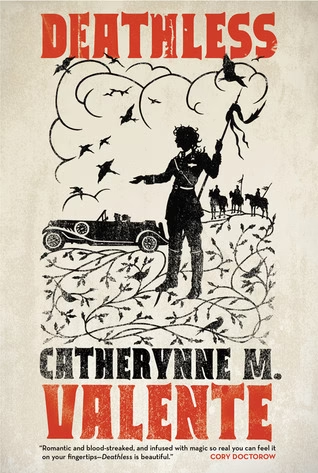
Koschei the Deathless is to Russian folklore what devils or wicked witches are to European culture: a menacing, evil figure; the villain of countless stories which have been passed on through story and text for generations. But Koschei has never before been seen through the eyes of Catherynne Valente, whose modernized and transformed take on the legend brings the action to modern times, spanning many of the great developments of Russian history in the twentieth century.
Deathless, however, is no dry, historical tome: it lights up like fire as the young Marya Morevna transforms from a clever child of the revolution, to Koschei’s beautiful bride, to his eventual undoing. Along the way there are Stalinist house elves, magical quests, secrecy and bureaucracy, and games of lust and power. All told, Deathless is a collision of magical history and actual history, of revolution and mythology, of love and death, which will bring Russian myth back to life in a stunning new incarnation.
The Girl in the Tower by Katherine Arden
…features Kaschei as the main antagonist.

The Bear and the Nightingale, Katherine Arden’s enchanting first novel, introduced readers to an irresistible heroine. Vasilisa has grown up at the edge of a Russian wilderness, where snowdrifts reach the eaves of her family’s wooden house and there is truth in the fairy tales told around the fire. Vasilisa’s gift for seeing what others do not won her the attention of Morozko—Frost, the winter demon from the stories—and together they saved her people from destruction. But Frost’s aid comes at a cost, and her people have condemned her as a witch.
In The Girl in the Tower, Vasilisa faces an impossible choice. Driven from her home by frightened villagers, she has only two options left: marriage or the convent. She cannot bring herself to accept either fate and instead chooses adventure, dressing herself as a boy and setting off astride her magnificent stallion Solovey.
But after she prevails in a skirmish with bandits, everything changes. The Grand Prince of Moscow anoints her a hero for her exploits, and she is reunited with her beloved sister and brother, who are now part of the Grand Prince’s inner circle. She dares not reveal to the court that she is a girl, for if her deception were discovered it would have terrible consequences for herself and her family. Before she can untangle herself from Moscow’s intrigues—and as Frost provides counsel that may or may not be trustworthy—she will also confront an even graver threat lying in wait for all of Moscow itself.
The Librarians TV series
Koschei’s Needle was a magical artifact that had the power to slay thousands in a single swipe and kill an Immortal.
Learn more here.
Grimm TV series
A Koschie (KAH-shee; Rus. Коще́й “Koshchey,” a skeleton-man in Russian folklore) is a radioactive skeleton man-like Wesen that first appeared in “Red Menace“.
Koschie are very free-spirited, in the sense that they have a very large libido and often use their reputation as healers to woo females. Using their healing abilities also “fires up” their sex drive. They enjoy drinking, they remember the names of everyone they’ve killed, and they can feel very remorseful after taking a life. They sometimes use their ability to heal to make up for the lives they have taken.
Koschie have the ability to heal other beings of serious injuries and aliments. Sometimes the injury or ailment heals instantaneously along with any pain associated with it, while other times the pain lingers for a while, but gradually goes away over time. Koschie can also afflict people with serious radiation poisoning, which will kill the victim within a few days. The dosage is so high that the afflicted area will still be “hot” a few days later. The use of both abilities, particularly the healing ability, puts stress on their bodies and weakens them the more they use the ability. If they use their healing ability too much, it will eventually kill them.
Learn more here.

Koschei in My Writing
Origin of the Fae: Koschei
Koschei, whether the Immortal or the Deathless, is a cunning wizard who had figured out how to stay alive no matter what.
Unfortunately, his fear of death and his fear of women had him devise a spell that had one too many loopholes. For one, anyone who held the talisman controlling his state of existence, could also control him. And if that talisman were to be destroyed, he’d die. For another, his use of dark magic to stay alive had resulted in him not staying young, too, but at whatever physical age his body just couldn’t age any further without falling apart. This is why his name, on occasion, means “walking skeleton”.
His fear of women is clearly shown in his need to keep them locked away. The only reason he, allegedly, went after Marya Morevna so many times was in retaliation for her keeping him locked up for so long.
These days, he’s merely held up as a warning of what sloppy spell work and social ineptitude will bring.
My Book
Origin of Irascible Immortals (Origin of the Fae #8)
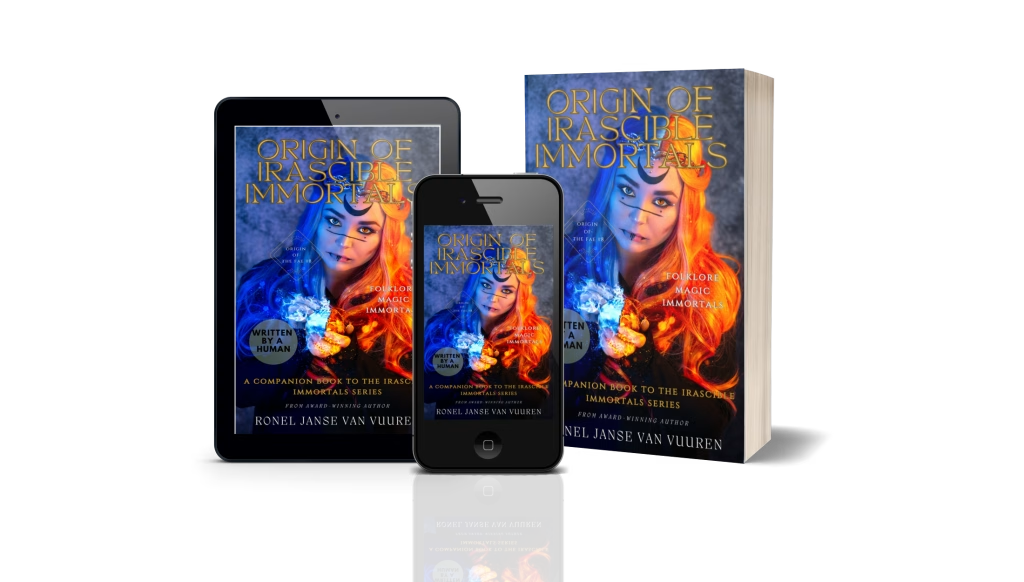
If this tale has lingered with you, I would be glad to hear it.
Where did you first encounter this creature – through story, superstition, memory, or something half-remembered?
If you know other versions of its myth, feel free to leave them in the record below. Folklore survives by being spoken again.
Further fragments and interpretations of this creature can be found in my Pinterest grimoire.
If you wish to support the time and craft behind these folklore posts – researching old tales, gathering fragments, and shaping them into something worth reading – you may do so by buying me a coffee. It can be a single offering, or something you return to whenever the spirit moves you.



Really enjoyed reading those folktales. I know they were Russian, but there awas a distinct Native American vibe to them. Thanks for sharing.
Thanks, Susanne. Yeah, those vibes are totally there!
Royalty. Gotta stop screwing around with immortals and magic, eh?
They always seem to be the ones in the thick of things.