It’s the first Wednesday of the month and time for another posting of the IWSG.
The awesome co-hosts for the October 7 posting of the IWSG are Ronel Janse van Vuuren, Liza at Middle Passages, JH Moncrieff, and Jemima Pett!
I’m #37 on the list!
October 7 question: Many people are calling for writers who use AI to disclose it. Most who employ ghostwriters do not admit it – do you think authors who use ghostwriters should have to disclose that, too?
That’s a loaded question… for some.
I’m a Writer. I Write.
I’m a writer. I write. I edit. I rewrite. I edit. I rewrite. I proofread. (Maybe I missed a step or two there?) There is no place there for a ghost writer to step in – let alone something other to do the writing for me.
And why would I? The fun part of being a writer is the writing. Though, I do enjoy editing and rewriting and proofreading, too.
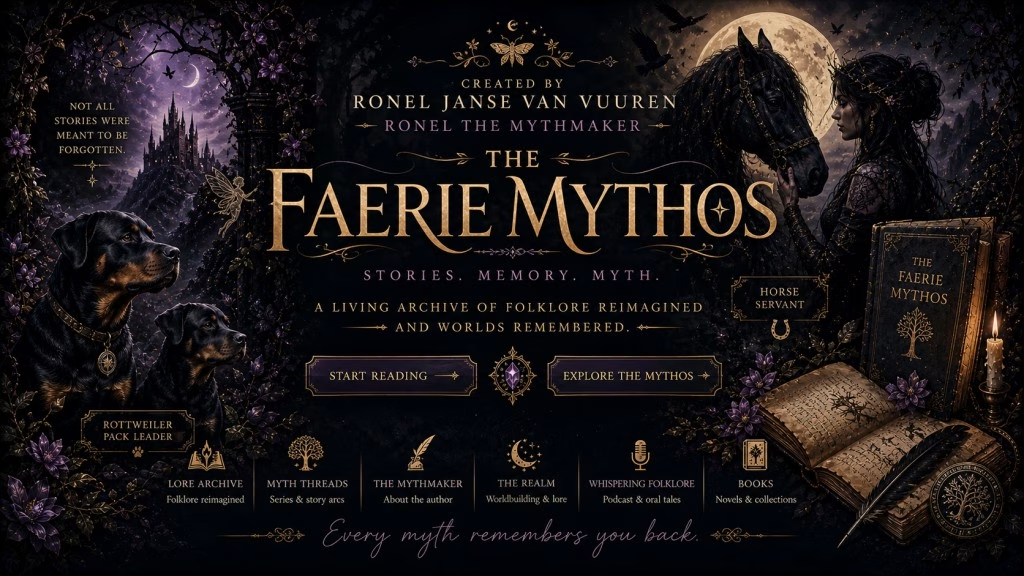
There was a time (2025!) I had stickers on my covers saying “written by a human”. I’ve been rebuilding and rebranding this year, so that’s not something I do anymore. But readers can trust that every word in a book I wrote was written by me. That’s a Ronel the Mythmaker promise. Just like entering the Faerie Mythos is a promise of rich worldbuilding, myths, magic, fierce heroines, and stories that make you think.
If you only want to share story ideas and have someone else write it, there’s a place for that, too. But that doesn’t make you a writer.
Who Actually Wrote the Book?
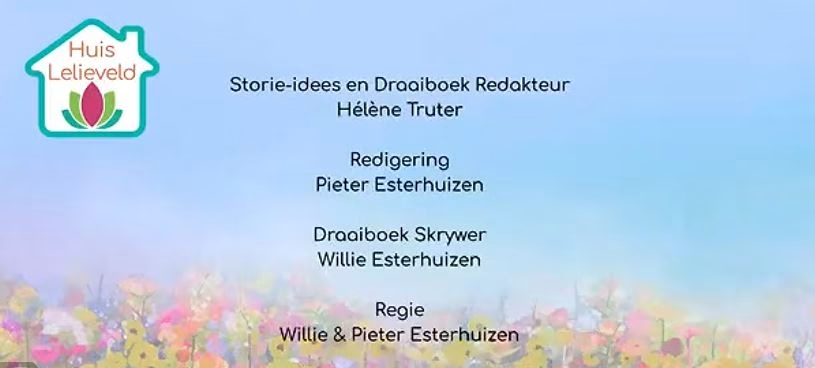
There’s this screenwriter whose work I’ve enjoyed my entire life. You can rewatch his stories and find something new every time. The writer/actor I’m talking about is, of course, Willie Esterhuizen.
The last two series of his I watched, he credits a close friend, an actress who has starred in his work, as the source of ideas for these stories. He still wrote the episodes himself, but Hélène Truter gave him ideas: like a Muse. She’s not insisting on writing credits, because she didn’t write anything. (Though she’s a writer herself.)
Which brings me back to this month’s question: if a ghostwriter does the writing and not you, you’re not a writer. #SorryNotSorry
If someone else wrote the book, it should be disclosed. Not because there’s anything wrong with using a ghostwriter, but readers deserve to know who actually wrote the words they’re reading.
And Then There’s AI
The same if your AI of choice did the bulk of the writing…
I’m not sure Gemini (or whoever) is going to credit you for ideas for stories they wrote like Willie did with Hélène.
This isn’t the first time I’ve written about the ethics of the publishing industry, either. I went down that particular rabbit hole last year in Unethical Publishing Industry Practices.
Where Do We Draw the Line?
The question this month is a bit ambivalent: Does disclosure mean “AI was used to generate the text of this book,” or does it mean “AI was used at any point in the creation of this book”?
I’m asking this because there have been reader events where authors have been disinvited for AI use – not in their writing, but in their marketing.
If you go on Pixabay, Pexels, and other free image sites, you’d be hard-pressed to find an image that has no AI involvement (people use AI to clean up photos, so that probably counts as AI usage…).
Programs like Canva have magical capabilities to change the tone, focus, texture and more of images… AI?
Where do we draw the line between disclosure and TMI?
With AI witch hunts destroying careers, should we add fuel to the fire? Will having a pretty book cover instead of something that looks like it came from a haunted 80s computer with Courier typeset get you burned at the stake?
Don’t Ask, Don’t Tell
And then I watched a video by Kevin Tumlinson about AI book cover design.
His advice?
Don’t ask, don’t tell.
And all I could think was: Well, I’ve watched enough American TV series to know where that phrase comes from…
Maybe we really have reached the point where we need to ask ourselves whether knowing exactly where — and how — AI was used actually helps readers, or whether we’re just creating another purity test.
Because if AI wrote the book? Tell me.
If AI designed the cover? …do I really need to know?
So Where Would You Draw the Line?
So what do you think? Should authors disclose the use of ghostwriters? What about AI — and does it matter whether AI helped write the book, design the cover, or polish the marketing?
Where would you draw the line?