Episode 224: Irascible Immortals: Apollo
The folklore of Apollo in a nutshell and how I reimagined it for my writing.
Transcript
You’re listening to the Faeries and Folklore podcast by Ronel.
I’m dark fantasy author Ronel Janse van Vuuren. With nearly a decade of digging around in dusty folklore books, researching creatures of imagination that ignited my curiosity, I’m here to share the folklore in a nutshell and how I reimagined it for my writing in an origin of the fae.
This is the Faeries and Folklore podcast.
Hi, I’m your host Ronel Janse van Vuuren. You can just call me Ronel. In today’s episode, we’re continuing our exploration of the fae realm.
This episode is brought to you by my Irascible Immortals series, available in ebook, paperback, hardback and audiobook. They’ve been alive forever. They’ve been bored for some time. And now they’re showing it. Go to ronelthemythmaker.com/my-books/the-irascible-immortals-series for more.
We’re continuing our exploration of the Immortals.
Today’s faery: Apollo
Folklore in a nutshell by Ronel
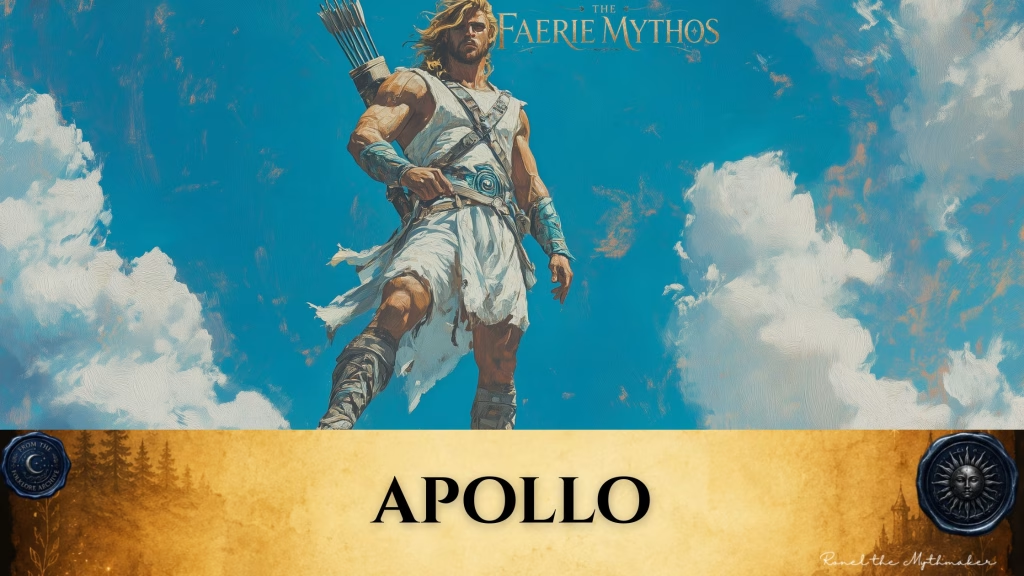
Apollo is the twin brother of Artemis, born to the titan Leto on the moving island Delos. As Hera in her jealousy forbade all land to give Leto a place to give birth, only Delos had mercy – and became an unmoving island in Hera’s rage. Zeus didn’t intervene in Hera’s pursuit of Leto, despite being the cause of it.
Apollo, after being fed ambrosia, took up the lyre and bow and set off to plague the world. It was believed that the sudden death of a person was due to one of Apollo’s arrows. He also killed the serpent Python who pursued his mother. Afterwards he took the power of prophecy from Pan and the Delphic Oracle.
He is sometimes called the god of song and music. He enjoys playing on the lyre that he either got from Hermes or – as he boasted – invented himself. He even built the walls of Troy by playing on this instrument. But he cannot abide competition. Poor Marsyas picked up a flute cursed by Athena, played great music – and the peasants said that not even Apollo could play such great music on his lyre. So he called a competition between the two of them, judged by the Muses. They thought the two musicians equal. And then Apollo said that they should play the same way: with instruments behind their backs while singing. Of course, Marsyas couldn’t do this with a flute and Apollo won. He then flayed the poor satyr alive and nailed his skin to a pine tree.
Though a handsome guy, he wasn’t always lucky in love. When he pursued the nymph Daphne, she ran from him and was turned into a laurel tree just to get away from him – some sources have it that Gaia spirited her away to Crete where she became Pasiphaë and left a laurel tree in her stead. Cassandra, daughter of King Priam of Troy, rejected his advances, too. He punished her by having her utter prophecies that no-one believed, despite being the truth.
There’s more to read about this god – mainly how others suffered because of his pride, temper and lust.
Origin of the fae: Apollo
Apollo is known for his temper, his pride, and for lusting after those who would rather not be noticed by him. He is also known as a bit of a clown: playing music to soothe the other gods, taking part in archery contests with his twin for fun, and backpedalling hard when someone stronger is offended. He asks incessant questions and most of the other gods (any pantheon) can’t really stand him. His brother Dionysus finds him hilarious, but his twin sister doesn’t have much patience with him anymore. He is known to make boastful statements – like being the sun god, when it’s actually Helios – that are later shown to be false or not as grand as he had wanted it to be. The Age of Information hasn’t done much to bolster his pride.
I hope that you’ve enjoyed this episode of the faeries and folklore podcast and that you’ve learned something new about faeries.
Remember that you can get a transcript of this episode in the description. If you’re new to the podcast, why not go and grab your free copy of Unseen, the second book in the Faery Tales series, on my website ronelthemythmaker.com? Loads of folklore, magic and danger await! Take care!
Available at
Audible | Podbean | Amazon Music | Spotify | Youtube | iHeart Radio | Player FM | Listen Notes | Apple Podcasts | TuneIn

Read the full folklore article:
Explore the folklore, modern interpretations, and the Faerie Mythos.
Listen to this season’s audiobook:
Listen to the full season with no interruptions.
Explore the Audiobook Library ✦ Browse the Lore Archive ✦ Discover the Faerie Mythos Books ✦ Join the Mythmaker’s Circle
Enjoying the podcast?
If you’ve enjoyed this episode, you can support the time and care that goes into researching, writing, recording, and producing the Faeries & Folklore Podcast by buying me a coffee.
Your support is always appreciated, whether it’s a one-time thank you or an occasional coffee whenever you feel like it. Every contribution helps me continue sharing the folklore, myths, and legends that inspire the Faerie Mythos.