
Episode 230: Irascible Immortals: Xochipilli
The folklore of Xochipilli in a nutshell and how I reimagined it for my writing.
Transcript
You’re listening to the Faeries and Folklore podcast by Ronel.
I’m dark fantasy author Ronel Janse van Vuuren. With nearly a decade of digging around in dusty folklore books, researching creatures of imagination that ignited my curiosity, I’m here to share the folklore in a nutshell and how I reimagined it for my writing in an origin of the fae.
This is the Faeries and Folklore podcast.
Hi, I’m your host Ronel Janse van Vuuren. You can just call me Ronel. In today’s episode, we’re continuing our exploration of the fae realm.
This episode is brought to you by my Irascible Immortals series, available in ebook, paperback, hardback and audiobook. They’ve been alive forever. They’ve been bored for some time. And now they’re showing it. Go to ronelthemythmaker.com/my-books/the-irascible-immortals-series for more.
We’re continuing our exploration of the Immortals.
Today’s faery: Xochipilli
Folklore in a nutshell by Ronel
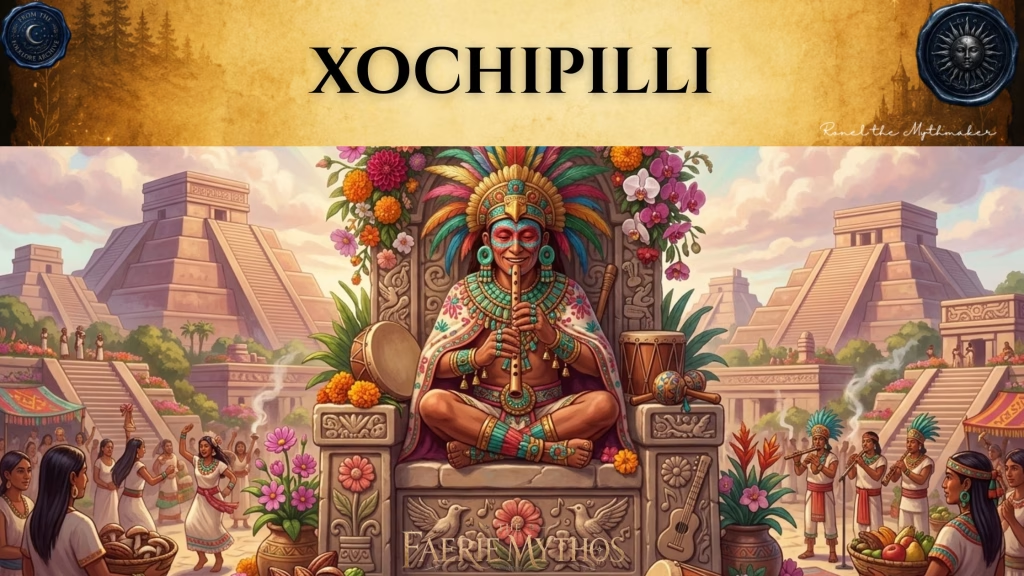
Xochipilli is the Aztec god of flowers, pleasure, love, music, games, fertility, the arts, feasting… the list is endless. Yet not many books about Aztec gods feature him. His name means “Flower Prince” or “Prince of Flowers. He is the twin – or male counterpart – of Xochiquetzal, the goddess of beauty, love and flowers – and much better known in various sources. Which poses the question: why is Xochipilli overlooked?
He is depicted as a youthful, care-free, handsome pleasure-seeker with a mischievous streak. Feasts are held in his honour, before which people fasted and only drank a thin maize porridge with a flower in its centre (known as the “fast of flowers”). They offered him sacrifices of blood and corn-based food such as tamales, as he was the god of maize. He was usually seen naked, with red skin, a green crown with green feathers stuck to it, an emblem on his back much like a banner sticking out of a hill covered in green plumage, he wore a cape around his middle which had a fringe from which small seashells hung. He also liked wearing elaborate sandals. Even his sceptre matched his outfit, having bit of a heart shape to it.
The famous statue of him currently housed in the National Museum of Anthropology in Mexico City – seated cross-legged on a low pedestal, arms resting on knees with head raised toward the sky, a necklace of shells, wrist and arm bracelets, a feathered headdress with birds on either side, the base adorned with a flower pattern – can be seen in copied statues in gardens and other places across the American continents. Some interpret this statue as representing the figure in the throes of the ecstasy brought on by hallucinogens. As the god of plants, it’s probably not a stretch, and the statue is covered with hallucinogenic mushrooms, flowers from psychotropic plants and animal skins. But it seems more like he is happily singing like the god of music he is, being a vibrant symbol of life, than stoned out of his mind.
Another reason why he’s probably been excluded from books in the previous century is because he has been interpreted as the patron of homosexuals and male prostitutes. His female counterpart is the patroness of prostitutes, and is talked about on podcasts, in books and more, but that is #girlpower. Yet, isn’t Xochipilli and Xochiquetzal two sides of the same coin? Some have argued that Xochipilli has been worshipped in both his masculine and feminine forms by nobles, artists and others since pre-Columbian times. And as they are called each other’s counterparts, I think this theory a sound one.
There’s a lot about this god we don’t know because of censoring over the centuries, but the plants he presided over certainly took care of unwanted pregnancies, STDs, pain and more – which is why during rituals and feasts surrounding Xochipilli the worshippers entered a “Flowery Dream” after days of abstinence, fasting and more in preparation to worship the god of pleasure.
*Yes, I know that “Aztec” isn’t what the people called themselves, but as it’s been the name used interchangeably for several tribes since 1810, I’m sticking to it.
Origin of the fae: Xochipilli
As many other deities, Xochipilli is gender-fluid. Though they are usually found in their male incarnation, mostly because of mortal constrictions on females and the rigid outlook of some pantheons. Xochipilli is a strong magic-user, on par with Isis and Hecate. Though he doesn’t advertise it, blood sacrifice makes the strongest spells, and he has plenty of it from his worshippers through the ages. He loves having fun, singing and dancing being his favourite pastimes. He is the god of flowers, among other things, and there’s nothing more beautiful than a field of marigolds.
I hope that you’ve enjoyed this episode of the faeries and folklore podcast and that you’ve learned something new about faeries.
Remember that you can get a transcript of this episode in the description. If you’re new to the podcast, why not go and grab your free copy of Unseen, the second book in the Faery Tales series, on my website ronelthemythmaker.com? Loads of folklore, magic and danger await! Take care!
Available at
Audible | Podbean | Amazon Music | Spotify | Youtube | iHeart Radio | Player FM | Listen Notes | Apple Podcasts | TuneIn

Read the full folklore article:
Explore the folklore, modern interpretations, and the Faerie Mythos.
Listen to this season’s audiobook:

Listen to the full season with no interruptions.
Explore the Audiobook Library ✦ Browse the Lore Archive ✦ Discover the Faerie Mythos Books ✦ Join the Mythmaker’s Circle
Enjoying the podcast?
If you’ve enjoyed this episode, you can support the time and care that goes into researching, writing, recording, and producing the Faeries & Folklore Podcast by buying me a coffee.
Your support is always appreciated, whether it’s a one-time thank you or an occasional coffee whenever you feel like it. Every contribution helps me continue sharing the folklore, myths, and legends that inspire the Faerie Mythos.


Love that name. Keeping it.