Episode 242: Irascible Immortals: Sphinx
The folklore of Sphinx in a nutshell and how I reimagined it for my writing.
Transcript
You’re listening to the Faeries and Folklore podcast by Ronel.
I’m dark fantasy author Ronel Janse van Vuuren. With nearly a decade of digging around in dusty folklore books, researching creatures of imagination that ignited my curiosity, I’m here to share the folklore in a nutshell and how I reimagined it for my writing in an origin of the fae.
This is the Faeries and Folklore podcast.
Hi, I’m your host Ronel Janse van Vuuren. You can just call me Ronel. In today’s episode, we’re continuing our exploration of the fae realm.
This episode is brought to you by my Irascible Immortals series, available in ebook, paperback, hardback and audiobook. They’ve been alive forever. They’ve been bored for some time. And now they’re showing it. Go to ronelthemythmaker.com/my-books/the-irascible-immortals-series for more.
We’re continuing our exploration of the Immortals.
Today’s immortal: Sphinx
Folklore in a nutshell by Ronel
Though mostly connected to Egypt, the sphinx is also found in Greek, Assyrian, Persian and Phoenician mythology. This mythical creature has the body of a lion, head of another animal or human, and sometimes has the wings of an eagle or falcon. In Egypt, it has a male head, and in Greece, a female head.
Egyptian sphinxes usually wore a headdress like that of the pharaohs. Sphinxes guarded temples and tombs.
Persian sphinxes usually had wings and a male head. They stood outside palaces and guarded against evil forces.
The sphinxes from ancient Greece, though, was always female and troublesome creatures born from the Chimaera and Orthus – the two-headed dog born from Echidna and Typhon – or sometimes the offspring of Echidna and Typhon, and siblings to the Nemean lion and Cerberus (among others). She’s the one who challenged all with riddles, killing those unable to answer her correctly. The most famous myth surrounding her, is the one where she terrorised Thebes and was beaten by Oedipus when he solved her infamous riddle:
What animal is that which in the morning goes on four feet, at noon on two, and in the evening upon three?
The answer is, of course, Man. And it’s about Time: as infants, humans crawl; as adults, they walk; in old-age, they need a cane.
These days, the answer would be more PC as “humankind”.
According to myth, this sphinx jumped to her death when her riddle was successfully answered.
A lot of ancient Greeks saw the sphinx as an Underworld demon creature who learned from the Muses themselves, and was usually depicted on funerary objects such as urns.
No matter where you look, the sphinx has a feline body and a human head – and the females are more vicious than the males. Beware!
Origin of the fae: Sphinx
There are several sphinxes – male and female. They have feline bodies – usually lion – and human heads. Most have eagle wings. They love riddles and puzzles – and have no tolerance for stupidity, eating those who cannot solve their riddles. They reside in the Underworld after the Fae made their Compact with Humankind.
I hope that you’ve enjoyed this episode of the faeries and folklore podcast and that you’ve learned something new about faeries.
Remember that you can get a transcript of this episode in the description. If you’re new to the podcast, why not go and grab your free copy of Unseen, the second book in the Faery Tales series, on my website ronelthemythmaker.com? Loads of folklore, magic and danger await! Take care!
Available at
Audible | Podbean | Amazon Music | Spotify | Youtube | iHeart Radio | Player FM | Listen Notes | Apple Podcasts | TuneIn

Read the full folklore article:

Explore the folklore, modern interpretations, and the Faerie Mythos.
Listen to this season’s audiobook:
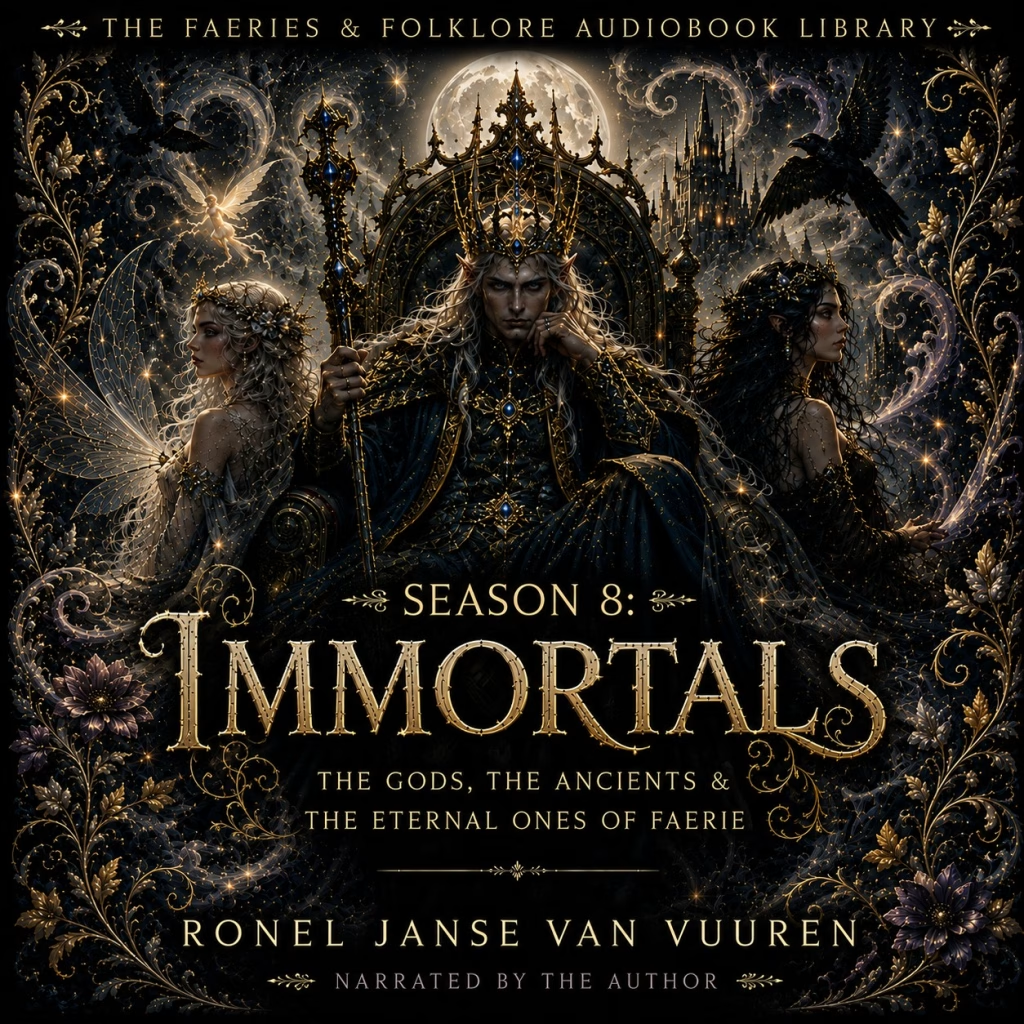
Listen to the full season with no interruptions.
Explore the Audiobook Library ✦ Browse the Lore Archive ✦ Discover the Faerie Mythos Books ✦ Join the Mythmaker’s Circle
Enjoying the podcast?
If you’ve enjoyed this episode, you can support the time and care that goes into researching, writing, recording, and producing the Faeries & Folklore Podcast by buying me a coffee.
Your support is always appreciated, whether it’s a one-time thank you or an occasional coffee whenever you feel like it. Every contribution helps me continue sharing the folklore, myths, and legends that inspire the Faerie Mythos.