
H is for Huge
I’m doing folklore and book review posts to reach and please a larger audience. Previous years have shown select interest in both and to minimise blogging throughout the year, I’m focusing my efforts on April.
If you’d rather check out my book review for today, go here.

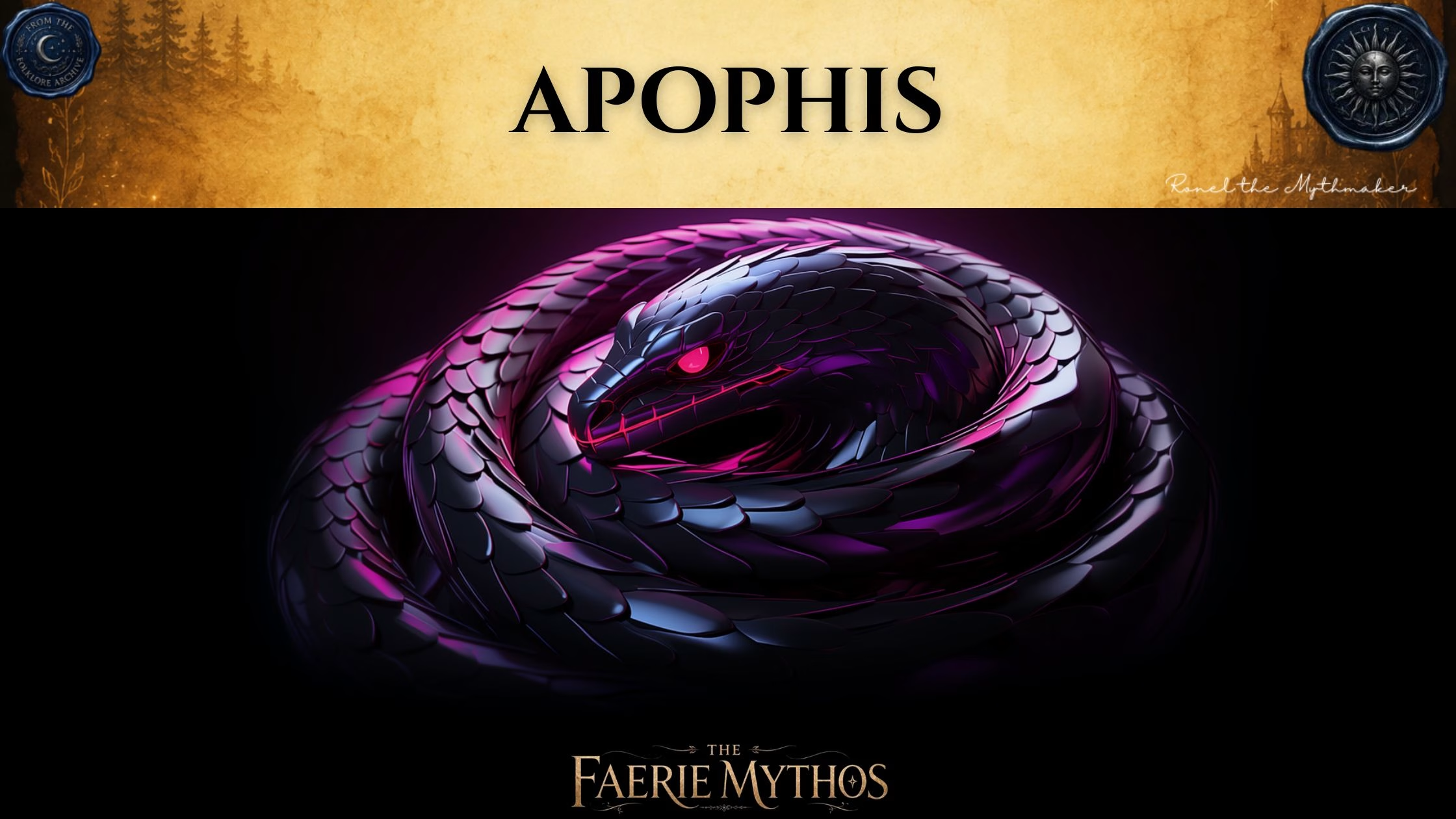
Apophis, or Apep, is the giant snake of chaos. I first encountered him in a Rick Riordan novel.

Folklore
Ancient Egyptian Legends by M. A. Murray, [1920]
Apep.—The enemy of Ra in the Duat.

Legends of the Gods by Sir E. A. Wallis Budge [1912]
The Leader-in Chief of the hosts of darkness was a fiend called Apep who appeared in the sky in the form of a monster serpent, and, marshalling all the fiends of the Tuat, attempted to keep the Sun-god imprisoned in the kingdom of darkness.

Encyclopedia of Demons in World Religions and Cultures by Theresa Bane
Apep
Variations: Apap, Apepi, Apis, Apophis, Apopis, ”Eater-up of Souls,” Enemy of Ra, Evil Lizard, Rerek, Serpent from the Nile, World Encircler
In the religion of the ancient Egyptians, Apep (“great snake” or “he who was spat out”) was the Lord of Darkness; he lived in the underworld. In service to the god Set, Apep was the personification of chaos and all that is evil. A fallen god himself, he commanded the demons Nak and Sebau. Apep has been depicted as a monstrous serpent, a crocodile, and in later times as a dragon. He is said to be sixteen yards long (14.6304 meters) with a head made of flint.
Apep, as well as various other nocturnal monsters from the ancient Egyptian beliefs, tries to prevent Ra from his daily passing across the sky by attacking him during the night when the sun is below the horizon. He tries to hypnotize souls who make it to the underworld and attempts to devour them while using his gigantic coils to stop the flow of the river they travel on.
Even though he is a fallen god, Apep is immortal. He has the ability to completely heal and rejuvenate the damage done daily to his body by Ra, his personal adversary. His roar is so loud it causes the entire underworld to shake. He has a magical gaze that can hypnotize Ra and those who travel with him. The power he releases in battle against Ra often causes earthquakes and thunderstorms. Whenever Apep is successful in swallowing Ra, during the day the absences of the sun god will be shown by an eclipse. Ra’s imprisonment never lasts long, however, as he has many allies who rush to his aid to free him.
The ancient Egyptians were fearful of Apep and had developed a means by which to defend themselves against him. The Book of Over – throwing Apep is a definitive guide to fighting him. Within its pages it explains the process of how to create, dismember, and dispose of wax figures or drawings of the demon. The deceased were oftentimes buried with magical spells that would destroy Apep if he tried to devour them. Additionally, an annual rite called the Banishing of Apep was performed. In the ceremony the priest would make an effigy of Apep that contained all of the evil of Egypt within it. Then he would ritually destroy it.
*Read more in the book.

A Wizard’s Bestiary by Oberon Zell Ravenheart and Ash “LeopardDancer” DeKirk
Apep is the mighty Moon Serpent of Egyptian mythology that emerges from the primal abyss when the world is formed, much like the Babylonian Tiamet. Apep represents storms, night, and death, and is associated with Set, the evil god of chaos. Apep is always trying to devour the sun-god, Ra. When he succeeds, the result is a solar eclipse, but he is always forced to regurgitate the blazing sun. Eventually Apep is bound by Horus, and chopped to pieces by Osiris.
*Read more in the book.

Further Reading:
- Apophis
- Apep
- Apopis
- Apophis in Egyptian Mythology
- Ancient Egyptian Gods and Goddesses
- Apophis [Egyptian mythology]

Folklore in a Nutshell by Ronel
Apophis, or Apep, is the god of chaos in Egyptian mythology and the enemy of Ra. Every night, he attempts to stop Ra from crossing through the Duat and then travelling through the sky during the day as the sun. Some accounts say that his wish is to swallow the sun, while others say that he only wishes to destroy Ra. For the most part, Apophis is seen as a giant serpent with a host of fiends out to destroy Ra as the sun god. Apophis is sometimes seen as a fallen god of chaos and evil who works for Set. When he fights Ra, the battles cause thunderstorms and earthquakes.
Whatever you might think of him, this god of darkness and chaos isn’t to be trifled with.

Apophis in Modern Culture
The Kane Chronicles book series by Rick Riordan
Apophis is the main antagonist of The Kane Chronicles book series by Rick Riordan. He is a destructive supernatural serpent who embodies Chaos, the evil counterpart of Ma’at (order).
Much of Apophis’ backstory is revealed in the first book. Since the beginning of time, Apophis was Ra’s enemy. Every night, when Ra sailed through the Duat, he and his lieutenants would battle Apophis, driving him off every time. Apophis was eventually imprisoned in a prison in the Duat, but not before the Egyptian priests foretold that he would one day devour the sun and plunge the world into eternal darkness.
Learn more here.

God of Egypt film
The demonic God Apophis is a primordial beast which dwells in the realm of Shadow; also called the Tenth Region of the Night or Bakhu, a great mountain to the west of the void where the creature sleeps just before the dawn. Entropy embodied, Apophis is driven to devour all of Creation.
Learn more here.

Stargate SG-1 TV series
Apophis, played by Peter Williams (seasons 1–6, 8) – A System Lord and the main villain for most of the first four seasons of Stargate SG-1. Based on the god Apep of Egyptian mythology, the character gained power after Ra‘s death in the film and commands a raid on Earth and Abydos in “Children of the Gods“, leading to the restart of the Stargate Program. His then-First Prime, Teal’c, defects from his army afterwards. Apophis’s standing amongst the System Lords is severely diminished after a failed full-scale assault on Earth in season 2’s “The Serpent’s Lair“. Apophis is killed and eventually revived by the Goa’uld Sokar in season 3. After defeating Sokar’s massive fleet and army in season 3’s “The Devil You Know“, Apophis becomes the most powerful Goa’uld in the galaxy. Despite his death aboard his Replicator-infested ship in season 5’s “Enemies“, Apophis appears in visions and alternate timelines in season 6’s “The Changeling“, season 8’s “Moebius” and Stargate: Continuum. In the latter, he is the last System Lord to resist the rule of Ba’al who kills Apophis shortly before his attempted takeover of Earth.
The astronomers David J. Tholen and Roy A. Tucker enjoyed the character so much that they named a near-Earth asteroid that they co-discovered in 2004, 99942 Apophis.[74]
Learn more here.


Apophis in My Writing
Origin of the Fae: Apophis
Apophis is a giant snake most of the time, though he can have a mortal form if he so wishes. Immortal just like the rest of the Egyptian pantheon, he waits for the chance to destroy the world. Though he would like nothing more than to swallow Ra whole, the indigestion of swallowing the sun and everyone else on Ra’s barque is just too much to handle, and so he is constantly on the lookout for other ways to meet his goals. He revels in chaos and darkness. Apophis can be found in the darkest, deepest recesses of the Duat.
See him in action:
Origin of Irascible Immortals (Origin of the Fae #7)

If this tale has lingered with you, I would be glad to hear it.
Where did you first encounter this creature – through story, superstition, memory, or something half-remembered?
If you know other versions of its myth, feel free to leave them in the record below. Folklore survives by being spoken again.
Further fragments and interpretations of this creature can be found in my Pinterest grimoire.
If you wish to support the time and craft behind these folklore posts – researching old tales, gathering fragments, and shaping them into something worth reading – you may do so by buying me a coffee. It can be a single offering, or something you return to whenever the spirit moves you.


Apophis was one of my major villains in my1895 Egyptian historical fantasy. How cool to meet him here! You’re a great teacher and tale-spinner, Ronel. https://rolandyeomans.blogspot.com/2023/04/h-is-for-c-s-lewis.html
Thanks, Roland. Your book should be awesome, as I enjoy your writing 🙂
I even like snakes and think they’re cool, but there’s no doubt that a huge snake-demon would be terrifying!
Alphabet of Alphabets: Hoch-Deutsches History
I know, right?